


When Zelle Sends Your Money to a Scammer: What You Can Actually Do
Zelle scam refund requests are denied far more often than most victims expect — and the reasons why are buried in fine print most people never read.
Here is the short answer if you need it fast:
Can you get a Zelle scam refund?
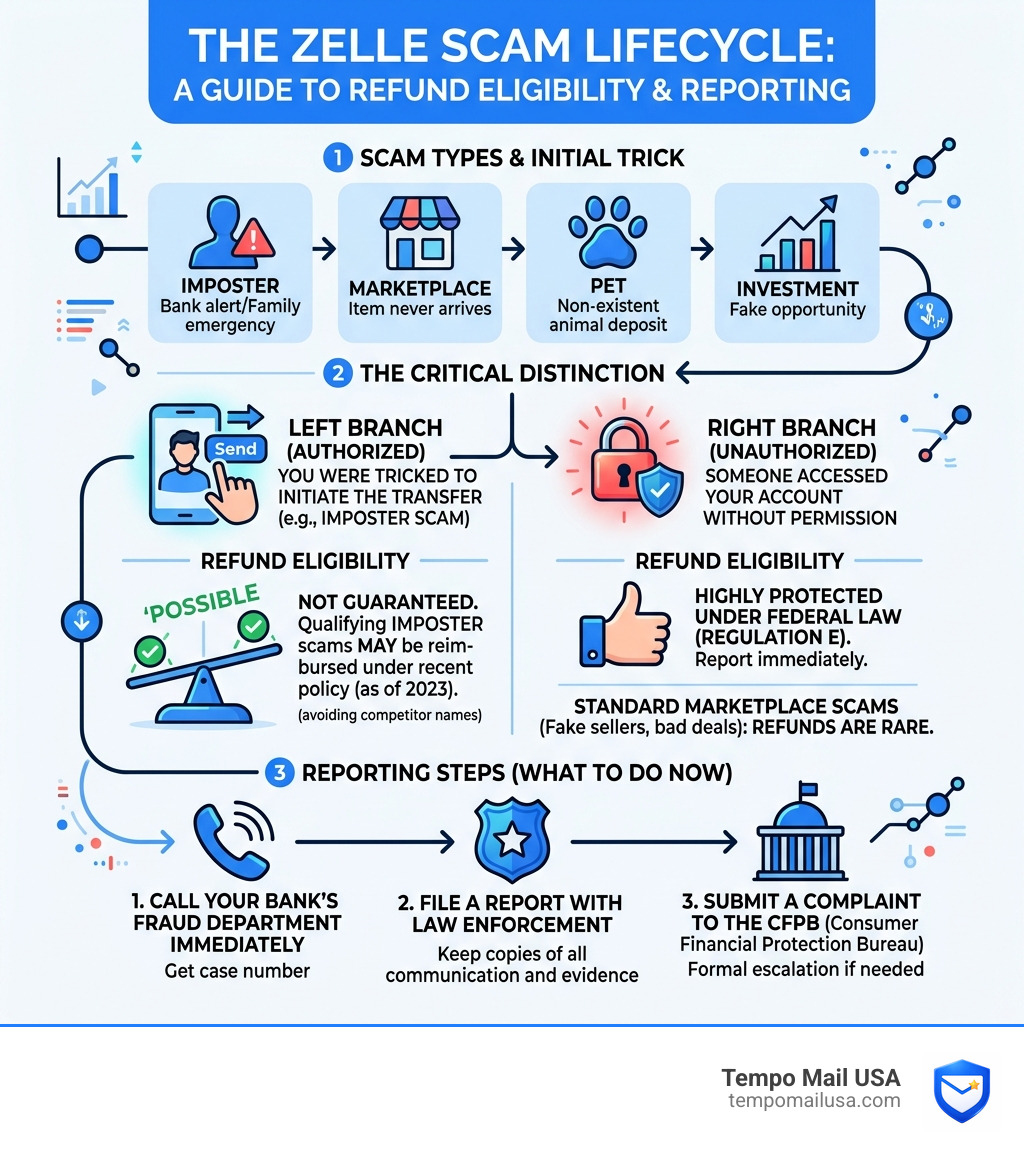
- Unauthorized transfer (someone accessed your account without permission): You are likely protected under federal law (Regulation E). Report immediately.
- Authorized transfer (you sent the money, but were tricked): Refunds are not guaranteed, but qualifying imposter scams may be reimbursed under bank policy as of 2023.
- Standard marketplace scam (fake seller, bad deal): Refunds are rare — Zelle treats these payments like cash.
Your first move in every case: Call your bank's fraud department right now, get a case number, and preserve all evidence.
The scale of the problem is staggering. Zelle moved over $1 trillion in payments in 2024. Even with 99.95% of those transactions going through without issue, that tiny fraction of fraud translated to nearly $500 million in losses that year alone. In just the first nine months of 2025, Americans lost $373.6 million to scams on peer-to-peer payment apps — up 35% year over year.
Senator Elizabeth Warren famously called Zelle "a perfect weapon for criminals" during a Senate hearing, and the pressure from lawmakers and the Consumer Financial Protection Bureau (CFPB) has slowly forced banks to change how they handle at least some scam claims.
But here is the hard truth: Zelle is built to move money fast, not to take it back. Once a payment lands in an enrolled recipient's account, it is gone in minutes. Recovery is possible in specific situations — but only if you know exactly what to do and how quickly to do it.
This guide walks you through every step.
The Reality of a Zelle Scam Refund in April 2026

As we navigate through April 2026, the landscape of digital payments has shifted. While Zelle remains a cornerstone of American banking—owned by seven major institutions including JPMorgan Chase, Bank of America, and Wells Fargo—the rules regarding a zelle scam refund have become a battlefield between consumer advocates and financial institutions.
The core of the issue lies in the Electronic Funds Transfer Act (EFTA), specifically Regulation E. Historically, banks used Regulation E as a shield. They argued that if you clicked "Send," the transaction was "authorized," and therefore they had no legal obligation to give your money back. However, due to immense pressure from the CFPB and high-profile Senate hearings, the industry began a quiet but significant policy shift.
According to the Zelle Scam Reimbursement Law 2026: What Banks Must Pay, banks are now increasingly expected to differentiate between "scams" and "fraud."
| Feature | Authorized Transaction (Scam) | Unauthorized Transaction (Fraud) |
|---|---|---|
| Definition | You were tricked into sending money yourself. | Someone hacked your account and sent money. |
| Reg E Protection | Generally No (except for Imposter Scams). | Yes (Federal Law Requirement). |
| Refund Likelihood | Low to Moderate (depends on bank policy). | High (if reported promptly). |
| Resolution Time | 10–45 business days. | 10 business days for provisional credit. |
Why Banks Deny Your Zelle Scam Refund Request
The most common reason for a denial is the "Authorization" defense. Banks often argue that Zelle is a service designed for people you know and trust. When you use it to buy concert tickets from a stranger on social media or pay a deposit on a "too-good-to-be-true" rental, you are technically authorizing the bank to move those funds.
Under the Will Zelle Refund Money If Scammed Refund Rules, many institutions still maintain that they are not responsible for your "buyer's remorse" or poor judgment in a marketplace setting. They treat these transfers like handing cash to a stranger on a street corner—once it leaves your hand, the bank considers its job done.
The "Unauthorized" Loophole for Recovery
If you didn't actually push the button, you are in a much stronger position. Unauthorized transfers occur through:
- Account Takeover (ATO): A criminal gains access to your banking app via phishing or credential stuffing.
- MFA Bypass: Scammers trick you into sharing a one-time passcode to "verify" your account, which they then use to link their device to your Zelle profile.
In these cases, Regulation E is your best friend. It limits your liability to $50 if you report the fraud within two business days. If you wait longer (up to 60 days), your liability could jump to $500. Beyond that, you might be responsible for the entire loss. This is why we stress: check your statements daily.
Step-by-Step Recovery: How to Dispute a Zelle Transaction
If you've been hit, don't panic, but do move with extreme urgency. You generally have a 120-day window to file a formal dispute, but your chances of a successful zelle scam refund drop with every passing hour.
The official path starts with the Report a Scam | Zelle page, but Zelle itself usually redirects you back to your specific bank. You will need to fill out a Zelle Dispute Form, which requires specific transaction IDs, the recipient's phone number or email, and a detailed narrative of what happened.
Immediate Actions in the First 60 Minutes
- Call the Fraud Department: Do not call the general customer service line. Ask specifically for the "Fraud and Claims Department."
- Request a Recall: While Zelle is "instant," there is a tiny window where a "recall" or "clawback" might be initiated if the receiving bank hasn't yet allowed the scammer to withdraw the funds.
- Freeze Your Accounts: If the scam involved a phone call or a link, assume your entire banking login is compromised. Change your password and enable hardware-based MFA if possible.
- Get a Case Number: Never hang up without a formal claim or case number. This is your paper trail for the CFPB later.
For more detailed steps, check our guide on Zelle Scam Refund Can You Get Your Money Back.
Gathering Evidence for a Stronger Claim
Banks love data. To win your dispute, provide:
- Screenshots: Capture the original ad, the chat logs where the scammer gave instructions, and the Zelle confirmation screen.
- Spoofed Numbers: If they called you, screenshot your call log showing the incoming number (even if it looked like your bank's real number).
- The Narrative: Write a clear, chronological timeline. "At 10:05 AM, I received a text... At 10:10 AM, I spoke to 'Mark' who claimed to be from the fraud dept..."
New 2026 Reimbursement Rules for Imposter Scams
The biggest change in the last few years is the Imposter Scam Policy. Following massive pressure from the Senate and the CFPB, Zelle’s parent company, Early Warning Services (EWS), implemented a policy requiring banks to reimburse victims of "qualifying" imposter scams.
This was a massive win for consumers. Previously, if a scammer called you pretending to be your bank and told you to "Zelle yourself" to "reverse a fraudulent charge," the bank would deny the refund because you initiated the transfer. Now, because the scammer impersonated a trusted institution, you may be eligible for a zelle scam refund.
Qualifying for a Zelle Scam Refund via Imposter Policy
To qualify, the scammer must have impersonated:
- Your Bank: Claiming there is a problem with your account.
- A Government Agency: Like the IRS, Social Security, or local police.
- A Service Provider: Like a utility company threatening to shut off your power.
If you fell for one of these, visit I believe I’ve been a victim of an imposter scam. Who should I contact? | Zelle to start the specific imposter dispute process.
The Role of the CFPB and Regulatory Pressure
The CFPB has been vocal about banks overlooking hundreds of thousands of fraud reports. In 2024 and 2025, investigations revealed that major banks were only refunding a fraction of legitimate unauthorized claims. This led to a "mandatory risk-flagging" requirement. Now, if you try to Zelle a large amount to a brand-new account that has "suspicious attributes," your bank is supposed to intervene or at least provide a specific warning. If they fail to flag a high-risk transaction, you have additional leverage in your dispute.
Escalating a Denied Claim and Protecting Your Identity
What if the bank says "No"? Don't take it as the final word. Many initial denials are automated or handled by entry-level adjusters.
- The OCC Complaint: If you use a national bank (like Chase or Citi), file a complaint with the Office of the Comptroller of the Currency.
- CFPB Complaint: This is often the most effective tool. When the CFPB gets involved, the bank’s legal and compliance teams have to look at your case, not just a customer service rep.
- Small Claims Court: If your loss is between $2,500 and $10,000 (depending on your state), small claims court is a viable option. Often, banks will settle rather than send a high-priced lawyer to fight a $3,000 claim.
Beyond the Bank: External Reporting Agencies
Reporting isn't just about getting money back; it’s about stopping the "mule networks" that scammers use.
- FTC: Report at ReportFraud.ftc.gov.
- FBI IC3: This is critical for tracking international crime syndicates.
- Secure Your Connection: Scammers often find victims via unsecure networks. Using a NordVPN for secure transactions can help mask your digital footprint and prevent "man-in-the-middle" attacks when you are banking on the go.
Spotting Secondary Recovery Scams
This is the "kick them while they're down" phase. After you lose money, you might get a message from someone claiming to be an "ethical hacker" or a "recovery specialist" who can get your money back for a small fee.
These are always scams. No one can "hack" the Zelle network to reverse a transaction. Legitimate recovery only happens through your bank or legal system. If they ask for an upfront fee, block them immediately.
Building a PII Firewall: Preventing Future Fraud
The reason you were targeted in the first place is likely because your Personally Identifiable Information (PII) is floating around the dark web. Scammers use your real email, phone number, and name to build trust.
To stop this, we recommend building a PII Firewall. This means moving away from using your primary "life" email for everything. When you sign up for marketplace apps, newsletters, or even utility accounts, you are creating a trail that lead scammers straight to you.
Advanced Digital Hygiene for 2026
We believe the future of privacy is "identity proxying." By using services like Tempo Mail USA, you can generate temporary email aliases. These aliases act as a buffer; if a service you use gets breached, the scammers only get a proxy email, not the one tied to your Zelle account.
- Secure Identity Proxy: Use a proxy for all non-essential sign-ups.
- Personal Data Removal: Use services that scrub your name from "people search" sites.
- PII Firewall: Think of your real email like your home address—don't give it to everyone you meet.
For more information on how to shield your primary identity from the "tiny fraud slice" that costs Americans billions, visit Tempo Mail USA.
Frequently Asked Questions about Zelle Scam Refunds
Can I get a Zelle scam refund if I authorized the payment?
In 2026, you may qualify for a refund if the transaction was part of a "qualifying imposter scam" (e.g., someone posing as your bank or a government agency). However, standard marketplace scams where you willingly sent money for goods not received (like a fake puppy or concert tickets) are still rarely reimbursed because the bank considers those "authorized" transfers.
How long do I have to file a Zelle dispute?
You typically have up to 120 days from the transaction date to file a formal dispute with your financial institution. However, the "golden window" is the first 24–48 hours. Reporting within this timeframe significantly increases the chances of the bank successfully "clawing back" funds from the recipient's account before the scammer can move them to a mule account or crypto exchange.
What is the difference between Zelle fraud and a Zelle scam?
Fraud refers to unauthorized access where a criminal hacks into your account and initiates a transfer without your knowledge (this is strictly protected by Regulation E). A scam occurs when you are tricked into pushing the "Send" button yourself. While scams used to be a total loss, 2026 policies now offer some protection for "imposter scams" where the criminal pretended to be a trusted authority.
Conclusion
Recovering from a Zelle scam is an uphill battle, but it is no longer the "impossible" task it was a few years ago. By understanding the distinction between authorized and unauthorized transfers, moving within the first hour of the incident, and leveraging the new imposter scam policies, you can maximize your chances of a zelle scam refund.
The best defense is a proactive one. Secure your accounts with hardware MFA, never move money while on a phone call with "the bank," and protect your PII by using identity proxies like those offered at https://tempomailusa.com. Stay vigilant, stay skeptical, and keep your "PII Firewall" strong.