



Why Google Click Fraud Threatens Your Ad Budget and Digital Privacy
Google click fraud happens when someone, or something, clicks on a pay-per-click ad without any real interest in the product or service being advertised. The culprits range from rival businesses trying to drain your budget, to automated bots running scripts around the clock, to organized click farms where workers are paid to click ads over and over again. The consequences are serious: wasted ad spend, misleading performance metrics, and corrupted data that makes it nearly impossible to optimize your campaigns effectively.
To put the problem in perspective, click fraud rates in search campaigns typically fall between 14% and 22%. Global losses from ad fraud are projected to surpass $172 billion per year by 2028. In high-risk industries like sports betting, invalid traffic can account for anywhere from 29% to 55% of all clicks. The issue is far from new either — back in 2006, Google settled a major click fraud class-action lawsuit for $90 million.
Invalid traffic generally falls into a few categories. Accidental clicks are the most benign, caused by unintentional taps or double-clicks. Manual fraud involves competitors or publishers deliberately clicking on ads. Automated bots use scripts designed to simulate human browsing behavior. Click farms employ real people who are paid to click ads repeatedly. And data-center traffic consists of non-human visits originating from server farms.
While Google does use automated systems to filter out invalid clicks, these built-in protections often struggle against more advanced tactics like IP rotation and device spoofing. For privacy-focused businesses, click fraud is more than just a budget problem — it is a data integrity issue that can pollute retargeting audiences and feed false signals into machine learning algorithms.
I'm Mohammad Waseem, and I've spent years optimizing web platforms and analyzing key advertising metrics like eCPM and CTR. Through hands-on work with monetization strategies across multiple campaigns, I've developed practical methods for detecting and preventing google click fraud before it erodes your bottom line.
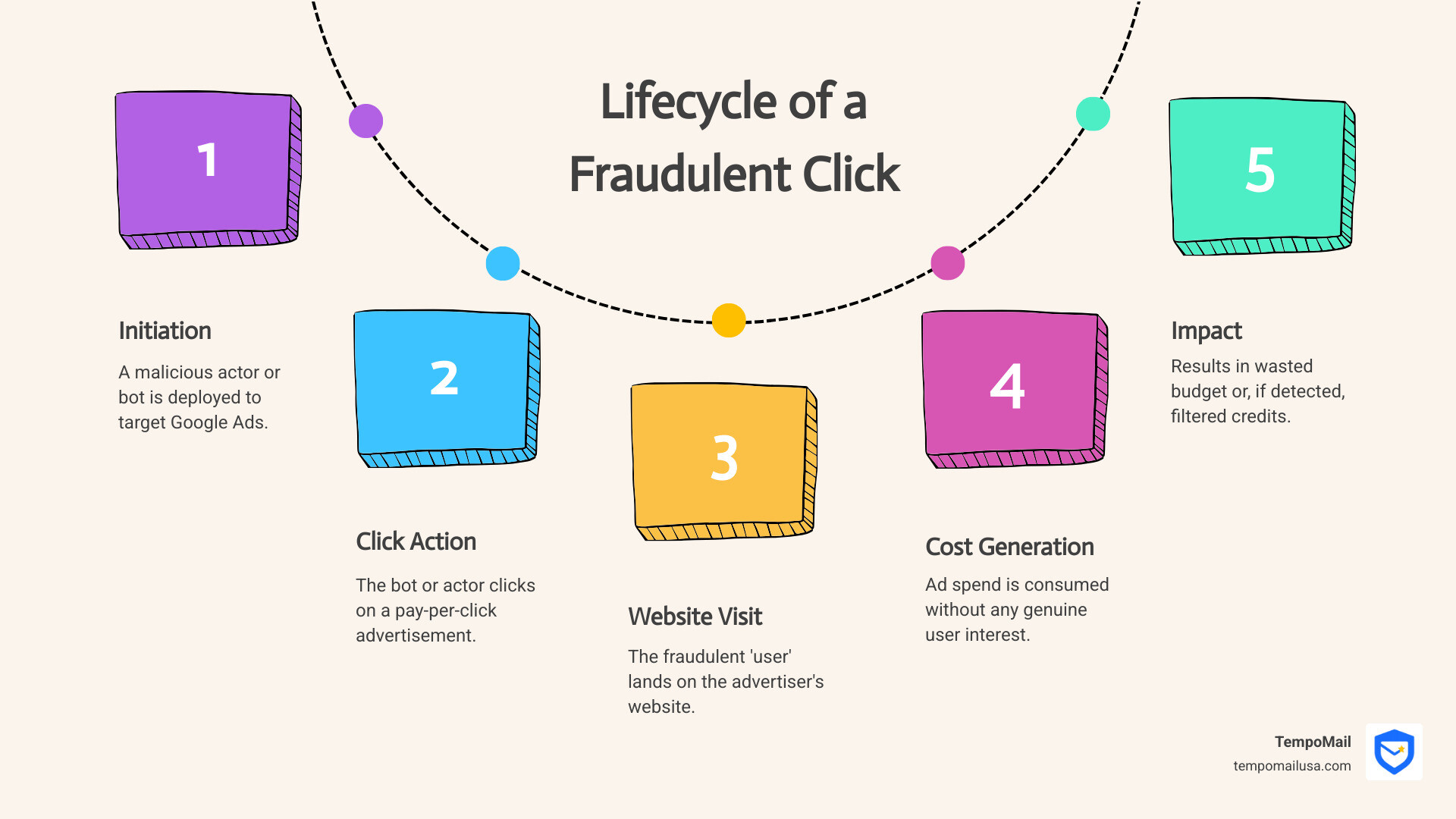
Understanding Google Click Fraud and Invalid Traffic
At its core, google click fraud undermines the entire premise of PPC advertising. Every click on a Google Ad is supposed to represent a real person with genuine interest, but fraudulent clicks break that contract. Researchers Kenneth C. Wilbur and Yi Zhu have studied this problem extensively, highlighting click fraud as one of the most persistent challenges in digital advertising. You can explore their findings through Scientific research on click fraud.
Google uses the umbrella term "invalid traffic" (IVT) to cover both deliberate fraud and unintentional clicks that still waste your budget. Understanding the different forms this traffic takes is the first step toward protecting your campaigns.
Types of Invalid Traffic in Google Ads
Invalid traffic comes in several distinct forms, each posing its own challenges for advertisers:
- Accidental Clicks are unintentional interactions, like a misplaced tap on a mobile device, that eat into your budget without reflecting real interest.
- Manual Clicks come from humans acting with malicious intent. This includes competitors trying to exhaust your daily budget, publishers inflating their ad revenue, and organized click farms where workers are hired specifically to click on ads.
- Automated Clicks from Bots are generated by software designed to mimic human browsing patterns. These often originate from botnets — networks of compromised computers controlled remotely. TechCrunch has reported on massive operations like "DormRing1" that illustrate just how large-scale these schemes can become.
- Data-Center Traffic is non-human traffic that flows from cloud providers and server farms, often used to generate clicks at scale without any real users involved.
- Impression Manipulation is a subtler tactic where fraudsters generate fake impressions to artificially lower your click-through rate and quality score, making your ads less competitive.
We have covered some initial management strategies in our article on how to Tackle Google Click Fraud: Tips for Advertisers.
Common Misconceptions About Google Click Fraud
There are several widespread myths that can leave advertisers vulnerable if they are not careful:
The first misconception is that Google's filters catch everything. While Google does a solid job identifying obvious patterns, sophisticated fraudsters who rotate IP addresses and mask their behavior can slip through. As the TrafficGuard blog has noted, relying solely on platform filters is often not enough.
Another common mistake is assuming that every traffic spike signals fraud. In reality, spikes can be perfectly legitimate — driven by seasonal demand, a recent budget increase, or a viral piece of content.
Some advertisers also jump to the conclusion that low conversion rates must mean click fraud is at play. While fraud can certainly suppress conversions, poor results are just as often caused by weak landing pages, overly broad keyword targeting, or misaligned ad copy.
Finally, many people believe that Google will automatically refund all fraudulent clicks. Google does issue credits for detected invalid activity, but the responsibility for identifying and reporting suspicious patterns frequently falls on the advertiser.
For a deeper dive into protective measures, check out our guide on Effective Click Fraud Protection: Safeguard.
How Google Detects and Filters Fraudulent Activity
Google takes a multi-layered approach to combating google click fraud, combining advanced technology with human expertise. Their systems analyze IP addresses, click timing patterns, and device information to spot anomalies that suggest fraudulent behavior.
The first line of defense is a set of automated systems powered by proprietary algorithms that evaluate every single click in real time. These algorithms look for known fraudulent signatures and flag suspicious activity before it ever reaches your billing statement. When patterns are too complex or novel for automation to catch, human reviewers step in to manually investigate emerging fraud trends and edge cases.
Google also integrates with HUMAN, a cybersecurity firm specializing in bot detection, to identify sophisticated automated attacks that might otherwise go unnoticed. On the publisher side, safeguards like the Shared Storage API help prevent abuse within Google Ad Manager.
In practice, Google's fraud prevention works on two timelines. Pre-invoice detection filters out invalid clicks before you are ever charged for them. Post-invoice credits are issued as adjustments when fraudulent activity is finded after billing has already occurred. You can learn more about these processes from Google's protection against invalid traffic.
Why Built-in Protections Are Sometimes Insufficient
Despite Google's significant investment in fraud prevention, their native defenses have real limitations. Modern fraudsters employ sophisticated tactics like IP rotation, where they cycle through thousands of different addresses to avoid detection. Device spoofing allows them to disguise a single machine as many different users, while behavior masking techniques simulate realistic browsing patterns that are difficult to distinguish from genuine human activity.
The economic incentives driving fraud are enormous. With global ad fraud losses projected to exceed $172 billion annually by 2028, there is no shortage of motivation for bad actors to stay one step ahead of detection systems. Google's automated filters tend to be most effective against large-scale, obvious bot attacks, but they can struggle with more subtle forms of fraud like a competitor methodically clicking your ads a few times each day from different locations.
The Role of Third-Party Prevention Tools
This is where third-party click fraud prevention tools become valuable. They complement Google's built-in protections by adding additional layers of security that address the gaps in native detection.
These tools offer real-time blocking capabilities, stopping fraudulent IPs from clicking your ads before any budget is consumed. They provide granular click-level analytics, often capturing more than 30 data points per click along with session recordings that let you see exactly what a visitor did on your site. Many of these platforms also automate the process of adding suspicious IPs, VPN users, and known bad actors to your exclusion lists, saving you hours of manual work. Advanced behavioral analysis powered by machine learning helps distinguish between bots and real humans with greater accuracy than rule-based systems alone.
If you suspect your campaigns are being targeted by invalid traffic, you can also use Google's official channels for Requesting an invalid traffic investigation.
The Financial and Performance Impact on Advertisers
The damage caused by google click fraud extends far beyond the immediate cost of a few wasted clicks. It creates a cascading effect that can undermine your entire advertising strategy and distort the data you rely on to make decisions.
The most obvious impact is budget depletion. Every fraudulent click consumes money that was meant to reach a genuine prospect, and in competitive industries where cost-per-click rates are already high, this drain adds up quickly. Worse still, the artificial demand created by fraudulent clicks can inflate your average CPC, meaning you end up paying more even for the legitimate clicks you do receive.
Beyond the direct financial hit, click fraud distorts your campaign metrics in ways that are hard to untangle. You might see impressively high click-through rates that look great on paper, but when those clicks never convert, your optimization efforts get thrown off course. Perhaps most damaging of all, fraudulent engagement data gets fed into Google's machine learning algorithms, effectively training them on false signals. This can lead the system to serve your ads to the wrong audiences or at the wrong times, compounding the problem over time.
In certain industries, the waste is staggering. In sports betting, for example, returning users who click on branded ads without converting can waste as much as 26% of the total advertising budget.
The table below highlights some of the key differences between genuine and fraudulent traffic patterns that can help you spot problems early:
| Metric | Genuine Traffic | Bot/Fraudulent Traffic |
|---|---|---|
| Click Frequency | Natural intervals | Unnaturally high or consistent |
| IP Address | Geographically logical | High density from single IPs/Data centers |
| Session Duration | Varied | Very short or unnaturally long |
| Conversion Rate | Correlates with clicks | Low or non-existent |
| Time of Day | Peak user hours | Consistent 24/7 activity |
Recognizing these patterns in your own data is one of the most effective ways to determine whether google click fraud is actively impacting your campaigns.
Advanced Strategies to Prevent Google Click Fraud
While Google provides a baseline level of protection, truly safeguarding your campaigns against click fraud requires a proactive, multi-layered approach. The following strategies go beyond the basics to help you stay ahead of increasingly sophisticated fraudsters.
Start by implementing IP exclusions. You can manually block known fraudulent IP addresses through your Google Ads settings, or use third-party tools to automate the process and keep your exclusion lists up to date. Refining your geographic targeting is another effective measure — by limiting your ads to the specific regions where your customers actually are, you reduce exposure to areas with historically high fraud rates.
Negative keywords deserve more attention than most advertisers give them. By preventing your ads from appearing for irrelevant search terms that bots frequently target, you can cut off a common avenue for fraudulent clicks. For a similar approach applied to email, see how we Stop Spam in its Tracks.
Regularly reviewing your search terms report is essential for catching low-quality queries that might indicate bot activity. If you notice fraud tends to spike during certain hours, adjusting your ad scheduling to pause campaigns during those periods can save significant budget. Finally, implementing server-side validation on your landing pages helps prevent bots from submitting fake leads through your forms, protecting both your data and your sales team's time.
Differentiating Genuine Spikes from Fraudulent Attacks
One of the trickiest aspects of managing click fraud is distinguishing between a legitimate traffic surge and an actual attack. Not every spike in clicks means something malicious is happening, and overreacting to normal fluctuations can lead to unnecessarily restrictive campaign settings.
When you see a sudden increase in traffic, start by checking for legitimate explanations. Did you recently increase your budget, add new keywords, or launch a promotion? Are there seasonal trends or news events that could be driving more searches in your category? Genuine traffic spikes typically come with a proportional increase in conversions and healthy session durations.
If the spike does not correlate with any known cause, dig deeper into the traffic sources. Check whether the clicks are coming from your target regions and standard consumer devices, or whether they are concentrated in unusual geographies or originating from data centers. Tools like the Invalid Traffic Calculator can help you quantify the risk.
These fraud prevention efforts connect to a broader philosophy of protecting your digital presence. Just as you would safeguard your personal information online, your advertising data deserves the same level of care. Learn more about protecting your online identity in our guide on how to Protect Your Privacy with Free Private Email Services.
Legal Precedents and Historical Fraud Cases
The history of google click fraud includes several landmark legal battles that underscore just how widespread and damaging this problem has become. These cases have shaped industry practices and established important precedents for advertiser rights.
The most significant case was Lane's Gifts v. Google in 2006, where Google agreed to a $90 million settlement in a class-action lawsuit brought by advertisers who claimed they had been charged for fraudulent clicks. This settlement was a turning point for the industry, as it formalized Google's refund policies and acknowledged the seriousness of the problem.
A year earlier, Yahoo faced a similar lawsuit and settled for $4.5 million, demonstrating that click fraud was not unique to any single platform but rather a systemic issue across the entire digital advertising ecosystem.
Individual criminal cases have also highlighted the lengths to which some people will go to exploit PPC systems. In 2004, programmer Michael Anthony Bradley was arrested for attempting to extort Google using click fraud software he had developed. More recently, in 2017, Fabio Gasperini was convicted for operating a botnet consisting of approximately 140,000 compromised computers, which he used to generate massive volumes of fraudulent ad clicks. Gasperini's case illustrates how click fraud has evolved from small-scale schemes into organized cybercrime, a trend explored in depth in Research on ad-fraud communities.
These legal precedents make it clear that click fraud is often highly organized and that advertisers do have legal recourse when they can demonstrate damages. They also serve as a reminder that the fight against ad fraud is ongoing, with new schemes constantly emerging as technology evolves.
Frequently Asked Questions about Google Click Fraud
How can I tell if my Google Ads are being hit by click fraud?
Look for sudden spikes in clicks without conversions, repeated clicks from the same IP, high bounce rates, and traffic from untargeted geographies. Discrepancies between Google Ads and Analytics data can also signal filtered invalid traffic.
Does Google refund money for invalid clicks?
Yes. Google uses Automatic Filtering to remove invalid clicks before you are charged. If fraud is detected after billing, Google issues Credits for Invalid Activity, which appear in your Billing Summary under "Adjustments."
Can I block specific IP addresses from seeing my ads?
Yes. You can manually add IP addresses to the "IP exclusions" section in your Google Ads account settings. For better efficiency, third-party tools can automate this process by identifying and blocking fraudulent IPs in real-time.
Conclusion
Protecting your campaigns from google click fraud is not a one-time task — it requires ongoing vigilance and a willingness to look beyond surface-level metrics. While Google's built-in detection systems provide a solid foundation, the sophistication of modern fraud means that advertisers who rely solely on platform defenses are leaving money on the table.
The most effective approach combines careful analysis of click-level data with third-party prevention tools and a clear understanding of what normal traffic looks like for your specific business. By staying proactive and treating fraud prevention as an integral part of your advertising strategy, you can ensure that your budget reaches real people who are genuinely interested in what you offer.
At TempoMail USA, we believe that protecting your digital identity and your business data go hand in hand. Just as our identity proxying services shield your personally identifiable information from exposure online, safeguarding your advertising spend is a critical component of your overall digital security posture. Do not let fraudulent clicks dictate the success of your campaigns.