

Temp Mail Edu: What You Actually Get, What It Cannot Do, and the Honest Way to a Real .edu Address
Search for temp mail edu and you will be promised something that sounds too convenient to question: a free, instant, disposable email address ending in .edu, no enrolment, no paperwork, no waiting. Student discounts, developer packs, education software — all yours for one click. Here is the verdict before the detail, because it changes how you should read everything that follows: no service on the internet can issue you a real US .edu email address. What sellers call temp mail edu is a disposable inbox on an academic-looking domain, and the gap between "looks academic" and "is a real student address" is exactly where the whole topic lives. This post shows you what you actually get, which doors it opens, which ones it bounces off, and the honest route to a real .edu address if that is what you genuinely need.
What ".edu" actually is, and why nobody can sell you one
A real .edu address is not a product. In the United States, the .edu top-level domain is restricted to accredited postsecondary institutions, and it is administered by Educause under rules set with the US Department of Education. A university gets its .edu domain because it is an accredited institution, and it hands out addresses on that domain to its own students and staff. No temp-mail service, no generator site, and no seller on a marketplace can register a .edu domain or create a mailbox on one. If a page tells you it can give you a genuine address at, say, harvard.edu or stateu.edu, that page is lying to you, and whatever it hands you instead is either a lookalike domain or somebody else's credentials.
The confusion is deliberate, and it works because the internet has more than one thing that ends in something edu-shaped. Poland runs .edu.pl for its academic institutions, administered by NASK. Kyrgyzstan has .edu.kg. Britain has .ac.uk. These are real academic namespaces in their own countries, and a private company can register a domain inside some of them. An address like you@reason.edu.pl or you@edu.kg contains the letters "edu" and looks academic to a casual check — and that look is the entire product being sold. When you see temp mail edu, edu temp mail, or edumail temp on a search page, the thing on offer is almost always one of these: a disposable inbox on .edu.pl, .edu.kg, or a similar academic-style domain, not a US .edu address. Knowing that one distinction puts you ahead of most of the people searching for it.
What sellers actually mean by "temp mail edu"
Strip away the marketing and there are three different things sold under the one phrase, and they are not equal. The first is the honest version: a disposable inbox on an academic-style domain, sold as what it is. VanishInbox, currently one of the top results for this keyword, offers three .edu.pl domains — reason.edu.pl, realize.edu.pl, and remind.edu.pl — with inboxes that self-destruct after ten minutes, and it says plainly on its own page that these are not affiliated with any university and that student-discount programmes require genuine enrolment. 1TempMail offers a .edu.kg address with a mailbox that stays active for seven days and keeps each message for 24 hours, and it marks the edu option as a Pro feature. eTempMail lets you pick an academic domain from a dropdown and generates the inbox instantly. Edumaili offers .edu.pl domains and states on its own page that programmes like the GitHub Student Pack, Adobe, Spotify, and Amazon Prime Student confirm enrolment against official records rather than the email domain alone, so a disposable address will not pass their checks. Credit where it is due: the better sellers disclose this. The worse ones bury it three scrolls down.
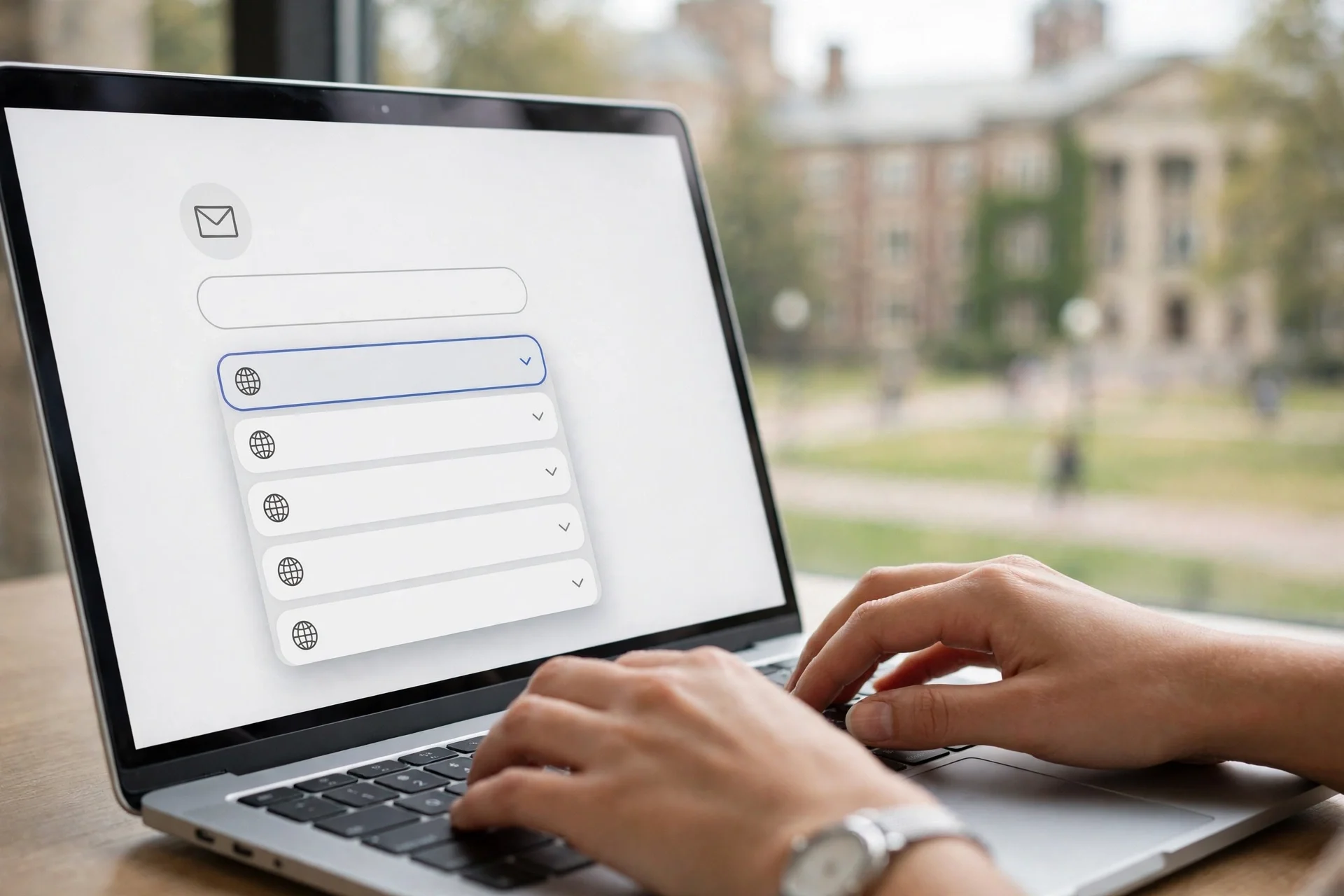
The second thing sold under the phrase is the "free edu email" generator page — a landing page whose real job is to get you to generate any disposable address at all, with the .edu angle as the hook. The address you get is a normal temp inbox with an academic suffix attached. It works fine as a disposable inbox. It is not a student credential, and treating it as one is where people get hurt.
The third is the outright scam: sellers offering "real .edu accounts" or "verified student emails" for a fee, usually on marketplaces and messaging apps. These are bought, shared, or stolen credentials, or accounts created with forged enrolment documents. They get banned, they get the buyer locked out of whatever was attached to them, and in the worst cases they are a straight path to someone else's identity being misused. If someone is selling you a real .edu address, walk away. That is not a grey area; it is a trap with a price tag.
I checked TempMailUSA's own domain list — and there is no .edu in it
Before writing this, I tested the obvious question on our own site, because a post like this should not guess about the product it recommends. On November 11, 2026, I opened tempomailusa.com, let it generate an inbox, and opened the domain picker. The picker lists 427 domains. I searched it for "edu" and the picker answered, verbatim, "No domains match your search." I searched for "ac.uk" and got the same answer. Not one of the 427 domains ends in .edu, .edu.pl, or .edu.kg, and none contains the letters "edu" anywhere at all. The closest matches are unrelated — one domain contains the word "student" and another happens to end in .net.pl, which is not an academic domain.
The generated address on that visit was xgtfa64@hta.2bd.net, and the only free domain in the picker is rover.info; the other 426 are premium. The page states that Pro inboxes last 365 days and free inboxes last 30 days, and the live countdown on the generated inbox read about 362 days remaining, ticking down in real time. No sign-up was needed for any of this — the inbox appeared the moment the homepage loaded — although the banner is upfront that only your first message is free to read and reading further messages is a Pro feature.
So here is the honest position, stated plainly: TempMailUSA does not offer a temp mail edu address, and this post will not pretend otherwise. If the academic-looking suffix is the thing you specifically need, that is a different service's product, and the sellers named above are where to look. What TempMailUSA does give you — and what most people actually need once the .edu fantasy is out of the way — is a disposable inbox in seconds with no registration, which is the right tool for the privacy job around a student signup, just not for the student credential itself. If you want a throwaway address for the marketing emails, the trial signups, and the "create an account to download the syllabus" forms that orbit student life, generate a disposable inbox at TempMailUSA and keep your real student address for the things that actually verify enrolment. If you are new to disposable mail generally, this guide to what temporary email is and how to create one covers the basics in one read.
The student-discount test: suffix checks versus enrolment checks
This is the section the ranking pages mostly dodge, so let us be precise about it. Whether a temp edu address "works" for a student discount depends entirely on what the discount checks, and there are two kinds of checks. A suffix check looks at the string of the address and asks only whether it ends in something academic. A small site with a hand-rolled student form might do this. An address on .edu.kg or .edu.pl can pass a suffix check, because the string contains ".edu". An enrolment check ignores the string and asks whether you are actually enrolled. The big student programmes all do this now, and they do it through verification services — most commonly SheerID — that check you against institutional records or ask for documents like a student ID, a dated enrolment letter, or a class schedule.

GitHub's Student Developer Pack verifies student status through SheerID, and it accepts a school-issued email as one form of proof among others, including documents. Spotify Premium Student verifies through SheerID. Adobe's student pricing verifies through SheerID. Amazon Prime Student asks for a .edu email address and verifies enrolment. Notion's student plan verifies student status too. In every one of these cases, the domain alone is not the credential — enrolment is — and a disposable address on an academic-style domain fails at the verification step, not the email step. That is why the honest sellers say so themselves: Edumaili and VanishInbox both warn on their own pages that a disposable address will not pass enrolment checks. When the seller and the critic agree, believe them.
Two honest caveats. First, I did not create accounts with a disposable edu address to test signups, because doing so would mean misrepresenting enrolment status, and I am not going to fabricate a test result to fill a paragraph. What this section rests on is how these programmes publish their verification methods, plus the sellers' own disclosures — which point the same way. Second, there is a real grey zone: smaller sites with only a suffix check may accept a .edu.kg or .edu.pl address, and some may not check anything at all. That is not a recommendation. It is a description of a gap that closes a little more every year, and building anything important on it — an account, a subscription, a portfolio — is building on sand.
The honest ways to get a real .edu address
If what you actually want is a genuine .edu address, there is no shortcut that is also real, but there are legitimate routes, and they are worth naming because the search results rarely do. The straightforward one is enrolment: enrol at an accredited college or university, including for a single online course, and the institution issues you a student email as part of enrolment. Community colleges are the practical version of this — many offer open registration, and a single low-cost course can come with a student email address and access to student discounts that are genuinely yours to use. It costs money, it takes paperwork, and it takes days, not seconds. That is the price of a real credential, and anyone telling you otherwise is selling you the fantasy.
Alumni addresses are the second route: some universities let graduates keep an alumni email address on the institution's domain, sometimes for life. It is worth checking with your own school's alumni office before assuming you have nothing. The third is to check whether your employer, library, or professional body has an academic partnership that includes an institutional email. None of these is instant. All of them are real, and a real address survives verification, password resets, and the passage of time — which is the whole point of having one.
What temp mail edu is actually good for
None of this makes the underlying idea useless. A disposable inbox on an academic-style domain has legitimate uses, and they are worth stating clearly, because the honest version of this product is a privacy tool. Developers and QA engineers use edu-domain addresses to test edu-aware signup flows — to check that a form accepts or rejects academic domains correctly — without touching a real student's address. Researchers use them to probe how a service treats academic domains. And ordinary users use disposable addresses for the edu-adjacent signups where only an email is needed: downloading a paper, joining a webinar, registering for a campus event list, or keeping the marketing mail from a student-adjacent service out of a real inbox. For those jobs, the address only has to receive mail, and a temp inbox does that well. The rule is simple: if the only thing being verified is that an inbox exists, a disposable address is the right tool. If what is being verified is that you are a student, it is the wrong one, and no domain suffix fixes that.
The risks nobody puts on the sales page
Every sales page for temp mail edu lists the benefits. Here are the costs, which are the part that actually matters. The first is expiry. A VanishInbox edu address lasts ten minutes. A 1TempMail edu mailbox lasts seven days. When the inbox dies, everything tied to it dies with it: password resets, security alerts, "someone signed in from a new device" warnings, and account recovery all go to an address that no longer exists. If you attached a disposable address to an account you care about, you have built a lock with no key, and the day you need to get back in is the day you discover it. Read the safety guide before you attach a disposable address to anything that matters — the risks are specific and avoidable, but only if you know them in advance.
The second is terms of service. Claiming a student discount you are not eligible for violates the terms of the programmes offering it, and the consequences run from a revoked discount to a banned account to, in the case of paid benefits obtained by deception, something worse. The sellers' own pages say this. Take them seriously.
The third is lock-in by accident. People do not plan to tie important accounts to a disposable address; it happens one careless signup at a time, and the cost arrives months later. And the fourth is the outright scam market described above: paid "real .edu accounts" that are shared, stolen, or forged, and that will get you banned or worse. If a deal involves paying for a student identity, it is not a deal.
If you still want a disposable inbox for a student signup, do it this way
For the readers who got the message and still want a disposable inbox for the layer of student life that does not verify enrolment, here is the method that does not end in regret. Step one: use your real student address for the account itself — the GitHub account, the Spotify account, the Adobe account, anything with a subscription or a portfolio attached. That address is the one that can receive a password reset in a year's time. Step two: use a disposable inbox for everything around it — the newsletters, the trial signups, the "give us your email to download this" forms, the services you are trying once and may never open again. Step three: generate the disposable address at the moment you need it, not days in advance. Open tempomailusa.com, copy the address it generates, and paste it into the signup form while the tab is open. Step four: read the verification code immediately. Most codes expire in minutes, and the inbox is right there — do not generate the address, wander off, and come back after the code has died. Step five: the same day, move anything that turns out to matter to a permanent inbox. If a throwaway signup becomes an account you use weekly, change its email to your real one before the inbox expires. That one habit prevents almost every disposable-email horror story.
Two related reality checks are worth reading alongside this one if you are weighing a temp address against a real one for a specific service. Our test of temp mail for Spotify walks through exactly where a disposable address helps with a music signup and where it strands you, and our test of temp email for Notion signup does the same for a productivity account. The pattern in both is the same as here: the signup is the easy part, and the recovery is the part that decides whether you made a good choice.
Frequently asked questions
What is temp mail edu?
Temp mail edu is a disposable email address on an academic-style domain, usually .edu.pl or .edu.kg, that you can generate instantly and use without registration. It is not a real US .edu address — those are issued only by accredited American institutions to their own students and staff, and no temp-mail service can create one.
Can I get a free edu email without being a student?
You can get a free disposable address that looks academic, on a domain like .edu.kg or .edu.pl, from the services named in this post. You cannot get a genuine .edu address without being enrolled at, employed by, or an alumnus of an accredited institution. Anything offered as a real .edu address to a non-student is either a lookalike domain or a scam.
Does temp mail edu work for the GitHub Student Developer Pack?
No, not for the pack itself. GitHub verifies student status through SheerID, checking enrolment against institutional records or documents. A disposable address on an academic-style domain fails at the verification step, and GitHub's own process does not treat the domain suffix as proof of enrolment.
Does temp mail edu work for Spotify Premium Student?
No. Spotify Premium Student also verifies through SheerID, so the same problem applies: the check is about enrolment, not about whether your address contains ".edu". A disposable address may receive the signup email, but it will not pass the student verification.
Is using a temp edu email illegal?
Using a disposable email address is not illegal in itself — it is a privacy tool, and receiving mail on an academic-style domain breaks no law. Using one to misrepresent your enrolment status and claim student discounts or benefits you are not eligible for violates those services' terms, and obtaining paid benefits by deception can have legal consequences. The line is not the tool; it is what you claim with it.
How long does a temp mail edu inbox last?
It depends on the service. VanishInbox edu addresses self-destruct after ten minutes. 1TempMail edu mailboxes last seven days, with each message kept for 24 hours. On TempMailUSA, which does not offer an edu domain, free inboxes last 30 days and Pro inboxes last 365 days. Whatever the lifetime, assume the address is gone when it expires, and never attach an account you need to recover to an inbox with a countdown on it.
The bottom line
Temp mail edu is a real product with a misleading name. What you are buying — or, on the free services, what you are getting — is a disposable inbox on a domain that looks academic. For testing, for privacy, and for signups that only need an inbox to exist, that is a fine tool, and the honest sellers say so. For student discounts, developer packs, and anything else that verifies enrolment, it does not work, and the programmes themselves, the verification services they use, and the sellers' own fine print all agree on that. If you need a real .edu address, the route is enrolment, alumni status, or an institutional partnership — slower, more expensive, and the only one that survives a verification check. And if what you need is simply a disposable inbox while you sort out the student side of your life, generate one, use it for the throwaway layer, and keep your real address for the accounts that matter. That split — disposable for the noise, permanent for the identity — is the whole skill, and it is the one this post exists to teach.
Need a disposable temporary email?
Protect your real inbox from spam and promotional clutter instantly and free.
Received a suspicious email, text, or charge alert?
Verify whether the sender domain is disposable, spoofed, or unverified before clicking links.