

Temp Email for Car Insurance Quotes: Shop the Price Without Selling Your Inbox to the Lead Machine
A car insurance quote is the most expensive free thing on the internet. Not the policy — the form. You type in your details to find out what coverage costs, and within minutes your phone starts ringing, your inbox starts filling, and strangers who know your car, your address, and your driving history start competing for your attention. The price you were shopping for is real. The audience you accidentally sold it to is the problem, and it is a problem with a simple, unglamorous fix: do not give the quote machine your real email address until you know who deserves it.
I am not telling you to hide from insurers. You need insurance, and the insurer you buy from needs to reach you — for the policy documents, the billing, the claim you hope you never file. What you do not need is to hand that permanent channel to every comparison site, lead broker, and agent in the funnel before you have picked a winner. There is a clean line between shopping and buying, and a temporary email address is how you draw it.
The quote you wanted vs. the quote you got
Start with what actually happens when you press submit on a typical comparison site, because most drivers picture one company receiving one form. That is not the business. Most popular comparison and quote-request sites are lead-generation platforms: they package your profile into a "lead" and sell it to insurance agents and agencies, often to five, ten, or more of them at once, with some buyers paying upwards of $50 each for the privilege of calling you. One broker's own write-up of the process is admirably blunt about it: this is not a bug in the system, it is the core business model. The more agents who receive your information, the more the lead generator gets paid.
Resale is the second act. Leads circulate through "hot," "warm," and "aged" pools, so a form you filled in on a Saturday can still generate outreach days or weeks later, from buyers you never heard of, for a quote you already bought elsewhere. Consumer complaints about this pattern read the same way every time: "non-stop," "hundreds," "daily," starting within minutes of submission. A 2026 academic study of the lead-marketing ecosystem put numbers on it: researchers created 105 synthetic profiles, submitted them to lead-generation sites, and monitored what came back for 60 days. They recorded 6,819 calls from 1,053 distinct phone numbers, with individual profiles receiving up to 593 calls, including 150 redials from the same caller — often beginning within seconds of submission. Email follows the same plumbing. If the phone can be sold that aggressively, assume the inbox is on the same manifest.
None of this makes comparison sites villains. They provide a real service — one form instead of twelve — and they are upfront about it in privacy policies most of us never read. But "upfront in paragraph 14" is not the same as consent you would give if you understood the volume. The honest way to shop is to assume every aggregator form is a broadcast, and to broadcast from an address you can abandon.
One form, a dozen inboxes: how the lead machine actually works
Here is the chain, step by step, so you can see exactly where your address travels:
First, the aggregator collects more than the price needs. A quote genuinely needs your car's year, make and model, where the car lives, and your driving history. It does not need your email to compute a number — but the form demands one anyway, because the email is not for the quote. It is the delivery mechanism for the lead.
Second, the lead is matched and sold. Buyers filter by state, vehicle, and coverage level, and the same profile can be sold to several agencies simultaneously. Each buyer gets your contact details and a reason to call quickly, because leads go stale fast and the first agent through often wins.
Third, the follow-up multiplies. Each buyer has its own email program: the quote, the "did you see your quote?" nudge, the discount-before-expiry offer, the cross-sell for home or renters coverage. Multiply one program by five to ten buyers, then add resale, and the arithmetic of an inbox avalanche becomes obvious.
Fourth, the data outlives the deal. Even after you buy from one insurer, the other buyers keep your profile in their systems, and aged-lead pools keep it circulating. Unsubscribing from one sender does nothing about the other nine, and the study above found that no opt-out method it tested was fully effective — contact often resumed from new numbers or domains.
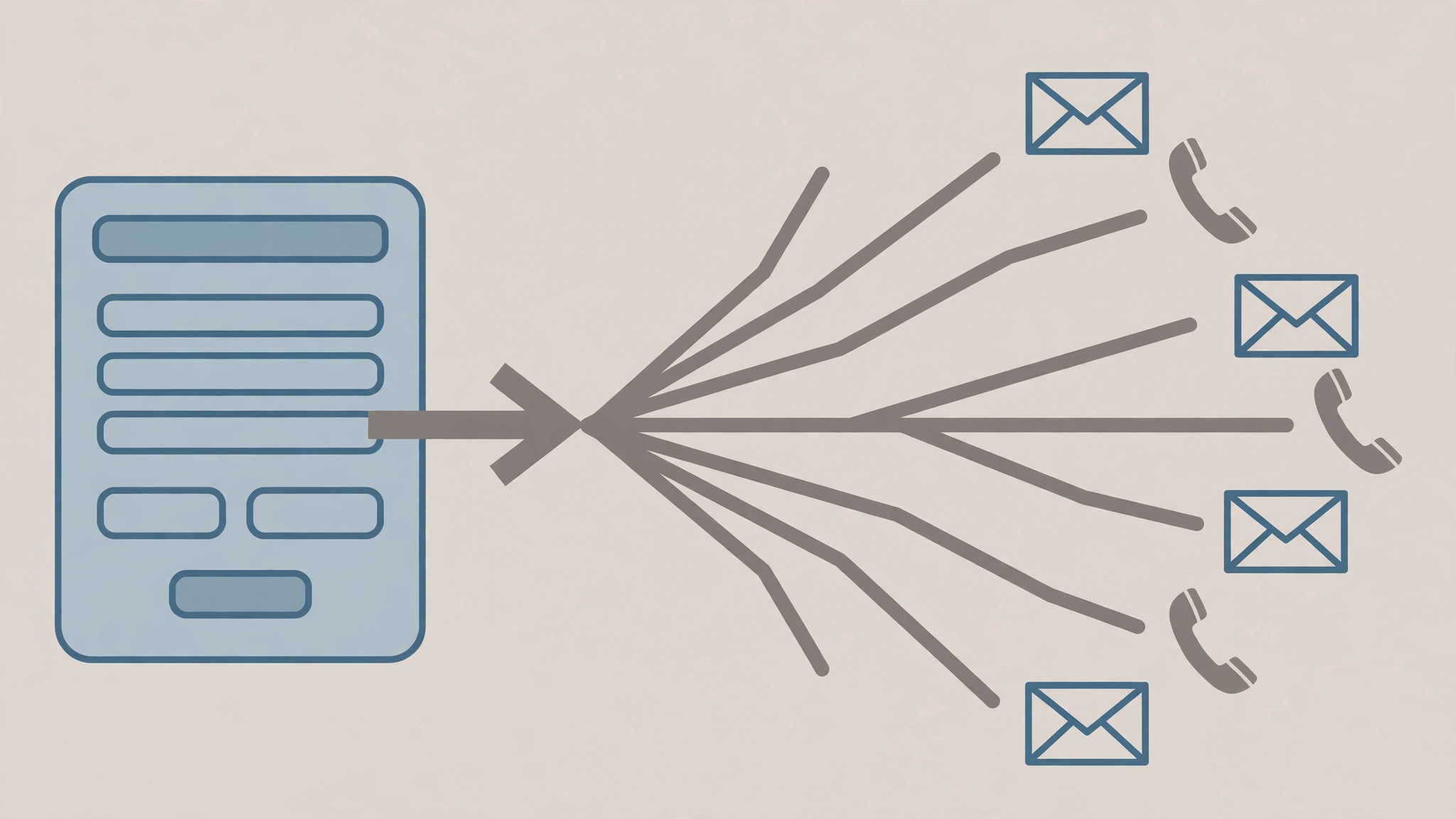
In-content image 1 — placed under "One form, a dozen inboxes: how the lead machine actually works". Prompt: clean editorial illustration of one online form with an arrow splitting into many envelopes and phone icons fanning out. Alt text recorded above.
What a quote needs, and what it only asks for
The most useful discipline in insurance shopping is separating identity from contact. Insurers price on identity-adjacent facts: who drives, what car, where it sleeps at night, what happened on the road in the last few years. Those facts have to be true — a wrong birth date, garaging address, or driving history gets you a price you cannot actually buy, and a misstatement on an application can give an insurer grounds to cancel a policy or deny a claim. Never fake those.
Contact details are a different category entirely. Your email address and phone number play no part in your price. They exist so sellers can reach you, and that is precisely why they are the right things to mask while you shop. A temporary email for the quote stage, and a number you control and can switch off for the call stage — a free voice number or a second line — gives you the quotes without giving every buyer a permanent line into your life. Once you choose a winner, you hand that one company your real details, deliberately, on your terms.
There is also a free, no-form option most shoppers skip: state comparison tools. Texas runs HelpInsure.com and California runs a premium comparison tool, and neither asks how to reach you. They will not sell you a policy, but they will tell you what the market looks like in your state before any seller has your address. Use them first, and you walk into the aggregator stage already knowing roughly what a fair price is — which also makes you harder to upsell.
The thirty-minute method: shop loud, buy quiet
Here is the method I would actually use, in order, on a Saturday morning with coffee:
First, ten minutes with the state tool. Check your state's published sample rates if one exists, and note the range for your car and coverage level. This is your anchor. Any quote far above it needs an explanation; any quote far below it needs a second look at what it excludes.
Second, ten minutes direct. Go to two or three insurers directly — not through an aggregator — and run their own quote tools. Direct quotes use your real details only with the company you are actually considering, and direct insurers are the ones most likely to let you complete a purchase without a phone call. Use a temporary email here too if the form allows it; you can always update the address when you buy.
Third, ten minutes with the aggregator, on burner contact details. This is the only stage where the lead machine gets anything, and what it gets is an address you will abandon and a number you can silence. Collect the quotes, screenshot the ones worth keeping, and do not answer the calls that follow in the next hour — the numbers in writing are the quotes; the calls are sales pressure.
Fourth, pick one winner and switch channels. Call or log in with the insurer directly, give them your real email and phone, and buy through their own system. The aggregator's job is done. The temporary address has done its job too, and it can expire.
The whole point of the order is that the loudest stage — the aggregator — is also the most disposable. Most shoppers do it backwards: they start with the aggregator on their real address, then spend months quieting the noise. Starting quiet and ending with one deliberate handover inverts the cost.
Where a temporary email breaks (read this before you rely on it)
A temporary address is a shopping tool, not a buying tool, and the boundary matters more here than in most categories because the purchase has legal weight. Do not use a disposable address for the policy itself. Policy documents, billing notices, renewal reminders, and claim correspondence all route through the address on file, and an expired inbox at renewal time is how a driver discovers a lapse the hard way. The same logic that says never use a temporary address for the accounts that matter applies with full force to a contract that keeps you legal on the road. The same shopping-vs-buying split governs free trials: a trial you might convert is a trial that needs a durable address, not a disposable one.
There are two more failure modes worth knowing. First, some quote forms block well-known disposable domains outright, or silently fail to deliver the quote to them. If a quote never arrives, that is usually what happened — it is the same blocklist problem that affects any disposable signup, and the fix is a different disposable domain, not hammering "resend." Second, if you actually want an agent's help — a complicated household, multiple cars, a teen driver, a prior claim that needs explaining — a burner inbox works against you. The agent cannot call you back on an address you abandoned, and a complicated quote done by email tag is a quote that will go wrong. For a complex case, skip the aggregator entirely and talk to one independent broker on your real details.
The honest summary: temporary email is for the comparison stage, for straightforward cars and straightforward drivers, for the stage where you are collecting numbers. The moment a quote becomes a policy, or a case becomes complicated, the real address takes over.
After you buy: the ten-minute cleanup
Buying the policy is not the end of the job; the lead machine does not know you bought, and it will keep selling your profile until you tell it to stop. Spend ten minutes on this, the week you buy:
Delete or let expire the temporary address you shopped with. Any mail still going there is proof the system worked — it is going nowhere, instead of into the inbox where your bank alerts live. If you used a voice number for the shopping stage, silence or recycle it the same week.
Unsubscribe from the aggregator's own list, not just the agents'. The aggregator is the source; the agents are downstream. And keep the winner's mail: the policy documents, the ID cards, and the renewal notice should all live on the real address you gave the insurer directly.
If calls continue from numbers you never gave your real number to, that is aged-lead circulation, and it is worth one complaint to the source if you can identify it — not because one complaint fixes the industry, but because documented complaints are what regulators and researchers cite when they measure this market. The study quoted above drew on more than 7,400 Better Business Bureau reviews and complaints to corroborate its findings. Yours would not be the first, and it would not be ignored.

In-content image 2 — placed under "After you buy: the ten-minute cleanup". Prompt: photorealistic tidy desk with a closed laptop, car keys, and a single paper folder in morning light. Alt text recorded above.
The fine-print test that takes ninety seconds
Before you submit any quote form, do one thing that takes less time than the form itself: find the privacy policy link, search it for "affiliates," "partners," and "third parties," and read the sentence that follows. If it says your information may be shared with marketing partners or lead buyers, you are looking at a broadcast, and you should shop from a temporary address. If it says the company does not sell your personal contact information, you are looking at a direct seller, and your real address is a reasonable choice.
This test is also the fastest way to tell a legitimate comparison site from a lookalike. Fake quote portals that impersonate real insurers exist, and they harvest far more than an email — payment details, banking credentials, one-time codes. A site with no findable privacy policy, no license information, and a form that asks for payment before it shows a price is not a quote site. Close it. The ninety-second check costs nothing; skipping it can cost a great deal more.
FAQ
Can I use a temp email for car insurance quotes? Yes, for the comparison stage. Aggregator and direct quote forms that only need to send you a quote or a verification code work fine with a temporary address. Do not use one for the policy itself — billing, renewal, and claims all route through the address on file, so the insurer you buy from should always have your real email.
Why do I get so many calls after one insurance quote? Because most comparison sites sell your profile as a lead to multiple agents at once, and those leads can be resold into aged pools. Industry write-ups describe five to ten buyers per lead as typical, and a 2026 study tracking 105 synthetic profiles recorded up to 593 calls to a single profile over 60 days. The calls are the business model, not an accident.
Will a temp email affect my insurance price? No. Your price is set by the car, where it is garaged, and your driving history — not by your email address. What changes is who can reach you afterwards. Mask the contact details while you shop, never the identity facts the quote is priced on.
What if the quote form rejects my temp email? Some forms block disposable domains, or silently fail to deliver to them. Try a different disposable domain first. If the form keeps rejecting disposable addresses and you still want that quote, use an email alias you control rather than your primary inbox — and remember that the site's blocklist is itself a signal about how it treats disposable signups. If a verification code never arrives at all, the OTP checklist covers the other causes, from greylisting delays to sender-side filtering.
Should I use a temp email for the insurer I actually buy from? No. Buy through the insurer's own system with your real email and phone. Policy documents, ID cards, renewal notices, and claim updates all depend on that channel staying open, and an expired temporary inbox at renewal time can mean a lapsed policy.
Is a temp email enough to stop insurance spam completely? It stops the email side cold, because the address dies when you abandon it. It does not stop calls to a phone number you handed out, which is why the method pairs a temporary email with a number you can silence. Together they cover both channels; either one alone leaves the other open.
Need a disposable temporary email?
Protect your real inbox from spam and promotional clutter instantly and free.
Received a suspicious email, text, or charge alert?
Verify whether the sender domain is disposable, spoofed, or unverified before clicking links.