

Temp Email for Halloween Party Invites: RSVP to the Real Parties, Starve the Fake Ones
Halloween week does something strange to an inbox. For eleven months of the year, an invitation is a rare, welcome thing. Then, in the last week of October, the invitations arrive in a pile: the office costume contest, the neighbor's porch party, the haunted house with a timed-entry ticket, the bar crawl that wants your email before it tells you the meeting point, the costume contest with a cash prize that requires an online entry form, and three more from people you half-remember. Somewhere in that pile, this year, sits a new kind of guest: an invitation that was never sent by anyone you know.
That is not paranoia. It is the documented shape of invitation fraud in 2026, and it is why Halloween is the one week of the year when the smartest thing you can do with your real email address is keep it out of the RSVP pile entirely.
The fake-invite wave is this year's Halloween story
The warning signs stacked up all year. In May 2026, the US Federal Trade Commission issued a consumer alert about a rise in fake party invitations impersonating services like Evite and Paperless Post. In July, AARP reported on the same wave, noting that the messages appear to come from friends, family members, and colleagues — which is exactly why they work. The Chicago and Northern Illinois Better Business Bureau put out its own alert about what it called "bogus party invitations." And in September 2026, Wired reported on the campaign in detail: invitations crafted from names pulled out of compromised address books and public social media, sent to people who had no reason to doubt them.
The mechanics are consistent across the reports, and they are worth memorizing because Halloween is the season when they blend in best. The message looks like a normal invitation — sometimes a convincing copy of an Evite or Paperless Post design, sometimes a plain "You're invited!" note with a friend's name on it. The trap is one step behind the envelope: click "View Invitation" and you land on a page asking for your email username and password, or your phone number and a verification code. Hand those over and the attacker has the keys to the account, or a way past its two-factor authentication. Other versions skip the login form and go straight for a download — Miami University's security office flagged invitation attachments that install a remote access Trojan, with filenames like TrueParty.exe and GlamourPartyInvite.exe.
Halloween is the perfect cover for this because the season already normalizes the weird. A costume party from a vague acquaintance does not raise an eyebrow on October 27. A haunted-house ticket link from a bar you visited once feels plausible. A "secret" party with a hidden location feels like the point. Scammers do not need to invent a new story for Halloween; they just need to ride the one everyone is already telling.
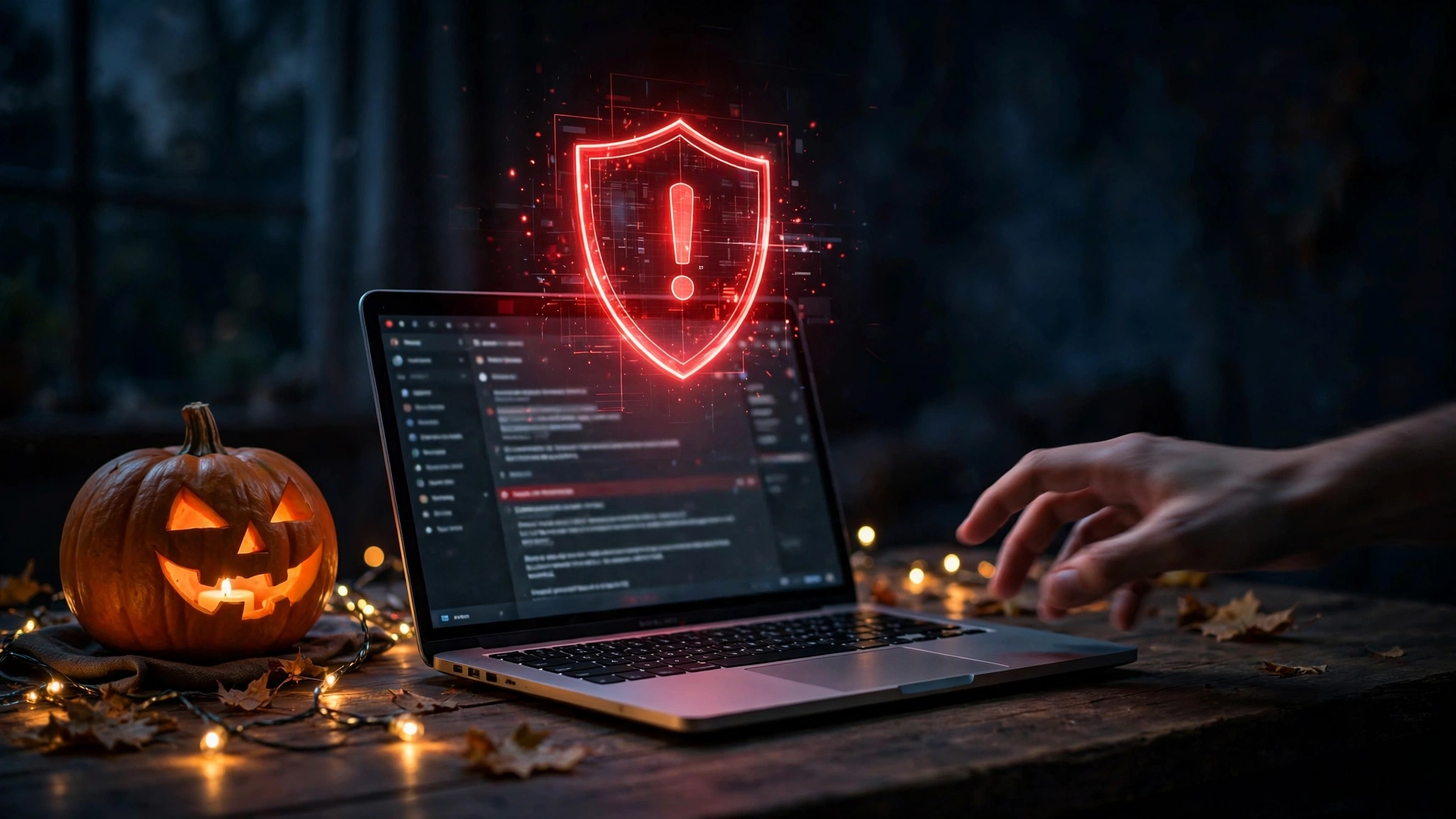
*In-content image 1 — placed under "The fake-invite wave is this year's Halloween story". Prompt: laptop screen at night displaying a suspicious party invitation email with a glowing red warning shield, hand pulling back, carved pumpkin and string lights on the desk. Alt text recorded above.*
What your real address actually costs you at Halloween
Leave the scams aside for a moment, because even the legitimate Halloween pile is expensive in inbox terms. Every RSVP form, costume-contest entry, haunted-house booking, and bar-crawl signup asks for an email, and almost none of them stop emailing you when the pumpkins come down.
Here is what a normal Halloween week of signups buys you, based on how these lists actually behave:
- The venue list. The haunted house, the bar crawl, the pop-up pumpkin patch — these are seasonal businesses that market year-round. Sign up in October and you are on the list for Valentine's events, spring openings, and next October, unless you hunt down the unsubscribe link in every message.
- The sponsor drip. Costume contests and "win a prize" entries are often lead-generation machines first and parties second. Your address gets shared with the sponsors whose logos sit at the bottom of the entry form, and each sponsor has its own definition of "occasional updates."
- The group-chat spillover. The friend who collects RSVPs on a shared spreadsheet, the coworker who forwards the office party invite to "everyone who might come" — your real address travels further than the form you filled in, because people forward invitations without thinking about it.
- The breach surface. Every one of those lists is a database that can leak. An address you used for one haunted house in 2026 is an address a credential-stuffing list can carry into 2027, and the more places it appears, the more password-reset attempts it attracts.
None of this is a reason to skip Halloween. It is a reason to stop paying for a costume party with a permanent line into your daily attention. A temporary address changes the economics of the whole week: the fun still arrives, the follow-up does not.
The one-week burner playbook
The approach that works is boring, which is why it works. One disposable address per event type, created when you need it, abandoned when the party is over.
Step 1: Sort the pile before you touch it. Open every invitation and sort it into three buckets: people you know and trust (the neighbor, the close friend), businesses you are actually buying from (the haunted house with a ticket you paid for), and everything else (the vague acquaintance, the contest, the bar crawl with a prize draw). The first bucket can have your real address if you want — though it does not need it. The third bucket never gets it.
Step 2: Give the third bucket a burner. Generate a temporary address and use it for the contest entries, the crawl signups, the "RSVP for a chance to win" forms, and any invitation where the sender is a brand rather than a person. The verification code or ticket confirmation still lands in the temporary inbox, which is all you need for a one-night event.
Step 3: Keep the burner alive only as long as the event. A haunted-house ticket for Saturday night needs an inbox that works until Saturday night — and not one minute longer, in the sense that matters. Once you have walked through the door, the address has done its job. Let it expire, and the November marketing from that venue dies with it instead of arriving in your real inbox.
Step 4: Never let the burner become the account. This is the line that matters, and it is the same line that runs through all disposable-email advice: a temporary address is for access, not for ownership. If a Halloween signup turns into something you will still need in December — a venue membership, a recurring event series, a prize you actually won and need to claim — move it to your real address deliberately, on your own terms. Do not let it happen by accident because the confirmation email is sitting in an inbox you are about to abandon.
That last step is where most people get hurt, and it is worth saying plainly: the risk of a temporary address is not that it fails, but that it succeeds and you forget what you put behind it. Treat the burner like a paper ticket, not a safe. Paper tickets get you in the door; they are not where you store valuables.
Real parties vs. traps: the 60-second sorting test
A disposable address limits the damage of a bad click, but it does not replace judgment. Before you RSVP to anything this week — burner address or not — run the invitation through this check. It takes about a minute, and it catches nearly every version of the 2026 fake-invite scam:
- Check the sender, not the name. A message that says it is from your friend Sue but arrives from a misspelled domain, a random Gmail address, or a domain you have never seen is not from Sue. Display names are free; domains are the evidence.
- Go to the platform directly. If the invite claims to be from Evite, Paperless Post, or Punchbowl, do not click through the email. Open the platform yourself and look for the event there. A real invitation will be waiting for you. A fake one will not exist.
- Never sign in to see an invitation. A legitimate invitation never asks for your email password, and never asks for a verification code to "confirm" the event. That request is the scam, not a step in it. Close the tab.
- Treat attachments as hostile. A real digital invitation is a web page, not a download. If clicking leads to an .exe or .msi file — the exact pattern Miami University warned about — do not run it, and do not let curiosity finish the sentence.
- Ask the host through another channel. One text — "hey, did you send me a Halloween invite?" — resolves the ambiguity that scammers depend on. If the host says no, you have your answer, and you can warn the other recipients too.
If an invitation fails even one of these checks, it goes in the same place as the marketing you will never read: nowhere. Delete it, and if it impersonated someone you know, tell that person — their address book may be the source, and they will want to know before the next wave goes out under their name.
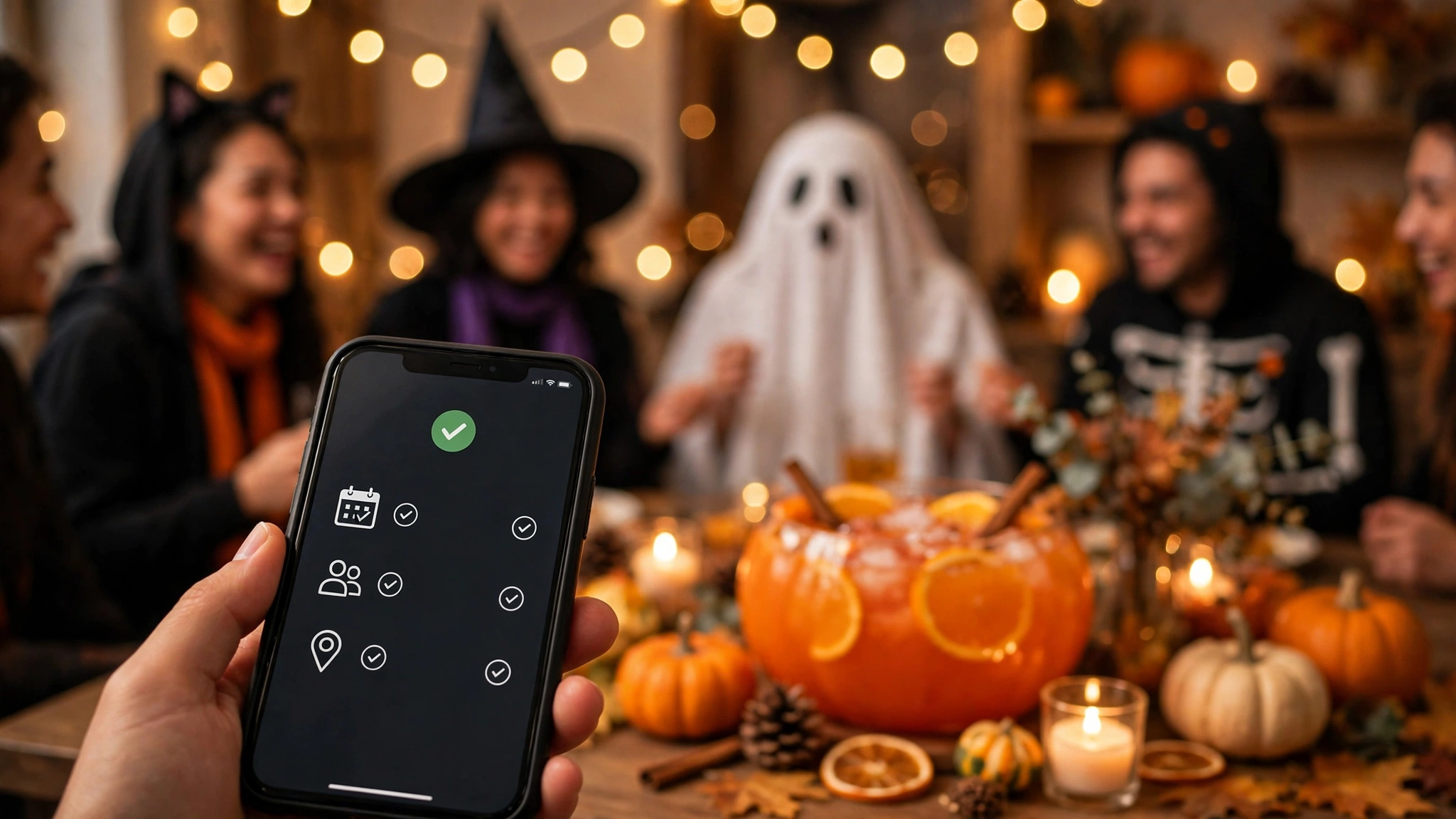
*In-content image 2 — placed under "Real parties vs. traps: the 60-second sorting test". Prompt: cheerful Halloween costume party scene viewed over a phone showing an RSVP confirmation, guests in simple costumes, pumpkin punch bowl in soft focus. Alt text recorded above.*
The one signup that still needs your real address
Every "use a temp email" article needs its honest exception, and Halloween has a clear one: anything you paid real money for, or anything tied to your children. A haunted-house ticket you bought with a card should live on an address you control long-term, because the refund, the rain-check, and the "your timed entry moved" email all route through it. A school Halloween event for your kids should go to the address the school already has on file, because that channel is also how you hear about cancellations and safety notices. The same logic that says never use a temporary address for the accounts that matter applies here with extra force: a party is disposable, a purchase and a child are not.
There is a second, subtler exception: the party you are hosting. If you are the one sending invitations, collecting RSVPs, and coordinating food for twenty people, use your real address. Your guests need to reach you, replies need to land somewhere you will actually read them, and a host who disappears behind a burner inbox is a host whose party falls apart. The burner is for attending, not for hosting.
Everything else — the contests, the crawls, the pop-ups, the vague-acquaintance parties, the "sign up for a chance to win" forms — is exactly what a temporary address was made for. And this year, with fake invitations riding the same wave as real ones, it is also the cheapest insurance you can buy: if you do RSVP to a fake, the address the scammer walks away with is one you were going to throw away on Sunday anyway.
The week after: what to do on November 1
Halloween ends, and the inbox work takes about ten minutes. Delete the temporary addresses you used for the week — or simply let them expire, which amounts to the same thing. If any venue or contest keeps emailing an address you abandoned, that is proof the system worked: the mail is going nowhere, instead of into the inbox where your bank alerts live. If something you actually want survived the week — a venue you will visit again, a party series worth following — subscribe to it deliberately from your real address, on your terms, instead of by accident through a form you filled in half-asleep on October 27.
And if you are already thinking about the next pile — because the holiday season starts the moment Halloween ends — the same playbook carries straight over. Temp email for Black Friday deals is the November version of this post, and the logic is identical: the deals are real, the list is forever, and the burner is what lets you have the first without the second.
FAQ
Can I use a temp email for Halloween party RSVPs? Yes, for most of them. Contest entries, bar crawls, haunted-house ticket confirmations, and party RSVPs from brands or vague acquaintances all work fine with a temporary address — the confirmation or ticket lands in the temporary inbox. Use your real address only for paid tickets you may need to refund and for events tied to your children or your school.
Do fake Halloween invitations really steal passwords? Yes, that is the documented pattern in 2026. The FTC's May 2026 alert, AARP's July 2026 report, and Wired's September 2026 coverage all describe invitations impersonating Evite, Paperless Post, and Punchbowl that lead to pages asking for email credentials or verification codes. A legitimate invitation never asks you to sign in to view it.
What if a Halloween signup rejects my temp email? Some sites block well-known disposable domains — it is the same blocklist problem that affects any disposable signup. If a code never arrives, that is usually what happened. Why websites reject temp email explains the mechanics, and the practical fix is to try a different disposable domain rather than hammering "resend," which can rate-limit the account.
What if my OTP or ticket code does not arrive in the temp inbox? Wait a few minutes first — verification mail can be greylisted and delayed — then check whether the sender's domain is one that filters disposable addresses. What to do when an OTP code does not arrive on a temp email walks through the full checklist. For a same-night event, switch to your real address rather than risk missing the door.
Can I use a temp email for a costume contest with a cash prize? You can enter with one, but think before you do: if you win, the prize claim will go to the address you entered with. For a small prize you will claim the same week, a temporary address is fine. For a large prize, a sponsored trip, or anything with a claim window longer than a few days, enter with an address you will still control when the winner is announced.
Is a temp email enough protection against fake invitations? It limits the damage — a scammer who harvests your disposable address gets an address you will abandon — but it is not a substitute for the sorting test above. Never enter your real email password or a verification code on a page reached from an invitation link, no matter which address you signed up with. And the same caution applies to event signups generally: temp email for concert presale codes shows how the same "real vs. trap" judgment plays out for ticketed events.
Need a disposable temporary email?
Protect your real inbox from spam and promotional clutter instantly and free.
Received a suspicious email, text, or charge alert?
Verify whether the sender domain is disposable, spoofed, or unverified before clicking links.