
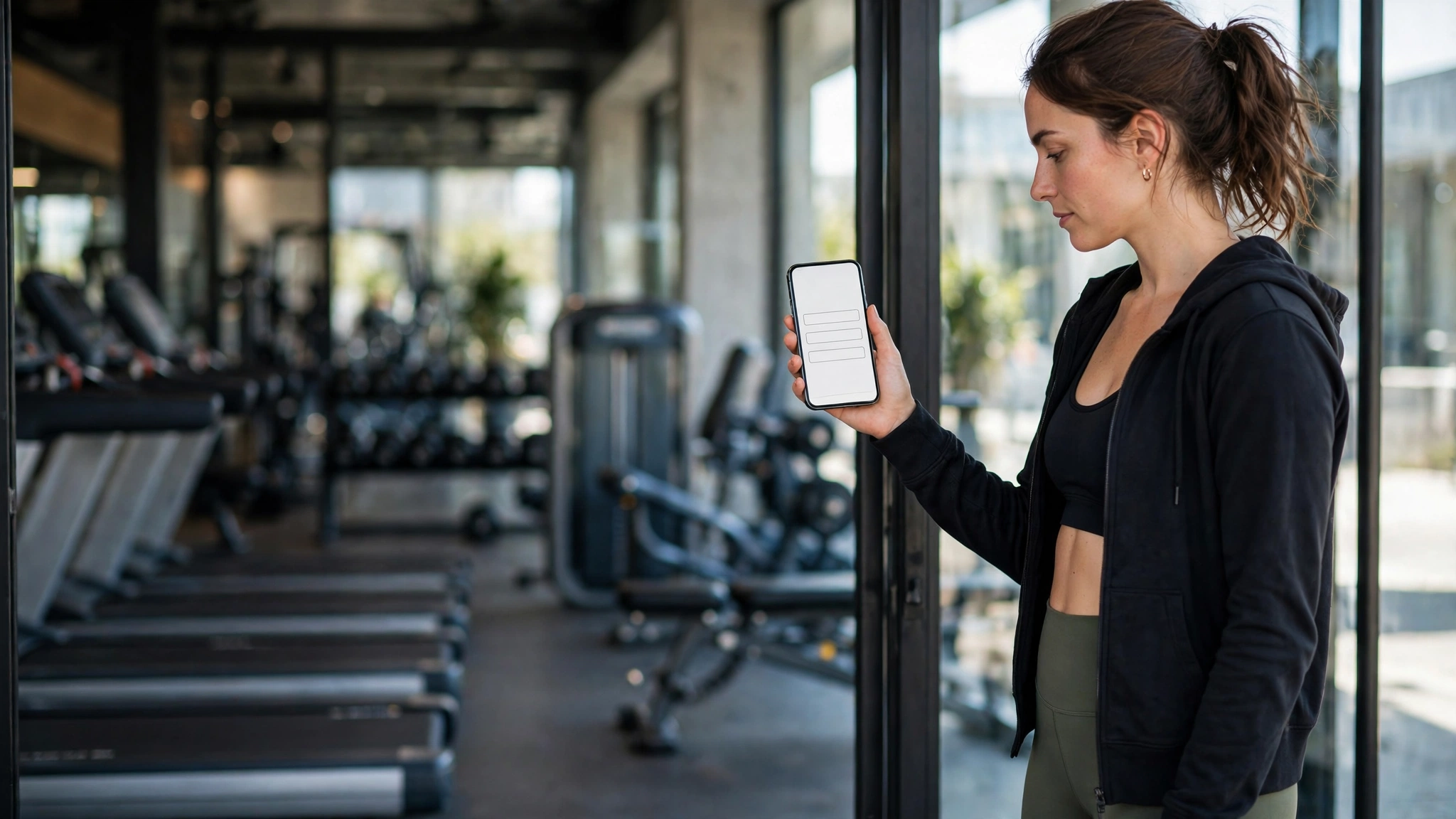
Temp Email for Gym and Fitness App Free Trials: Audition the Workout, Not the Follow-Up
November and December are the smartest months of the year to trial a gym, and almost nobody treats them that way. Everyone waits for January, joins the resolution crowd, and judges a place at its worst: packed classes, a queue for every machine, staff too busy to learn anyone's name. Trial in November and you see the gym as it actually is on an ordinary Tuesday. The classes have room. The trainers have time. The locker room tells the truth.
There is one catch, and it is not the workout. It is the fortnight after you hand over your email address. A gym trial is not really a free pass. It is the start of a sales sequence, and that sequence is being tested just as much as the equipment is. My position is simple: audition the gym on a temporary email address, judge it on what happens inside the building, and hand over your real address only at the moment you decide to stay. Everything before that decision is a stranger's inbox problem, not yours.
A trial on your real address buys you something you did not ask for. The follow-up does not arrive once. It arrives as a campaign, designed to outlast your willpower. A temporary address breaks that campaign cleanly: the trial ends, the emails keep going to an inbox you no longer open, and your real inbox never learns the gym existed. That is the whole trick, and it is worth doing properly rather than halfway.
The pass is free. The follow-up is the product
Gyms do not follow up by accident. Follow-up is a documented discipline in the fitness industry, with published playbooks that read more like sales manuals than hospitality guides. One gym lead guide recommends five to eight touchpoints before a prospect takes action, laid out as a seven-day sequence: a welcome text on day one, an email with the class schedule on day two, a personal call on day three, a nudge on day five, and a social-proof email on day seven. A fitness consulting playbook prescribes seven touchpoints over fourteen days: calls, emails, and texts stacked from day one through week two. Another sales process trims it to five touches over seven days, starting with a call and an automated text within five minutes of the form submission.
Read those three together and the picture is unmistakable. When you submit a trial form, you are not joining a queue. You are entering a machine that has already decided when it will contact you, on which channel, and with what argument, for the next one to two weeks. The call that arrives while the confirmation page is still loading is not a person who cares about your fitness goals. It is a system working as designed.
This is the same machinery that multiplies a single quote form into weeks of contractor mail, which is why the discipline that works for home service quotes works here too: the shopping phase gets an address you can abandon, and the business you hire gets the one you cannot. The difference is that a gym's drip is more personal. It uses your first name, references the class you asked about, and by day seven sends you a member's success story as though you were already on first-name terms. That intimacy is manufactured, and it works best on an inbox you actually read. On a temporary address, the same sequence reads as what it is: a sales funnel running on schedule into a room nobody is sitting in.
None of this makes gyms villains. A gym is a business with thin margins and brutal churn, and following up with trial visitors is legitimate selling. But legitimate selling is still selling, and you are allowed to decide how much of it reaches your real inbox. The temp address does not hide you from the gym — your face at reception and your phone number do that job badly, as with every trial. What it does is confine the campaign to a room you can walk out of.
Three doors into the same gym

Not every gym trial is the same offer, and the email strategy changes with the door you walk through. Get this wrong and the temp address either fails outright or, worse, succeeds at signup and then traps you at the exact moment you need the inbox most. We have applied the same audition logic to VPN trials, where the vendor's honesty is the product; with gyms, the thing being auditioned is the building and its contract, not just its software.
The first door is the big-box day pass or short trial: a large gym, a form at reception or online, a pass for a day, three days, or a week. This is the cleanest case for a temp email. The pass itself is the product, there is usually no card involved for a genuinely free pass, and the decision — do I like this building at the hour I would actually train — can be made in one or two visits. One address, one gym, one decision.
The second door is the boutique studio intro offer: a week or a month of unlimited classes at a small studio, often at a low introductory price rather than genuinely free. Here the temp email is useful but not sufficient, because money has entered the picture. The intro price is charged to a card, and the end of the intro period usually converts to a full membership unless you cancel. The email address is the envelope the renewal notices arrive in, and an envelope you abandon is one you cannot read. Use the temp address for the inquiry if the studio allows it, but put the renewal date in your own calendar the day you pay, and treat that calendar entry — not any email — as the thing that protects you.
The third door is the fitness app trial: a phone app, a signup inside the app store, a seven- or fourteen-day trial that converts automatically. Here a temp email is nearly useless on its own, because the billing identity is your app-store account, not the email field. The trial converts against the store subscription, and cancellation happens in the store's subscription settings, not inside the app. This is the same trap that catches streaming trials with a card on file: the charge runs against the payment method, and no inbox trick changes that. For an app trial, the temp email can still shield you from marketing mail, but the real protection is a calendar reminder set the moment you start, plus a cancellation you perform yourself on day one if the app lets you keep using the trial after cancelling.
Three doors, three different stakes. A free pass with no card is a sample. An intro offer with a card is a billing relationship with a discount attached. An app-store trial is a subscription wearing a trial costume. The temp address fits the first cleanly, helps the second only alongside a calendar, and is decorative for the third unless you handle the billing separately.
The card, the contract, and the cancellation maze
Every gym trial conversation eventually arrives at the same three questions, and you should ask all three before you sign anything, including a "free" form. First: is a card required? Second: what happens the day the trial ends — a hard stop, or an automatic conversion? Third: how do I cancel, exactly, in what channel, and can I do it without coming back into the building?
The card question is the one our honest rules for free trials treat as absolute, and gyms are no exception. Card on file means a real, monitored address or a permanent alias, every time, because renewal notices, failed-payment alerts, and cancellation confirmations all travel to that address. A temp inbox that expires in hours or days is the wrong home for a billing relationship that renews monthly. If the trial asks for no card, the temp address works end to end. If it asks for a card, the temp address is for the inquiry phase only, and the account holding the card needs an address you will still control in six months.
The contract question is where gyms earn their reputation. Some memberships are month-to-month. Some lock you in for a year. Some charge an annual fee on top of the monthly rate, due in a month you will not remember. Some require thirty days' notice to cancel, which means "cancel today" actually means "pay for one more month." None of this is hidden, exactly — it is in the agreement, in small print, on a screen you scrolled past while thinking about treadmills. Screenshot the terms that matter before you sign: length, what happens at the end, the cancellation path, and any annual fee. The screenshot takes fifteen seconds and it does not change when the gym redesigns its pricing page.
The cancellation question is the one people forget to ask while excited about a new gym, and it is the one that costs the most money later. Can you cancel online, in the app, by email — or only in person, at reception, during staffed hours, with a form? A gym that makes joining take thirty seconds online and cancelling take a visit in person has told you everything about its business model. That is not a reason to refuse the trial. It is a reason to trial on an address you can abandon, to keep the cancellation instructions in your own notes, and to set the reminder for the day before the notice period starts, not the day the charge lands. My opinion, stated plainly: a gym confident in its product does not need a cancellation maze. The maze is a retention strategy, and it works because most people would rather pay one more month than make an awkward visit to reception.
The 30-minute trial that actually tells you something
A gym trial is short, so the test has to be short too, and it has to test the things that decide whether you will still be going in March. Forget the equipment count. A gym with two hundred machines you never use is not better than a gym with forty in the places you actually train.
First, go at the hour you would actually train, not the quiet hour the tour guide suggests. A gym at 10 a.m. on a Tuesday tells you nothing about the same gym at 6 p.m. on a Monday. Count the wait for the equipment you use most. If there is a queue for it now, there will be a queue in January, when the resolution crowd arrives.
Second, take one class, or watch one from the back, even if classes are not your main reason for joining. A class shows you the coaching, the crowd, and the culture in a way an empty gym floor never will. Are instructors paying attention to beginners, or performing for the regulars? Is the room welcoming to someone on their first day, or does it feel like a club you have not joined? You are not just buying equipment. You are buying a room you will walk into three times a week, and the room's manners matter as much as its machines.
Third, inspect the unglamorous parts: the locker room, the showers, the water fountain, the parking situation at your hour. These are the things that end memberships quietly. Nobody quits because the dumbbells were too light. People quit because the showers were grim, the lockers were broken, or parking added ten minutes of dread to every visit. The tour skips these rooms for a reason. Walk into them anyway.
Fourth, ask the cancellation question out loud, at reception, before you leave: "If I join and want to cancel in three months, exactly how do I do it?" A clear, specific answer — online, in the app, by email, here is the link — is a good sign. A vague answer, a form you cannot see, or a suggestion to "talk to us when the time comes" is information too, and it should weigh as heavily as anything you saw on the gym floor. Write the answers down while you are still in the car park. The trial's clock is short. Your notes are what survive it.
Where the burner breaks

A temp email is a good audition tool and a bad home, and gyms punish the confusion in specific, predictable ways. There are five places it breaks, and each one has a simple rule attached.
The first is the membership you keep. The moment a gym becomes your gym, the temp address has done its job and should be retired. Password resets for the member app, class bookings, freeze requests, and billing notices all need an inbox you will own in a year. Change the email on the account to your real address the day you join, before the temp inbox expires, not after. After is too late, and "too late" here means negotiating with reception about an account you cannot prove is yours.
The second is personal training and coaching packages. A trainer relationship is a real relationship: session bookings, program documents, payment schedules, and rescheduling all travel by email. A trainer who cannot reach you reliably is a trainer you will miss sessions with, and missed sessions are still charged sessions in most studios. The burner is for auditioning the gym. The trainer gets your real address from the first paid session.
The third is family and household plans. Other people depend on the login, and an expired inbox locks everyone out, not just you. A partner's class bookings, a teenager's youth membership, a shared family plan — all of it assumes one reachable address. Do not build a household's fitness routine on an address designed to disappear.
The fourth is health data in the app. Fitness apps collect more than workout logs: weight, heart rate, sleep, location from outdoor runs, sometimes health conditions entered to customize a plan. That data lives in an account tied to the signup email, and account recovery runs through that email. An account you cannot recover is an account whose data you cannot delete either, which is a worse position than never having created it. If an app asks for health data during a trial, that is a signal to use a real address or skip the trial, not to hide behind a disposable one.
The fifth is the freeze and the cancellation notice. Gyms send freeze confirmations, cancellation confirmations, and final-bill notices by email, and those emails are the evidence if a charge is disputed later. A cancellation you cannot prove is a cancellation that did not happen, as far as the billing system is concerned. Keep the cancellation confirmation in your real inbox, forwarded from the trial address if necessary, until one full billing cycle has passed with no charge. That is the only receipt that matters, and it is worth more than every marketing email the gym ever sent you combined.
The rule underneath all five is the same one that governs every signup category where an account accumulates value: sample with the disposable address, keep with the permanent one. The line between the two is the moment you pay for something you intend to keep — not the moment you first walk through the door.
Frequently asked questions
Can I use a temp email for a gym day pass?
Usually yes, for a genuinely free pass with no card attached. The pass is a sample, and a sample is exactly what a temp address is for. If the gym's form rejects the address, that is its signup policy, not a problem to work around by hunting for a domain that slips past the filter. Use a dedicated secondary inbox for the inquiry instead, and keep the same rule: the shopping phase gets an address you can abandon.
Will the gym take me less seriously if I use a temp email?
The staff who greet you will judge you on whether you show up, listen, and wipe down the equipment, not on your email domain. What actually signals seriousness is showing up at the hour you would train, asking specific questions, and replying promptly when you do decide. A clear idea of what you want from a gym impresses a good gym far more than a permanent-looking address does.
Does a temp email stop a gym from charging me after a trial?
No. The charge runs against the payment method on file, not the email address. A disposable email hides you from marketing mail; it does nothing to the card, the contract, or the notice period. The only reliable protection is cancelling before the trial ends, through the gym's actual cancellation channel, with the confirmation saved. The calendar reminder matters more than the email choice, and it matters most for intro offers that convert automatically.
What if I trial three gyms in one month?
Use one temp address per gym, not one address for all three. Three separate inboxes keep each gym's follow-up sequence, booking confirmations, and cancellation instructions apart instead of tangled in one thread, and if one gym's list is shared or breached, the blast radius stays at one trial. It also makes the decision easier: each gym has its own folder of notes and its own cancellation path written down.
Should I use a temp email for a fitness app I plan to keep?
No. Once an app becomes the place your workouts, health data, and progress live, it has earned a reachable address, because password resets, data export requests, and subscription notices all travel by email. Keep the disposable address for sampling during the trial, and migrate to your real address the moment you decide to subscribe — before the temp inbox expires, while the email-change confirmation can still reach you.
What is the single biggest mistake people make with gym trials?
Trialling the gym at the wrong hour and signing up before checking the cancellation path, in that order. The wrong hour hides the crowds you will actually train in, and the unchecked cancellation path turns a bad decision into months of charges. Both are avoidable in thirty minutes: visit at your real training hour, ask the cancellation question out loud, and write both answers down before you leave the building.
The verdict: audition the gym, not the follow-up
So where does this leave the temp email for gym and fitness trials? In a narrower, more useful place than the hype suggests, and a more honest one than the gym's own signup page suggests.
Use it when you are sampling: a day pass, a genuinely free trial with no card, a studio you are curious about but not committed to. It keeps the fourteen-day drip out of your real inbox, it separates one gym's paperwork from another's, and it limits what a shared lead list or a data-sharing deal can take from a signup you barely thought about. That is real value, and it is enough to justify the habit — especially in November and December, when a quiet trial tells you more than a January visit ever will.
Do not use it as a payment shield, a cancellation method, or a home for a membership you intend to keep, because it is none of those. The card charges you regardless of the address. The contract renews regardless of the address. And the account you build on a disposable address is an account you cannot recover, which matters the moment the trial becomes a gym you actually attend three times a week.
The gym trial in 2026 is a fair offer wrapped in a sales sequence. That is not a reason to stop sampling. It is a reason to sample deliberately: one gym at a time, at your real training hour, on a disposable address, with the cancellation question asked out loud and the answer written down. The gyms worth joining will survive that test easily. The ones that only survive on the strength of their follow-up sequence will not — and that, more than any equipment list, is the information a trial is supposed to give you.
Need a disposable temporary email?
Protect your real inbox from spam and promotional clutter instantly and free.
Received a suspicious email, text, or charge alert?
Verify whether the sender domain is disposable, spoofed, or unverified before clicking links.