

Temp Email for Ancestry and DNA Kit Signups: The Privacy Move That Can Cost You Your Results
A DNA kit usually arrives as a gift, and the gift is where the trouble starts. Someone hands you a small box, you open it to find a tube you are supposed to spit into, and before anything interesting happens, a screen asks for your email address. Not after the results. Not when you feel ready. First. The account comes before the sample, and the account comes before you have had a single minute to think about what you are handing over.
The instinct that follows is completely understandable. A company is about to hold your genetic code, the most personal information you own, and your first move is to reach for an address that cannot be traced back to your real inbox. A temp email feels like the one lever of control in a transaction where you are giving up everything else. I understand that instinct, and for most signups on this blog I would tell you to follow it. For a DNA kit, I am going to tell you not to, and the reason is not that temp mail is bad. It is that a DNA account is not a signup. It is a relationship that lasts for years, built around the one piece of data you can never change, and the email address on it is the key, the mailbox, and the exit door all at once. Put a disposable key on that door and you have not protected your privacy. You have put a timer on your own access to your genome.
My verdict, up front so you can stop reading if you are in a hurry: do not register a DNA kit on a temp email. Use a dedicated permanent alias instead, one address used only for that DNA company, guarded like the account it protects. Everything below is why that sentence is true, including the parts of the temp-mail case that are genuinely fair, because a recommendation you cannot trust on the other side is not worth much.
What the email address is actually for on a DNA account
On most signups, the email address does one job: it receives a confirmation link, and then it fades into the background. On a DNA account, it does at least six jobs, and they stretch across years rather than minutes. That difference is the whole argument, so it is worth spelling out.
First, activation. You cannot just spit in the tube and mail it. The kit has to be registered to an account, and the account has to be confirmed. 23andMe requires you to confirm your email address before you can register a kit at all, and it sends that confirmation to the address you typed in. If the address is dead by the time you get around to it, the kit is a tube in a drawer, not a test in progress.
Second, the account is one-to-one in a way people do not expect. Ancestry states plainly that each email address may be connected to only one Ancestry account, and that a kit bought for another adult has to be registered on that adult's own account. You cannot run the whole family's DNA through one address and sort it out later. The system is designed around one person, one account, one email, and fighting that design is where most family-kit messes begin.
Third, results are not a single delivery. The sample takes weeks to process, the "your results are ready" message goes to the account email, and then the account keeps producing reasons to be contacted: new DNA relatives, updated ancestry estimates, new health or trait reports, changes to research consent options, and notices when the company's policies change. A DNA account is a living file, not a receipt.
Fourth, recovery. When you forget the password in two years, the reset goes to the account email. 23andMe's own support pages say that if you no longer have access to that email, you are contacting Customer Care for help, which is a slow, identity-checking process, not a button. MyHeritage has a self-service Account Recovery Wizard, but it only works if you still know the registered email address, and if you have forgotten even that, you are back to manual support with identity questions. The email is not just how the company reaches you. It is how you prove you are you.
Fifth, exit. Withdrawing research consent, requesting deletion of your sample or your data, downloading your raw DNA file: all of it happens inside an account you must be able to log into. An account you cannot reach is an account you cannot clean up. People think of a temp email as a way to walk away from a company. On a DNA account, it is the opposite. It is a way to lose the ability to walk away on your own terms.
The privacy case for a temp address, stated fairly
None of that erases the real privacy case, and I want to state it honestly before arguing against it, because the case is not foolish. A temp address does keep a DNA company's marketing out of your real inbox. It does stop that company from having one more thread connecting your genetic data to the address where your bank, your employer, and your family reach you. If you are buying a kit out of curiosity and you are mainly worried about yet another company adding you to its mailing lists, a disposable address solves exactly that worry, cleanly and for free.
But here is the uncomfortable limit of that case: the email address is the least identifying thing you hand a DNA company. By the time you have registered a kit, the company also has your name, your payment details, your shipping address, and a saliva sample containing your entire genome. Swapping the email does not anonymize any of that. It hides the mailbox, not the person, and it does nothing about the other identifiers that actually link your records together. Temp mail is spam control, not invisibility, and on a DNA account the distinction matters more than anywhere else, because the data at stake is not a newsletter preference. It is you, in a form you cannot rotate, revoke, or reissue.
There is also a risk that runs in the opposite direction from what people expect. Many disposable inboxes are effectively public: anyone who guesses or learns the address can open it. A "your results are ready" message, a password reset link, or a relative-match notification sitting in a public inbox is not a theoretical exposure. It is a message about your genetic data readable by a stranger, and it arrives precisely because you chose an address designed to be disposable rather than defended. A private, permanent alias with a strong password and two-factor authentication is a smaller attack surface than a temp inbox, not a larger one.
So the honest scorecard is this. Temp mail wins on one thing: marketing separation. It loses, or at best draws, on everything else: anonymity, account security, longevity, recovery, and control over your data. And the one thing it wins on is available another way, without the timer. That is why the recommendation flips for DNA kits when it holds for so many other signups.
Where it breaks: four slow failures
DNA accounts do not usually fail dramatically. They fail slowly, in the gap between what you meant to do and what the inbox allowed you to do. Four failures cover nearly all of them.
1. The activation window. Kits sit in drawers. People buy them in November, receive them at holidays, and activate them in February, or buy one for themselves during a sale and get around to it after a move. A temp inbox, meanwhile, is measured in hours or days. By activation day, the confirmation email is long gone, the address may not even exist anymore, and the kit cannot be registered until you create a new account on a new address, assuming the kit itself has not already been tied to the dead one. The failure is not that temp mail is unreliable. It is that its lifespan and a DNA kit's lifespan are measured in different units.
2. The one-email, one-account trap. Because Ancestry ties one email to one account, and because a kit for another adult needs that adult's own account, families trip over this constantly. A well-meaning buyer registers two kits on one temp address, or registers a parent's kit on their own disposable address, and discovers the tangle only when results are ready and the accounts cannot be separated cleanly. Each kit needs its own person and its own reachable address. Sharing one disposable address across a family's kits is the DNA version of a mistake we have warned about elsewhere: reusing the same temp email everywhere quietly rebuilds the single profile you were trying to avoid, except here the profile is genetic.
3. The years-long tail. This is the failure people underestimate most, because at signup the relationship feels short. It is not. Relative matches arrive for years. Ethnicity estimates get revised as reference panels grow. Health reports get added. Privacy policies change, and the notice of the change goes to the account email. Consent options you set on day one may need revisiting in year three. Every one of those moments assumes an inbox that still exists, and a temp address guarantees the opposite. The general rule from our guide to situations that need your real address applies here in its strongest form: if you will need the account in a year, the address on it must be one you will still own in a year, and a DNA account is a multi-year account by nature.

4. Recovery and exit, when they matter most. Password resets, email-change confirmations, data downloads, deletion requests, and research-consent withdrawals all flow through the account email. When that inbox is dead, each of those becomes a support case instead of a click, and support cases for genetic data are rightly slow: the company has to verify you are the person whose genome it holds before it hands over access or deletes anything. MyHeritage's recovery wizard can help if you remember the registered address and can verify your identity, and 23andMe routes the fully locked-out to Customer Care. Both paths work eventually for most people. Neither is a plan. A plan is an address that never dies.
The gift problem nobody mentions
DNA kits are among the most gifted items that carry this much personal data, and gifting creates a second, stranger problem. When you buy a kit for your mother, your partner, or your adult child, whose account should it live on? The instinct is to handle it yourself: you bought it, you set it up, you used your temp address to keep things tidy. That instinct creates a situation where one person holds the keys to another person's genetic data.
The consequences are practical before they are philosophical. The recipient cannot check their own results without going through you. They cannot change their own research consent. They cannot download their own raw data. If your temp inbox dies, or if your relationship changes, or if you simply stop checking that address, their genetic file is stranded behind an account they never controlled. And the consent question is real: the person whose saliva is in the tube should be the person who agreed to the terms, chose the privacy settings, and can withdraw consent later. Registering someone else's DNA under your disposable address inverts all of that.
Ancestry's own structure points to the clean answer: the kit belongs on the recipient's own account, and once they have registered it, they can invite you to manage their test. That invitation is the proper channel for helping a parent with their results. It gives you access without giving you ownership, and it leaves the recipient in control of their own data. If you are the giver, your job is to help them create an account on an address they will keep, not to lend them yours for a weekend.
The setup I would actually use
Here is the setup that gets you nearly everything a temp address promises, without the expiry date. Create a dedicated permanent alias, an address used for one DNA company and nothing else, that forwards to an inbox you actually read or that you check on purpose. One alias per company keeps a breach or a marketing leak contained to that company, and because the alias is permanent, password resets, results notices, and consent emails keep working in year three exactly as they did on day one. If a DNA company's form rejects a disposable domain, and many do, for the same blocklist reasons that make other sites reject temp email, an alias sails through, because it lives on an ordinary domain with a real reputation.
Then do four things while the account is fresh, because fresh is when all of this is easy. First, turn on two-factor authentication and store backup codes somewhere offline. Second, download your raw DNA data and save a copy of your results, so you hold your own file regardless of what happens to the account. Third, open the privacy settings and make separate decisions about marketing emails and research consent: unsubscribing from marketing does not withdraw research consent, and withdrawing research consent does not delete your data, and those are three different switches that deserve three deliberate choices. Fourth, put a yearly reminder in your calendar to log in, check the settings, and confirm the recovery address still works. Two minutes a year is the entire maintenance cost of this setup.
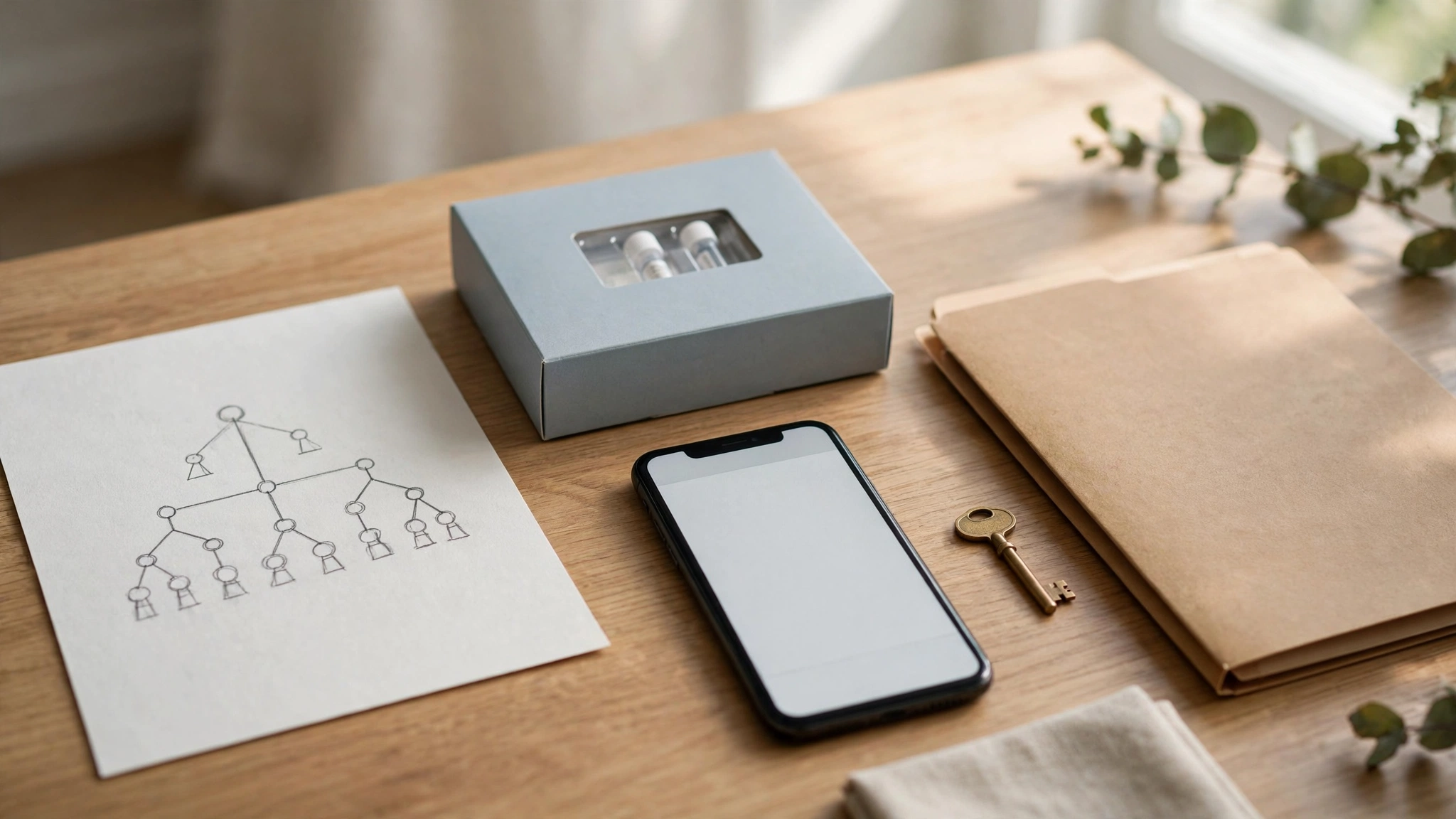
The same keeper-versus-throwaway test that governs free trials governs here, and a DNA account fails the throwaway test on every question. Will you need it in a year? Yes. Does money, identity, or recovery hang on it? Your genome and your account recovery do. Can the company reach you another way if the inbox dies? No. Three strikes, and the answer is a permanent address, full stop.
If you already registered on a temp address
If you are reading this with a sinking feeling because a kit is already sitting on a temp address, do not panic, and do not wait. The rescue only works while you can still log in and while the temp inbox still receives mail, so do it today. Log in, go to account settings, and change the account email to a permanent alias. Confirm the change from the new inbox. Add a phone number for recovery, turn on two-factor authentication, and download your raw data while you are in there. That sequence takes about ten minutes and converts a fragile account into a durable one.
If you are already locked out and the inbox is dead, do not create a second account and try to register the same kit again; a kit that is already registered will not cleanly re-register. Go to the company's support path instead: MyHeritage's Account Recovery Wizard if you remember the registered email address, or 23andMe's Customer Care if you do not. Bring everything that proves the account is yours: the order confirmation, the kit barcode, the name and birth date on the account, and the card used to buy it. Be honest about what happened. Support teams have heard the temp-email story many times, and honesty gets you through identity verification faster than a creative retelling. Slow and annoying, but recoverable for most people, and the sooner you start, the fewer results and relative matches pile up behind a door you cannot open.
The line, in the end, is simple. Disposable addresses are for signups, not for relationships, and a DNA account is one of the longest relationships you will ever open online, with the one dataset you can never change. Keep the temp email for the thousand noisy signups that deserve it. For the kit that reads your genome, use an address that will still be yours when the results, and the questions they raise, are still arriving years from now.
Frequently asked questions
Can I use a temp email for Ancestry or 23andMe?
Technically you can try, but you should not. 23andMe requires email confirmation before kit registration, Ancestry ties one email to one account, and both companies will keep contacting that address for years about results, matches, and consent. A temp inbox is likely to expire long before the relationship does, leaving you locked out of your own genetic data.
What happens if my temp inbox expires after I register a kit?
The account keeps existing, but your access to it degrades fast. Password resets, security alerts, results notices, and data-download links all go to the dead address. Recovery then means a support process with identity verification, through MyHeritage's Account Recovery Wizard or 23andMe's Customer Care, instead of a simple reset link.
Can someone else read my DNA results if I use a temp email?
Your results themselves sit behind your account password, so a stranger with only the address cannot simply open them. The risk is narrower and still real: many disposable inboxes are effectively public, so reset links, results-ready notices, and relative-match messages sent to that address can be readable by anyone who finds it, and a reset link in the wrong hands is a path into the account.
I bought a kit as a gift. Whose email should be on it?
The recipient's, on an account they control. A kit bought for another adult must be registered on that adult's own account, and after registration they can invite you to manage their test. Registering someone else's DNA under your own temp address leaves them unable to control, download, or delete their own genetic data.
Is a temp email better than nothing for DNA privacy?
It is better than handing a DNA company your main personal address for marketing purposes, but a dedicated permanent alias is better than both. The alias gives you the same marketing separation, plus an address that never expires, passes disposable-domain blocklists, and keeps password resets and consent emails working for years.
What is the safest email setup for a DNA account?
One dedicated permanent alias per DNA company, protected by a strong unique password and two-factor authentication, with a recovery phone number on file. Download your raw data while access is fresh, decide marketing, research consent, and deletion separately in the privacy settings, and check the account once a year to confirm the recovery address still works.
Need a disposable temporary email?
Protect your real inbox from spam and promotional clutter instantly and free.
Received a suspicious email, text, or charge alert?
Verify whether the sender domain is disposable, spoofed, or unverified before clicking links.