



Kaiser Permanente is one of the largest integrated managed care organizations in the United States, serving over 13.1 million members across 8 states and Washington, D.C.
If you're looking for a quick overview, here's what you need to know:
| Key Fact | Detail |
|---|---|
| Founded | July 21, 1945 |
| Headquarters | Oakland, California |
| Members Served | 13.1 million (2025) |
| Hospitals | 40 |
| Medical Facilities | 610+ |
| States Covered | CA, CO, GA, HI, MD, OR, VA, WA + D.C. |
| Annual Revenue | $127.7 billion (2025) |
| Total Employees | 243,795 (including 25,505 physicians) |
| Type | Integrated managed care consortium |
Kaiser Permanente combines health insurance, hospitals, and doctors into one connected system. That means your health plan, your doctor, and your hospital are all working together — not separately.
This model is called integrated care, and it's what sets Kaiser Permanente apart from most traditional health providers.
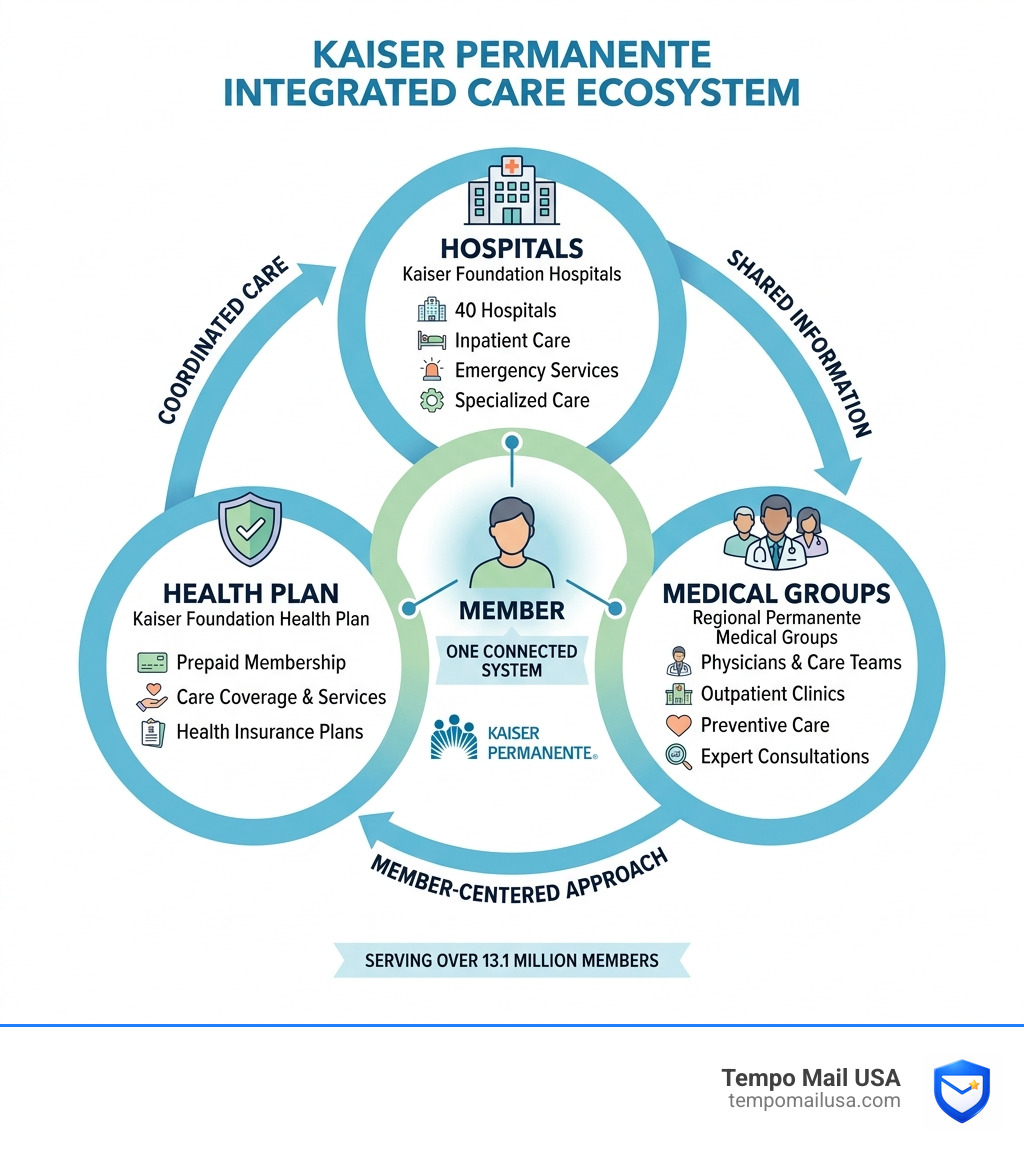
The organization runs as a consortium of three main parts: Kaiser Foundation Health Plan, Kaiser Foundation Hospitals, and regional Permanente Medical Groups. Together, they cover everything from routine checkups to emergency surgery under one roof.
It started during the Great Depression and World War II, when industrialist Henry J. Kaiser and physician Sidney Garfield created a prepaid health plan for workers building massive infrastructure projects. What began as a solution for remote construction workers eventually became the largest managed care organization in the country.
One thing worth knowing: when you sign up for a Kaiser Permanente member account or explore their plans online, you'll be sharing personal health and contact information. If you're privacy-conscious, it's worth thinking carefully about what email address you use during that process.
Organizational Structure and History

To understand kaiser permanente, you have to look at it as a three-legged stool. If one leg is missing, the whole thing falls over. The organization is technically a "consortium," which is a fancy way of saying a group of separate entities working as one.
The three core components are:
- Kaiser Foundation Health Plan, Inc.: This is the non-profit side that handles the insurance part of the equation. They collect the premiums and manage the enrollment.
- Kaiser Foundation Hospitals: Another non-profit entity that owns and operates the actual hospital buildings and medical centers.
- Permanente Medical Groups: These are for-profit partnerships or professional corporations of physicians. While the hospitals and health plans are non-profit, the doctors operate as independent for-profit groups that contract exclusively with the health plan.
Headquartered in Oakland, California, this structure allows for a unified care experience where the insurance provider and the healthcare provider aren't constantly arguing over bills. Since the physicians are generally salaried rather than paid per procedure, the incentive shifts from "doing more tests" to "keeping the patient healthy."
The History and Founding of Kaiser Permanente
The story of kaiser permanente didn't start in a boardroom; it started in the dusty California desert during the Great Depression. In 1933, Dr. Sidney Garfield noticed that thousands of workers building the Colorado River Aqueduct had no access to affordable healthcare. He set up a small hospital at "Desert Center" and initially struggled to get paid.
The breakthrough happened when he teamed up with industrialist Henry J. Kaiser. Instead of charging workers for every individual bandage or visit, they developed a "prepaid" model. Five cents a day was deducted from a worker's paycheck to cover all future medical needs. It was revolutionary.
When World War II broke out, Henry J. Kaiser applied this same model to his massive shipyards in Richmond, California, and Portland, Oregon. Tens of thousands of "Rosies" (women shipyard workers) and diverse laborers needed care fast. By the time the war ended in 1945, the plan was so popular that it was opened to the general public. On July 21, 1945, the modern version of the organization was officially born.
The Integrated Care Model: How Kaiser Permanente Works

Most of us are used to the "fragmented" model of healthcare: you see a doctor, they send you to a lab, the lab sends results to a specialist, and your insurance company denies the claim for the specialist. At kaiser permanente, that friction is mostly removed.
Because the doctors, hospitals, and insurance are all under one umbrella, they use a "Value-Based Care" model. This means they are rewarded for good health outcomes rather than the volume of patients seen.
Key features of this model include:
- Salaried Physicians: Doctors aren't rushing through appointments to bill more "units." They are paid a salary, which allows them to focus on what the patient actually needs.
- Physician-Led Leadership: At Permanente Medicine, doctors are the ones making the clinical decisions, not insurance adjusters. This physician-led approach is designed to ensure that medical expertise drives the organization's policy.
- Preventive Care: We often hear that "an ounce of prevention is worth a pound of cure." Kaiser lives by this. They proactively reach out for screenings, vaccinations, and wellness checks because keeping you out of the hospital is better for both you and their bottom line.
- Whole-Person Wellness: Their approach covers mind, body, and spirit. This includes integrated mental health services, fitness programs, and even social health initiatives like housing and food security.
Navigating Services and Locations at Kaiser Permanente
As of April 2026, kaiser permanente operates in eight primary regions. While they are most famous for their massive presence in California, they have expanded significantly across the United States.
The current service areas include:
- Northern California: Over 3.3 million members.
- Southern California: Over 3.4 million members.
- Colorado: Serving the Denver, Boulder, and Colorado Springs areas.
- Georgia: Primarily the Atlanta metropolitan area.
- Hawaii: Comprehensive care across the islands.
- Mid-Atlantic: Serving Maryland, Virginia, and Washington, D.C.
- Northwest: Covering parts of Oregon and Washington state.
- Washington: Centered around the Seattle and Puget Sound regions.
With over 734 locations, including medical offices and 40 hospitals, they have created a "one-stop-shop" environment. In many facilities, you can see your doctor, get an X-ray, and pick up your prescription at the pharmacy without ever leaving the building.
Membership, Locations, and Financial Scale
The sheer scale of kaiser permanente is hard to wrap your head around. It is the largest managed care organization in the U.S., and its financial metrics reflect that.
| Metric | 2025/2026 Data |
|---|---|
| Total Membership | 13.1 million |
| Operating Revenue | $127.7 Billion |
| Operating Income | $1.4 Billion |
| Total Employees | 243,795 |
| Nurses | 78,630 |
| Physicians | 25,505 |
| Hospitals | 40 |
| Medical Offices | 610+ |
In 2025, the organization reported a revenue of $127.7 billion. While that sounds like a massive profit, their operating income was actually a relatively modest $1.4 billion, which is often reinvested into new facilities, technology, and community health programs. This scale allows them to negotiate better prices for medications and equipment, theoretically keeping costs lower for members.
Innovation, Technology, and Challenges

kaiser permanente has always been a bit of a tech pioneer. In the 1970s, they were among the first to experiment with computerized medical records. Today, their system, KP HealthConnect, is one of the largest private electronic health record systems in the world. It allows any Kaiser doctor you see to instantly view your entire medical history, including allergies, past surgeries, and recent lab results.
Recent Innovations and Expansions
We've seen some major moves in the last couple of years:
- Risant Health: Kaiser recently launched Risant Health, a new non-profit organization designed to acquire and support other community-based health systems. This allows Kaiser to spread its integrated model to regions where it doesn't currently operate hospitals.
- Renown Health Partnership: In early 2026, a joint venture with Renown Health was solidified to expand services in Northern Nevada, with full integration expected by 2027.
- AI Care Navigation: They are currently implementing AI tools to help strengthen patient-physician connections and make care navigation more efficient.
- Mental Health Workforce: Kaiser has set a goal to license 1,000 new therapists by 2028 to address the national shortage of mental health professionals.
Controversies and Challenges
No organization this size is without its hurdles. Over the years, kaiser permanente has faced several high-profile challenges:
- Labor Disputes: With over 240,000 employees, labor relations can be tricky. There have been significant strikes by nurses and mental health clinicians over staffing levels and wage increases.
- Mental Health Access: Regulatory bodies have fined the organization in the past for long wait times for mental health appointments. They are currently under intense scrutiny to improve these services.
- Patient Dumping Allegations: In the mid-2000s, the organization faced legal trouble over allegations of "patient dumping" (discharging homeless patients to shelters or streets). This led to significant changes in their discharge policies and new community partnerships.
- Regulatory Fines: Like many large insurers, they have faced fines related to Medicare documentation and other administrative compliance issues.
Frequently Asked Questions about Kaiser Permanente
How do I sign in to my Kaiser Permanente member account?
To access your records, you can visit the member sign-in page. You will need your User ID and password. If you don't have an account yet, you'll need your medical record number (found on your ID card) to register. The portal allows you to email your doctor, view lab results, and order prescription refills for home delivery.
What states and regions does Kaiser Permanente serve?
As of 2026, they serve 8 states and the District of Columbia. The states are California, Colorado, Georgia, Hawaii, Maryland, Oregon, Virginia, and Washington. Their largest footprint remains in California, divided into Northern and Southern regions.
Is Kaiser Permanente a non-profit or for-profit organization?
It’s both! The Kaiser Foundation Health Plan and Kaiser Foundation Hospitals are not-for-profit entities. However, the Permanente Medical Groups (the doctors) are for-profit professional corporations. This unique hybrid structure is what allows them to function as a "consortium."
Conclusion
Kaiser Permanente remains a titan in the American healthcare landscape. By integrating insurance and medical care, they've created a model that prioritizes prevention and collaboration. From its industrial roots in the shipyards to its modern AI-driven care navigation, the organization continues to evolve to meet the needs of its 13.1 million members.
Whether they are launching new initiatives like Risant Health or building new oncology wings, their focus remains on "whole-person" care. However, as they grow, the challenges of maintaining labor harmony and ensuring rapid mental health access remain top priorities.
As you navigate health insurance and medical providers, your data is valuable. When signing up for new services or managing your health online, consider how you share your personal information. At Tempo Mail USA, we believe in providing a layer of protection between your real identity and the digital services you use. By using secure email aliases, you can shield your personal PII (Personally Identifiable Information) from potential data breaches or unwanted tracking.