
How to Generate a Random Fake Email Address in Seconds

Your Real Inbox Is Worth Protecting — Here's How a Random Fake Email Helps
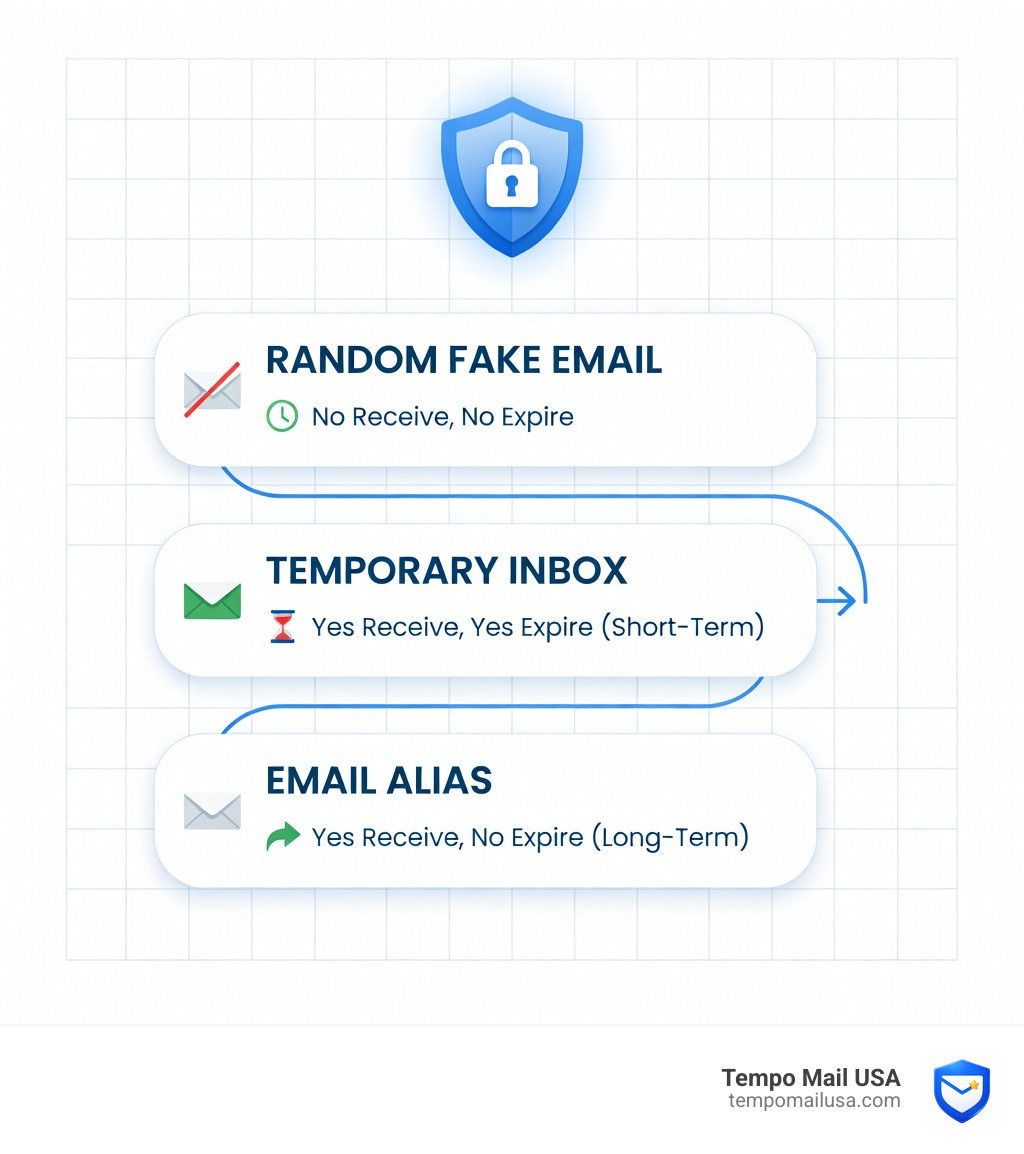
What is a random fake email? A random fake email is a fictional, syntactically correct address used as a placeholder in forms or databases. It protects your privacy by ensuring your real email is never exposed to potential spam or data leaks.
| Type | Can Receive Mail? | Expires? | Best For |
|---|---|---|---|
| Random fake email | No | No | Testing, placeholders, form data |
| Temporary inbox | Yes | Yes (10 min – 3 hrs) | Sign-ups, trials, verification |
| Email alias | Yes | No | Long-term privacy, forwarding |
Think about how often you hand over your email address. Nearly 99% of apps and services ask for one just to let you in. That's a lot of opportunities for spam, data breaches, and unwanted tracking to find their way to your real inbox.
The average person signs up for dozens of services a year. Most of those services will send you marketing emails. Some will suffer data breaches. A few will sell your address outright.
A random fake email puts a barrier between you and all of that.
Whether you want to skip the spam, test a web app safely, or just avoid handing your personal information to a site you'll never visit again — fake email addresses are a simple, free solution that more people should be using.
The Ultimate Guide to Using a Random Fake Email
Why use a random fake email? Using a fake address provides immediate anonymity, prevents marketing fatigue, and mitigates the risk of identity theft during data breaches. It acts as a digital shield for your primary inbox.
We live in an era where our email address is essentially our digital passport. It’s linked to our bank accounts, our social media, and our private conversations. Yet, we hand it out to every coffee shop, newsletter, and "free" ebook site we encounter. This is where a random fake email becomes your best friend.
A "dummy mailbox" or a fake address acts as a shield. By using one, you maintain total anonymity. You don't have to worry about a marketing department selling your data or a hacker finding your real login credentials in a leaked database. What is Temporary Email and How It Works is a concept built on the idea of immediate utility without the long-term baggage.
To help you decide which tool is right for your specific situation, we've put together a comparison of the three main types of "not-real" emails:
| Feature | Random Fake Email | Temporary Inbox | Email Alias |
|---|---|---|---|
| Primary Goal | Syntax/Data Testing | One-time Verification | Long-term Privacy |
| Inbox Access | None | Public/Short-lived | Private/Forwarded |
| Anonymity | High | Medium | High |
| Setup Time | Instant | Instant | Seconds |
| Best For | Developers/QA | Free Trials | Shopping/Newsletters |
How Random Email Generators Work
You might wonder how these tools come up with addresses like j.doe83@example.com or x7y2z9@testmail.org so quickly. It’s all down to algorithm logic. Most generators use a script to pull from various data pools. Some use random strings of alphanumeric characters, while others focus on "pronounceable IDs"—combinations of consonants and vowels that look like real names but are entirely unique.
Understand How Temporary Email Works for Privacy by realizing that these tools often tap into US name databases to create realistic-sounding personas. They also offer a wide variety of domains. While many use common ones like Gmail or Yahoo for realism, others use "test" domains like @example.com.
The probability that a truly random, 10-character ID is already a registered, real email address is incredibly low—often cited as a 99.99% chance of being unregistered. This makes them perfect for "burners" because you aren't accidentally spamming a real person named Gertrude87.
How to generate a random fake email for testing
If you are in QA engineering or software development, you know the pain of needing 500 unique users to test a new registration flow. You can't use your own email 500 times!
- Select your quantity: Many tools allow you to generate bulk lists—sometimes up to 10,000 addresses at once.
- Choose your format: Do you need them to look like real names (e.g.,
first.last@domain.com) or random strings? - Export: Most professional tools let you download the list as a CSV or Excel file so you can pop them straight into your mock data database.
Are random fake email addresses real or fictional?
It is important to distinguish between a "fake" email and a "disposable" one. A random fake email is typically non-functional. It is a fictional string of text that follows email syntax (something@something.com).
These are used for:
- UI Demos: Showing a client how a profile page looks without using real user data.
- Syntax Testing: Ensuring your code correctly identifies a valid email format versus a typo.
- Placeholder Data: Filling up a database to see how it handles large volumes of entries.
Because they don't have an actual server behind them, they will result in a delivery failure if you try to send them a message. If you need to actually receive a verification code, you should look into temporary inboxes or aliases instead.
Why You Should Use Fake Addresses Instead of Your Real One
Marketing fatigue is real. Every time you want to see a price or download a coupon, you're hit with a popup demanding your email. Why You Should Use Temporary Email for Safe Signups is simple: it stops the cycle before it starts.
Think about store loyalty cards. They offer you 10% off in exchange for your email, then proceed to send you three emails a day for the next five years. By using a random fake email, you get the discount without the digital clutter. It’s also the perfect way to extend "one-time" free trials for streaming services or software.
There’s also a significant security risk to "subaddressing" (also known as the plus trick, like myname+netflix@gmail.com). While services like have i been pwned can tell you if your data has been leaked, the plus trick actually makes it easier for advertisers to track you. They can simply strip away the "+netflix" part to find your real, primary address. A truly random fake email or a professional alias doesn't leave that trail.
Best Practices for Managing Multiple Disposable Addresses
If you start using different addresses for different services, things can get messy. We recommend a "compartmentalization" strategy. Use one set of addresses for "low-stakes" stuff like one-time coupons, and another for "medium-stakes" stuff like newsletters you actually enjoy.
Get a One-Time Email Address and Ghost the Spammers by rotating your addresses regularly. If you notice one specific address is starting to get a lot of junk, simply delete it or stop using it.
For the best experience, we suggest you create a free Tempo Mail USA account. Unlike public generators, a professional service gives you a private dashboard to manage your aliases. You can see which services are sending you mail and "turn off" any address that becomes a liability.
Security Considerations:
- Avoid Public Inboxes for Sensitive Data: Never use a public "10-minute mail" service for bank accounts or anything involving your PII (Personally Identifiable Information). Anyone who knows the address can often see the inbox.
- Use Browser Extensions: Many services offer extensions that let you generate a random fake email with a single click right in the signup field.
- Record Your Usage: If you use a fake email for a service you might need to log back into, make sure you save that address in a password manager.
Frequently Asked Questions about Disposable Mail
Can a random fake email receive actual messages?
No. A pure random fake email is a non-functional text string used for placeholders. To receive messages, you must use a temporary email service or an email alias. What is Temporary Email? Key Insights and Comparisons explains that functional temporary inboxes usually expire after 10 minutes to 3 hours.
Are there risks to using a free random email generator?
Yes. Some free services may log your IP address or data. Additionally, public inboxes are not private; anyone with the address can see the messages. Always understand how temporary email works for privacy before using it for sensitive accounts.
How many fake emails can I generate at once?
Most web tools generate 1-50 addresses, but professional developer tools can generate up to 10,000 in bulk. You can discover reliable disposable emails that work efficiently by using services that offer CSV or JSON export options.
Conclusion
Your privacy is a right, not a luxury. When every click is tracked and every signup is a potential data leak, taking control of your digital identity is essential. Using a random fake email is the first step toward reclaiming your inbox.
At Tempo Mail USA, we act as your personal privacy firewall. We provide secure email alias generation that proxies your identity, shielding your real personal data from third-party services. By using our tools, you can enjoy the internet's many services without the fear of spam or identity theft.
Don't wait for the next big data breach to wish you had protected yourself. Protect your identity today with Tempo Mail USA and start browsing with the confidence that your real address is safe and sound.
Related: Once you can generate the address, the next step is using it well — read Fake Email for Sign Up: Use a Throwaway Inbox Without Losing the Account for the signup-form walkthrough, what to do when a form rejects your address, and when never to use a throwaway inbox.
Need a disposable temporary email?
Protect your real inbox from spam and promotional clutter instantly and free.
Received a suspicious email, text, or charge alert?
Verify whether the sender domain is disposable, spoofed, or unverified before clicking links.