

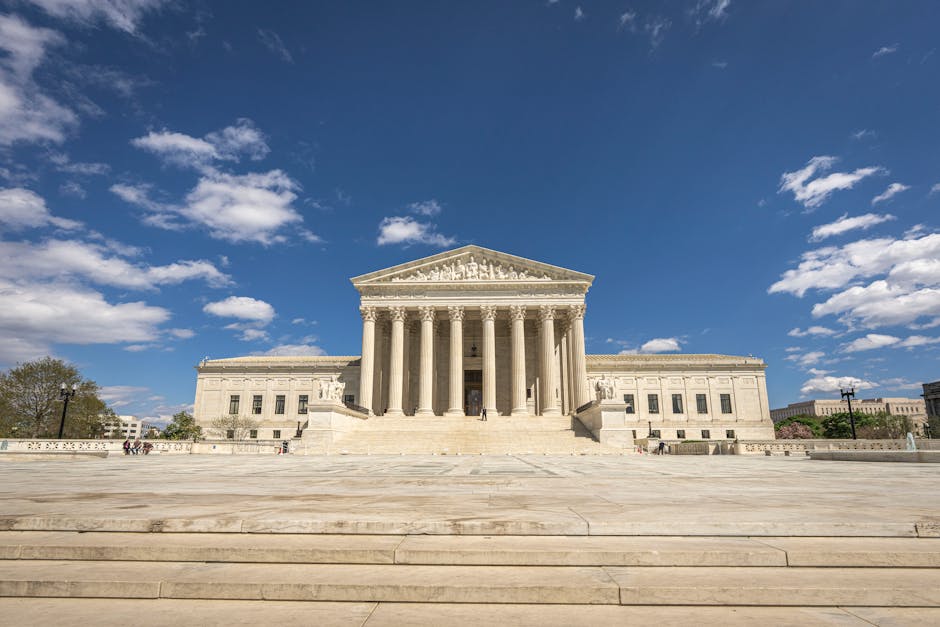

What You Should Know About How Many Justices Are on the Supreme Court
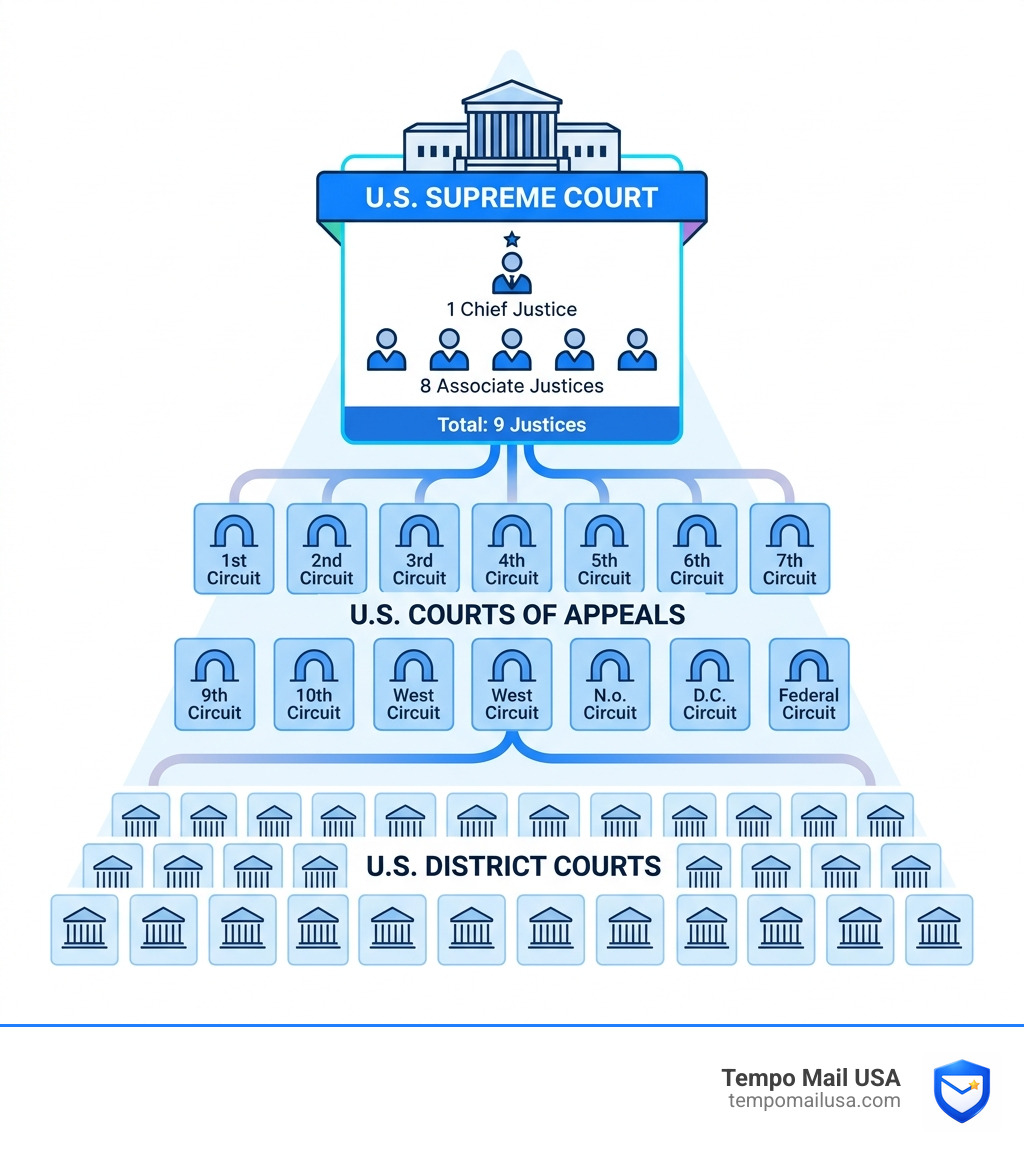
How many justices are on the Supreme Court? The answer is nine — one Chief Justice and eight Associate Justices.
Here's the quick breakdown:
| Role | Number |
|---|---|
| Chief Justice | 1 |
| Associate Justices | 8 |
| Total Justices | 9 |
The nine-justice count has been the law of the land since 1869. It is not set by the Constitution — Congress decides the number through federal statute (28 U.S.C. §1).
The Supreme Court sits at the very top of the U.S. federal judiciary. It has the final say on what the Constitution means. Every law, executive action, and lower court ruling can ultimately be reviewed here.
That's a lot of power concentrated in nine people with lifetime appointments.
This article walks you through nine things worth knowing about the Court's size, structure, and the people who serve on it — from the history behind the number to the debates happening right now about changing it.
1. The Current Count: How Many Justices Are on the Supreme Court Today?
As of May 2026, the U.S. Supreme Court consists of exactly nine justices. This roster is composed of one Chief Justice, who acts as the administrative head of the federal judiciary, and eight Associate Justices. While they all have an equal vote in cases, the Chief Justice holds certain unique ceremonial and administrative duties.
This specific number isn't just a suggestion; it is codified in federal law. Specifically, 28 U.S.C. §1 states that "The Supreme Court of the United States shall consist of a Chief Justice of the United States and eight associate justices." You can find the Official list of Justices on the Court's website, which serves as the authoritative record of who is currently sitting on the bench.
Why the number of justices on the supreme court matters
You might wonder why we care if there are nine, seven, or fifteen justices. The reason lies in the Court's immense power of judicial review. Established in the landmark 1803 case Marbury v. Madison, judicial review allows the Court to declare acts of Congress or actions by the President unconstitutional.
As the final arbiter of the law, the Court ensures that the American legal system provides "Equal Justice Under Law." Because the Court interprets the Constitution in ways that affect every citizen's daily life—from privacy rights to environmental regulations—the ideological balance of these nine individuals is one of the most closely watched aspects of the American government.
Quorum requirements and voting
To actually conduct business, the Court doesn't always need all nine members present, but it does need a quorum. By statute, a quorum consists of six justices. If fewer than six are available (due to vacancies or recusals), the Court cannot decide the case.
When it comes to winning a case, a simple majority is required. In a full house of nine, that means five votes. If there is a tie (which can happen if a seat is vacant or a justice sits out), the lower court's ruling is upheld, but no national precedent is set. This is why having an odd number of justices is generally preferred—it prevents the "deadlock" that would occur with an even-numbered bench.
2. The History of the "Magic Nine" and the Judiciary Act of 1869
It might surprise you to learn that the "nine" we are so used to today wasn't always the standard. In fact, the Constitution is surprisingly silent on the matter. It mandates that a Supreme Court exists but leaves it up to Congress to decide how many people should sit on it.
The Historical background of the Court shows a roller coaster of changes during the 19th century.
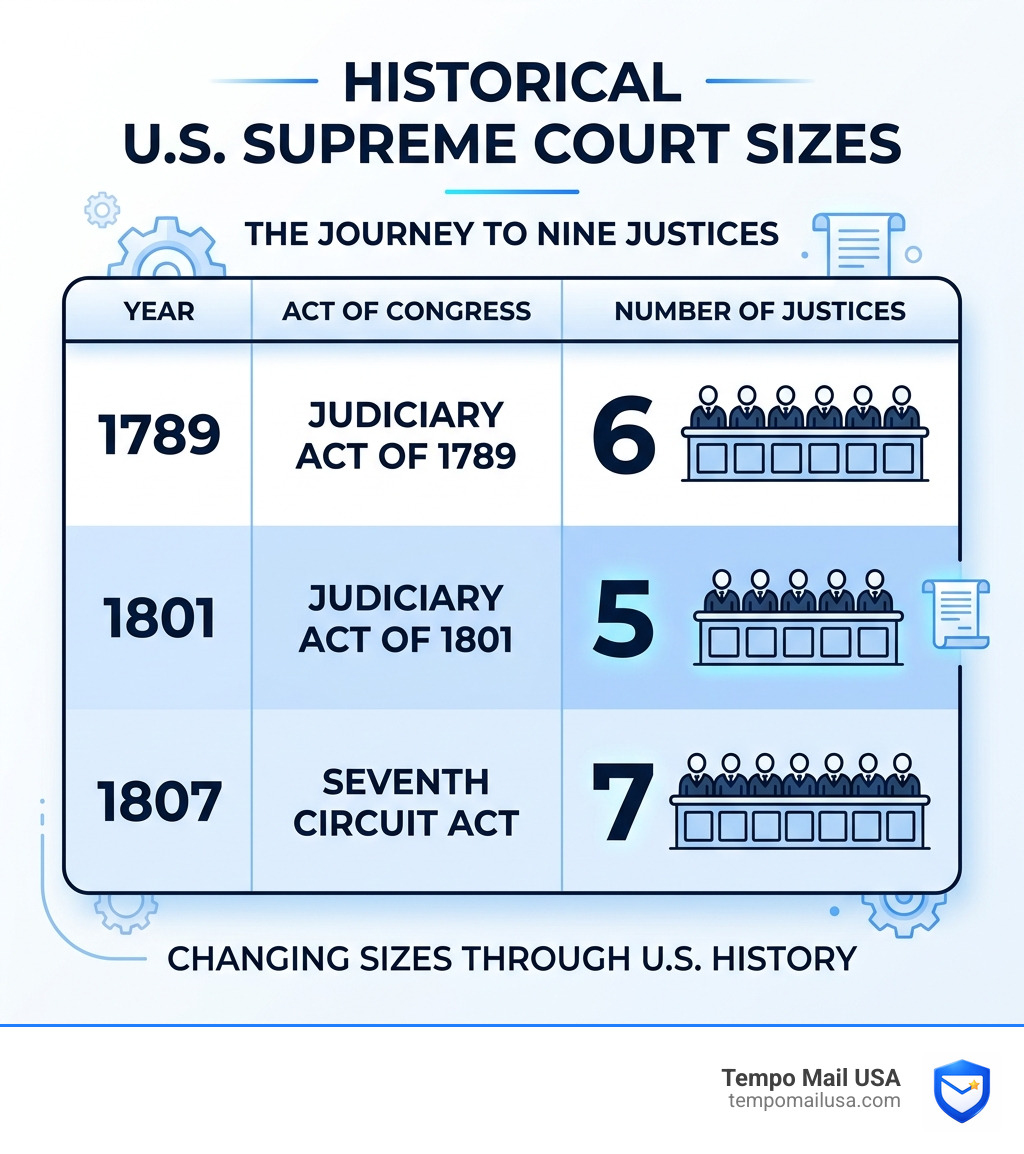
| Year | Act of Congress | Number of Justices |
|---|---|---|
| 1789 | Judiciary Act of 1789 | 6 |
| 1801 | Judiciary Act of 1801 | 5 |
| 1807 | Seventh Circuit Act | 7 |
| 1837 | Eighth and Ninth Circuits Act | 9 |
| 1863 | Tenth Circuit Act | 10 |
| 1866 | Judicial Circuits Act | 7 |
| 1869 | Judiciary Act of 1869 | 9 |
The number often changed for purely political reasons. For example, in 1866, Congress reduced the number of seats from ten to seven specifically to prevent President Andrew Johnson from appointing any new justices. Once Johnson left office, Congress promptly passed the Judiciary Act of 1869, which set the number back to nine. It has remained there for over 150 years.
3. Meet the Bench: Who Are the Current Supreme Court Justices?
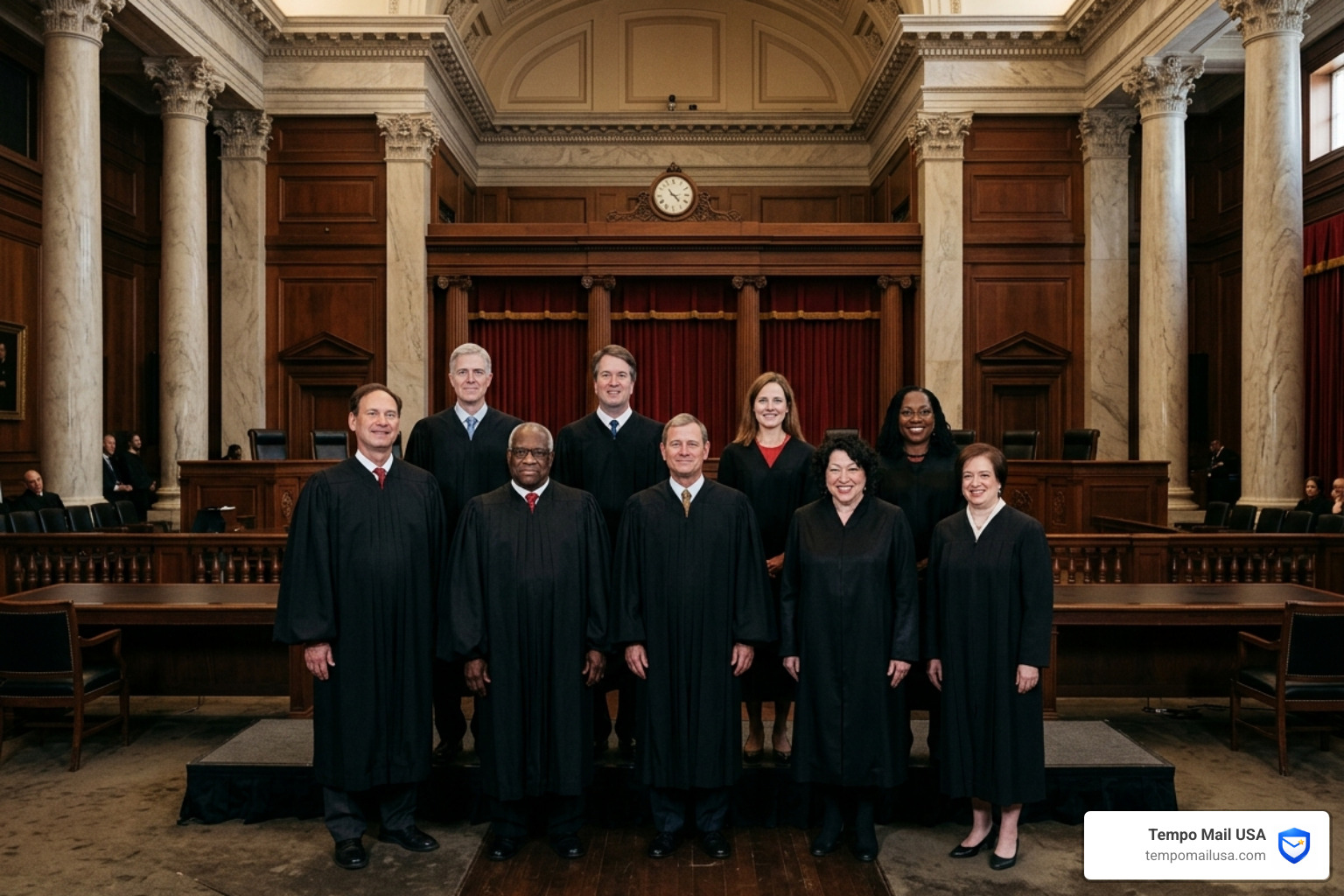
As we look at the bench in May 2026, the Court is led by Chief Justice John G. Roberts, Jr., who has served in that role since 2005. Following him in order of seniority are the Associate Justices. Here is the current lineup:
- John G. Roberts, Jr. (Chief Justice): Appointed by George W. Bush.
- Clarence Thomas: The longest-serving justice currently on the bench, appointed by George H.W. Bush.
- Samuel A. Alito, Jr.: Appointed by George W. Bush.
- Sonia Sotomayor: Appointed by Barack Obama.
- Elena Kagan: Appointed by Barack Obama.
- Neil M. Gorsuch: Appointed by Donald Trump.
- Brett M. Kavanaugh: Appointed by Donald Trump.
- Amy Coney Barrett: Appointed by Donald Trump.
- Ketanji Brown Jackson: Appointed by Joe Biden in 2022.
For more detailed information on their professional backgrounds, you can view the Biographies of current members on the official SCOTUS website.
Demographic diversity among the justices on the supreme court
The composition of the Court has changed drastically in terms of demographics. While the first 100 years featured a fairly homogenous group, the modern Court is more diverse than ever. We currently see a significant number of women on the bench and representation from various ethnic backgrounds.
However, one area where the Court remains less "diverse" is in education. For decades, nearly every justice graduated from either Harvard or Yale Law School. Justice Amy Coney Barrett (Notre Dame) broke this "Ivy League" streak recently. According to the Supreme Court FAQ, historical "firsts" like Thurgood Marshall (first African American) and Sandra Day O'Connor (first woman) paved the way for the current multi-faceted bench.
4. Lifetime Appointments and the Path to the High Court
Unlike the President or members of Congress, Supreme Court justices do not have term limits. Under Article III of the Constitution, they hold their offices during "good Behaviour," which effectively means a lifetime appointment.
The process to become one of the nine is rigorous:
- Presidential Nomination: The President selects a candidate.
- Senate Judiciary Committee Hearing: The candidate undergoes intense questioning.
- Senate Confirmation: The full Senate votes. A simple majority is required for "advice and consent."

This lifetime tenure was designed to ensure judicial independence. The Founders wanted justices to make decisions based on the law, not on the fear of being fired by a politician or losing an election. A justice can only be removed through impeachment by the House and conviction by the Senate—a feat that has only been attempted once in history (against Samuel Chase in 1805, who was acquitted).
5. Modern Debates: Will the Number of Justices Change?
Just because the number has been nine since 1869 doesn't mean it's set in stone. In recent years, the conversation around "court-packing" has resurfaced. This term refers to the idea of increasing the number of justices to change the ideological lean of the Court.
This isn't a new idea. In 1937, President Franklin D. Roosevelt famously proposed a plan to add a new justice for every sitting justice over the age of 70 (up to a total of 15 justices). He was frustrated that the Court was striking down his New Deal legislation. The plan was widely unpopular and failed, but it remains a cautionary tale in the History of Supreme Court Justices.
As of May 2026, debates continue. Some advocates suggest moving to 13 justices to match the number of federal appellate circuits, while others propose 18-year term limits to ensure regular turnover. Critics argue that changing the number for political reasons would destroy the Court's legitimacy.
Frequently Asked Questions about the Supreme Court
How many justices have served in total?
Throughout U.S. history, there have been a total of 116 justices. This includes 17 Chief Justices and 104 Associate Justices (some individuals served in both roles at different times). This relatively small number over nearly 250 years highlights just how stable the Court has been compared to other branches of government.
What is the average length of a justice's tenure?
On average, a justice serves for about 16 years. However, this varies wildly. William O. Douglas holds the record for the longest service at over 36 years. On the other end of the spectrum, some justices have served for less than a year due to health issues or unexpected deaths. In the modern era, justices are generally appointed younger and serve longer than they did in the 18th century.
Can the President fire a Supreme Court justice?
No. The President has no power to remove a justice once they are confirmed. This is a core feature of the separation of powers. The only way a justice leaves the bench is through death, voluntary retirement, resignation, or the congressional impeachment process.
Conclusion
Understanding how many justices are on the Supreme Court is about more than just remembering the number nine. It’s about understanding a system designed for stability, independence, and the careful interpretation of our nation’s highest laws. From the Judiciary Act of 1869 to the diverse bench we see today in 2026, the Court remains the final guardian of the Constitution.
Just as the Supreme Court acts as a final safeguard for the law, we at Tempo Mail USA believe in providing a final safeguard for your personal information. In an age where public records and digital footprints can expose your most private details, our temporary email aliases act as a firewall. By shielding your real PII (Personally Identifiable Information) from services and public databases, we help you maintain the "privacy and security" that every citizen deserves.
Whether you're researching the high court or just signing up for a new newsletter, stay protected. Secure your identity with Tempo Mail USA and keep your real data off the bench.