

Half the Homepage Is the Same Story Twice: A Repeat Audit of ShortNews

You know the feeling from somewhere else entirely. You scroll a feed, you see a headline, you scroll a little more, and there it is again — same story, different slot, as if the page forgot it already showed it to you. On a social feed you shrug; the feed is infinite and nobody promised otherwise. On a short-news homepage, the repeat matters more, because the whole promise is compression. "News in 60 words. Zero noise." "Stay informed in under 5 minutes a day." If half the page is the same story twice, then the five minutes are not buying you as much news as the promise implies. So I did the dull, honest thing: I opened the ShortNews demo homepage, and I counted. Not the words this time — the stories.
ShortNews is a short-news website script, and its live demo is the same one this series audited for word counts two days ago. That audit found the cards shorter than the promise — 10 to 24 words against a 60-word ceiling — and mostly honest about it. This audit asks the next question, the one a reader only notices on a second visit: how much of this homepage is actually new?
First, the count: 27 slots, 15 stories
Here is the method, because a count without a method is just a number I typed. I went through the demo homepage top to bottom and wrote down every news-card slot: the featured story at the top, the three cards beside it, the twelve word-counted cards in the main grid, the three single-appearance cards further down (one each for Health, Entertainment, and Science), and the eight cards in the closing list. I did not count the swipeable web stories — the "7 Breathtaking Space Discoveries" listicles — because they are a different format, and mixing them into the count would have muddied it. Twenty-seven news-card slots. Then I counted the distinct headlines among them. Fifteen.
Twelve slots, nearly half the page, show a headline the page already showed. That is the finding, stated plainly before any interpretation: on the demo homepage, as fetched today, 27 slots carry 15 stories. A reader who scrolls the whole page reads twelve cards they have already read.
Now, before anyone over-reads this, let me say what it is not. It is not proof that the script forces repetition. Demo data is seeded by hand, and seeded catalogues repeat for boring reasons: a small pool of sample stories, sections built by copying a block, a list widget pulling "latest" without excluding what the featured slot already showed. Nothing on the homepage says the repetition is a feature. A live site with a hundred real stories would not repeat at this rate. I am not claiming the product is broken. I am claiming the demo — the only thing a visitor can inspect — teaches a reader something its promise does not mention: scrolling further does not keep teaching you new things at the rate the first screen suggests.
And there is a second, smaller honesty point inside the count. The first screen is the most efficient part of the page. The featured story, the three top cards, and the twelve grid cards together contain twelve of the fifteen unique stories. The other three — the health study, the blockbuster sequel, the exoplanet image — sit further down, past the swipeable stories. So the reader who stops after the grid has missed only those three. The reader who scrolls to the bottom has spent extra time to re-read the AI story, the Mars video, the AI chip, the foldable phones, the championship, the rookie, the Olympics, and the underdog upset. Scrolling, on this page, is mostly re-reading.
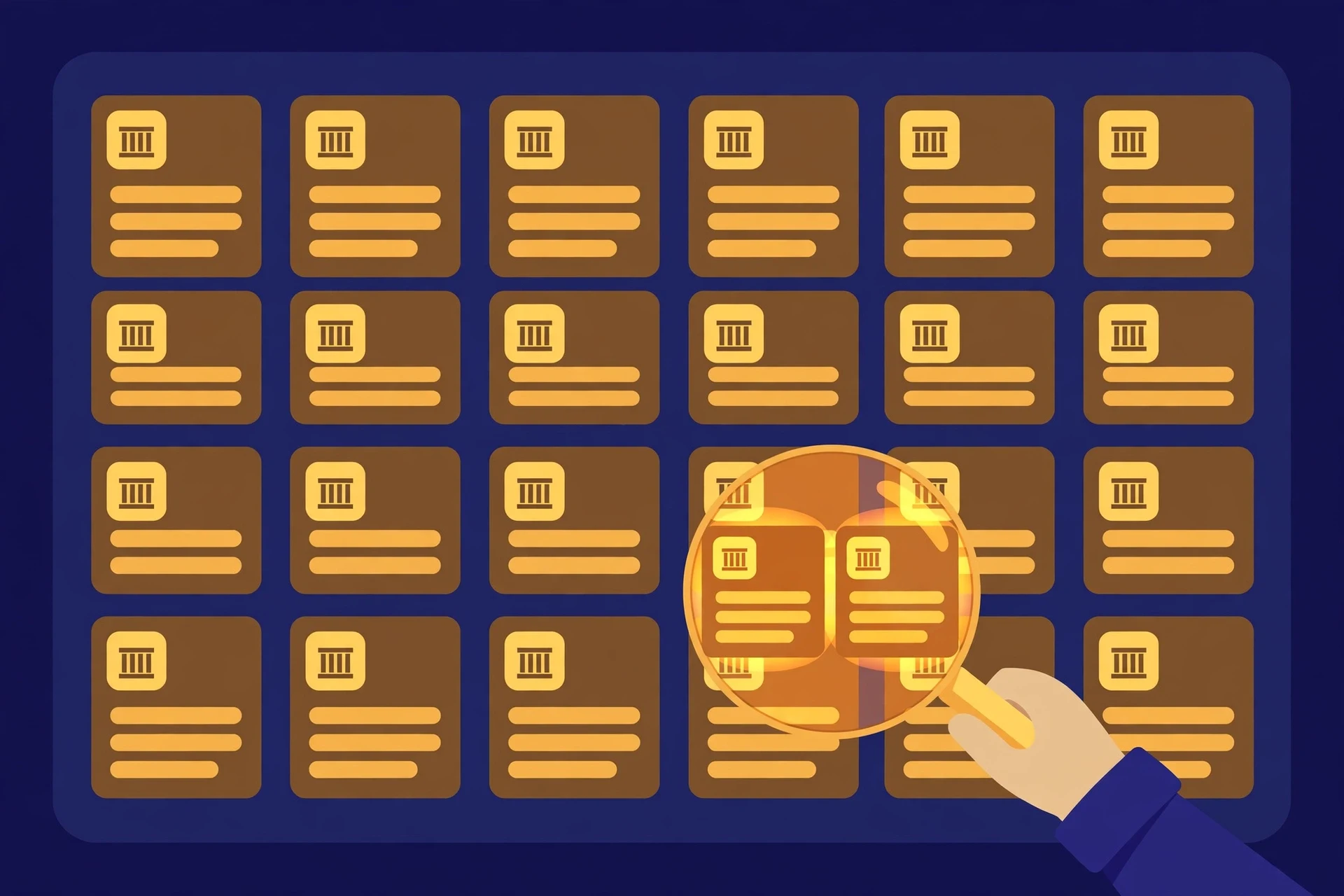
Where the repeats hide: a map of the page
Repetition is not evenly spread, and the unevenness is the interesting part. The AI story appears three times: as the featured story, again in the grid, and again in the closing list. The AI chip story appears three times too. The championship, the rookie, the Olympics, the underdog upset, the foldable phones, and the Mars video each appear twice or three times across the same three zones. The markets rally appears in the top cards and again in the grid, carrying its BREAKING tag both times.
The pattern is architectural, not accidental-looking. The page is built from sections — featured, latest, trending, more — and each section pulls from the same small pool without, apparently, excluding what another section already showed. That is a normal way to build a demo: write fifteen sample stories, wire four sections to the same pool, and every section looks full. On a live site with real volume, the same architecture behaves differently, because the pool is deep enough that sections rarely collide. But the demo is what a visitor sees, and what a visitor sees is a page whose sections disagree about what "latest" means. The top says these are the top stories. The grid says these are the stories. The closing list says these are more stories. They are, to a large extent, the same stories, and a reader who trusts the section labels will believe they have read more news than they have.
The repeats are not random: the page has a shape

Count the 27 slots by category and the page stops looking like a general news diet at all. Technology takes 12 slots. Sports takes 9. Business takes 3. Health, Entertainment, and Science take 1 each. Technology plus Sports is 21 of 27 — just under four-fifths of the page. The previous audit in this series noticed the technology lean qualitatively; counting it makes it starker, because the lean survives even after you remove the repeats. Count unique stories by category instead and the shape holds: of the fifteen distinct stories, six are technology, four are sports, two are business, and one each is health, entertainment, and science. Repetition amplifies the skew, but it does not create it. The pool itself is tech-and-sports heavy.
Again, the honest caveat first: demo seeding explains a lot of this. Technology stories are the easiest sample stories to write, and sports results compress beautifully into short cards, which is why both categories dominate a hand-seeded demo. I will not claim the script forces this mix, because nothing on the page says so, and the category list itself — Technology, Sports, Business, Health, Entertainment, Science — is a perfectly reasonable general-news spread. The mix is a property of this demo's sample data, not necessarily of the product.
But the reader's problem does not care about the cause. A reader does not experience "the demo's seeding choices". A reader experiences a homepage that is four-fifths technology and sports, and a reader who reads that homepage every morning for a month would come away fluent in chip announcements and scoring records and vague on everything else — not because the site hid the other categories, but because the homepage showed them technology and sports first, most, and largest. The previous audit's advice stands, and the count strengthens it: use the category links, do not just scroll the homepage. Categories are the only part of the site that lets you choose your diet instead of accepting the homepage's. And from the operator's side, the count suggests a cheap editorial rule worth more than any feature: guarantee each category a slot on the first screen, and exclude stories already shown above from the sections below. Both rules are one line of logic each, and both would have turned this demo's 27 slots into something much closer to 27 stories.
There is also a small placeholder tell worth naming. The "Watch: Mars Mission" card's thumbnail is not the demo's own media at all — the page source shows it served from a YouTube thumbnail address. Demos borrow images constantly, so on its own this means nothing. But it is a reminder of what a demo is: a stage set, not a newsroom. Its dates run Oct 13–19, 2026, while its title promises summaries "updated every few minutes". Those two facts cannot both describe a live newsroom, and nobody should expect them to — demo data is frozen by definition. Freshness, like breadth, is something a demo cannot prove, and a reader should not credit it until a live site does.
What repetition costs the reader
So what does a repeated card actually cost? Start with time, because time is the product's own unit. The promise is "informed in under 5 minutes a day", and five minutes is roughly the time to read the homepage's cards once. But that arithmetic assumes every card is new. If twelve of twenty-seven slots are repeats, a reader who scrolls the whole page spends nearly half their reading time re-reading, and the five minutes buys fifteen stories' worth of information, not twenty-seven. The promise is not false — fifteen short stories in five minutes is still a real briefing — but it is thinner than the page's length suggests, and a reader who judges the site by how far they scrolled will overestimate how much they learned.
The second cost is subtler: repetition feels like importance. A story you meet three times on one page feels bigger than a story you meet once, even when the only reason you met it three times is that three sections pulled from the same pool. The AI story is the featured story, a grid card, and a closing-list card, so it reads as the story of the day. The exoplanet image appears once, at the bottom, so it reads as a footnote. That ranking may be entirely accidental — an artefact of which sample stories were written first — but the reader experiences it as editorial judgement. A homepage that repeats its pool is, without meaning to, telling its readers what matters, and the telling is driven by seeding order rather than news judgement.
The third cost is trust, and it is the one that compounds. A reader who notices the repeats — usually on the second or third visit, as a vague "haven't I read this already?" — starts to discount the whole page. Not dramatically, but in the way that matters for a habit product: the next morning, the page feels a little less worth opening. Short-news sites live or die on the morning habit. A page that teaches its readers, quietly, that scrolling further mostly re-shows them what they already saw is teaching them to stop scrolling, and then to stop coming. The fix is cheap, which is what makes it worth naming: deduplicate across sections, and the page instantly feels deeper without a single new story being written.
What this demo cannot tell us
Honesty requires the other half of the ledger. This audit inspected one homepage, once, from the outside. It did not open a story page, so it cannot say whether tapping a repeated card leads to the same article or to different angles on the same story — a distinction that would soften the finding if the story pages differed. It did not inspect an admin panel, so it cannot say whether the script offers deduplication or section-exclusion controls a live operator would switch on. It did not subscribe to the newsletter, and it cannot say anything about price or licence, because the shop's front page carries no ShortNews listing today and this series does not invent prices. What the audit can say is narrower, and it is enough: as a visitor experiences it today, the demo homepage's breadth is smaller than its length, its category mix is narrower than its category list, and its section labels promise more novelty than its sections deliver. All of that is checkable by anyone with the same URL and ten minutes.
Run this audit on any short-news site in ten minutes
You do not need my word for any of this, and you do not need a tool. Open any short-news homepage and do what I did. First, count the slots: every card, top to bottom, excluding listicles and story formats if they are a separate product. Second, count the distinct headlines. If the second number is much smaller than the first, the page is repeating, and the gap is the size of the illusion. Third, count the slots by category, and then the distinct stories by category. If one or two categories dominate both counts, the skew is in the pool, not just the layout. Fourth, check the dates: a page that promises freshness should carry today's stories. Fifth, check one repeat: tap the same headline in two sections and see whether you land on the same article. If you do, the repeat is pure duplication. If you do not, the site is doing something smarter than its homepage suggests, and it deserves the credit.
And the habit to take from this site applies here too: test small before you commit. A short-news diet is a commitment of attention, not money, but attention is the scarcer currency. Read a site for three mornings before you make it your morning briefing. First mornings are always the best behaved. Third mornings show you the real diet — and by the third morning you will know whether the page is informing you or merely keeping you busy.
Frequently asked questions
Is ShortNews a real product I can buy? ShortNews is a short-news website script with a live demo at shortnews-demo.codester.shop. Its demo promises "News in 60 words. Zero noise." and a daily briefing "in under 5 minutes". No price is stated in this article because the shop's front page carried no ShortNews listing when checked today — check the shop itself before assuming a price.
How many stories does the demo homepage actually contain? Twenty-seven news-card slots carrying fifteen distinct headlines, as counted from the demo homepage on 2026-11-04. Twelve slots repeat a headline already shown higher on the same page. The swipeable web stories are a separate format and were not counted in either number.
Does repetition mean the script is bad? No. Repetition on a demo most likely reflects hand-seeded sample data and sections pulling from the same small pool without excluding already-shown stories. A live site with real story volume would repeat far less. The finding is about what a visitor sees on the demo today, not a verdict on the script's code, which was not inspected.
Which categories dominate the demo? Technology (12 of 27 slots) and Sports (9 of 27). Together they are just under four-fifths of the page. Counting distinct stories gives the same shape: six technology, four sports, two business, and one each for health, entertainment, and science.
Can a reader avoid the repeats? Mostly, yes: stop after the main grid and use the category links instead of scrolling to the closing list, which on this demo contains no new headlines at all. The three single-appearance stories (health, entertainment, science) sit past the web stories, so a reader who wants breadth should jump to categories rather than scroll.
How is this different from the earlier ShortNews post in this series? The earlier post, linked below, counted words on the cards — 10 to 24 words against a 60-word ceiling — and asked what such short summaries can carry. This post counts stories on the page — 27 slots against 15 headlines — and asks how much news the page actually delivers. Different count, different question, same demo.
Who should not run a short-news site
If your catalogue is small, do not launch with a homepage built from four sections pulling from the same pool — the repeats will be visible on day one, and your earliest visitors will learn that scrolling is pointless. Either seed a deeper catalogue first, or build the homepage from one section until the pool can fill four. If your editorial strength is breadth — a local paper, a niche journal, a community digest — a short-news format will fight you: the format rewards results (a score, a beat, a record) and starves explanations, and your readers will notice the starvation before they notice the speed. And if you cannot commit to deduplication as an editorial rule, do not promise "zero noise": on a page like this one, the noise is not length. The noise is the same story, a second and third time, dressed as more news.
Judge a short-news page by its distinct stories, not its slots. Fifteen stories in five minutes is a fine briefing, honestly labelled. Twenty-seven slots pretending to be twenty-seven stories is not.
Earlier in this series: Count the Words Before You Trust the News: A 60-Word Test of ShortNews — the word-count audit of the same demo. And the most recent script post: Plans Changed? What Moving a Doctor Appointment Really Tests About a Booking Site. The blog index carries the full series.*
Need a disposable temporary email?
Protect your real inbox from spam and promotional clutter instantly and free.
Received a suspicious email, text, or charge alert?
Verify whether the sender domain is disposable, spoofed, or unverified before clicking links.