

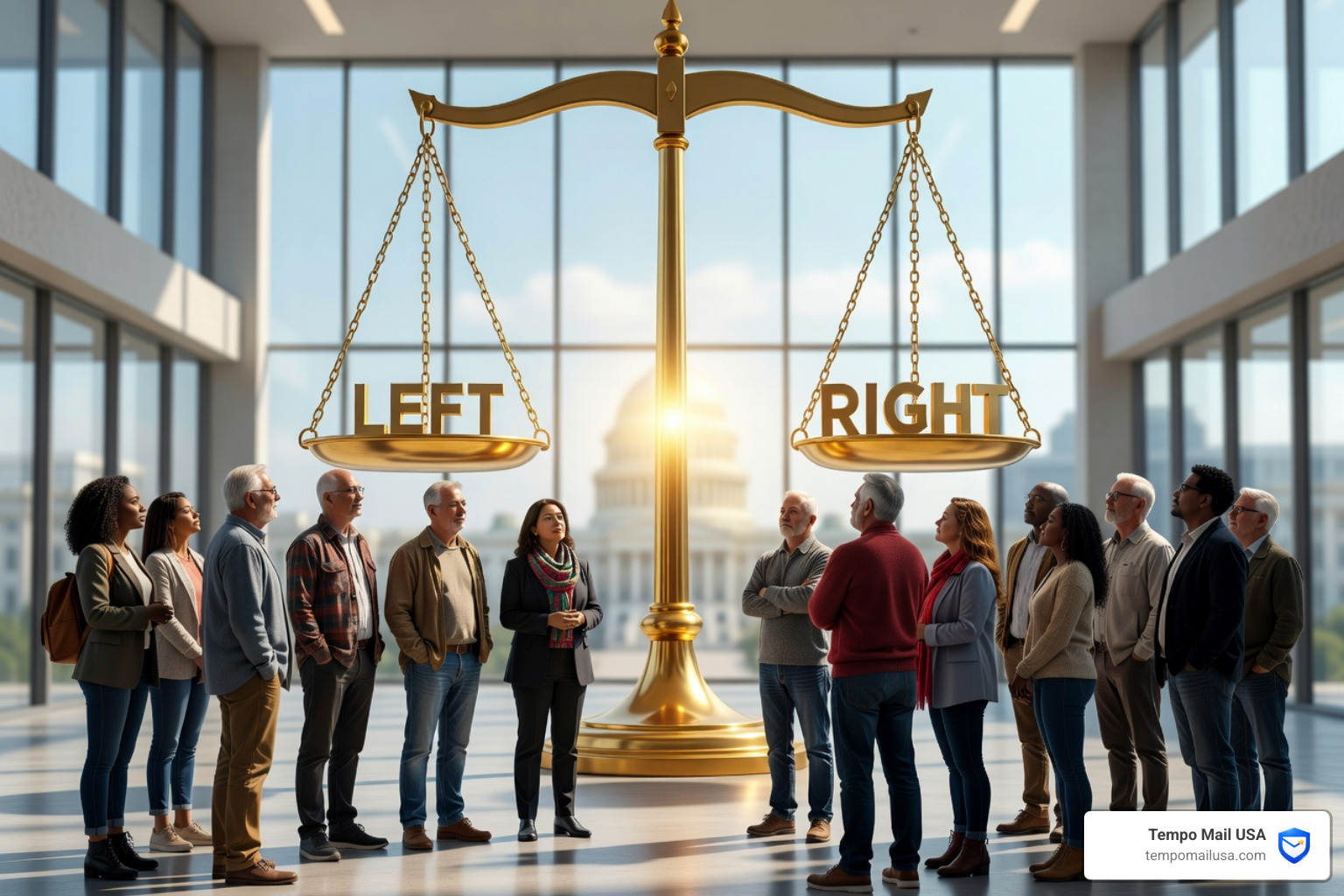

What Does Moderate Mean in Politics — Quick Answer
What does moderate mean in politics is one of the most searched political questions, and the short answer is this:
A political moderate is someone who holds centrist views on the left-right political spectrum — avoiding extreme positions and favoring pragmatic, compromise-driven solutions.
Here's a quick breakdown:
| Term | Meaning |
|---|---|
| Moderate | Rejects extremes on both left and right; favors balance and pragmatism |
| Centrist | Positioned in the middle of the political spectrum; often used interchangeably with moderate |
| Independent | Not aligned with a major political party; may or may not be moderate in views |
| Pragmatist | Focuses on what works in practice over rigid ideology; closely linked to moderate thinking |
According to Gallup polling, somewhere between 35% and 38% of American voters identified as moderate throughout the 1990s and 2000s. That's a huge slice of the electorate — yet moderates are often the least talked-about group in political media.
That gap between size and visibility is exactly what makes this topic worth understanding.
In a political landscape that increasingly rewards loud, extreme positions, moderates occupy a quieter but surprisingly powerful space. They're not simply people who can't make up their minds. Research published in the American Political Science Review shows that genuine moderates are 4 to 5 times more responsive to candidate ideology than strong partisans — making them the most consequential voters in many elections.
This guide explains who moderates really are, what they believe, and why they matter more than most political coverage suggests.
Defining the Political Middle: What Does Moderate Mean in Politics?

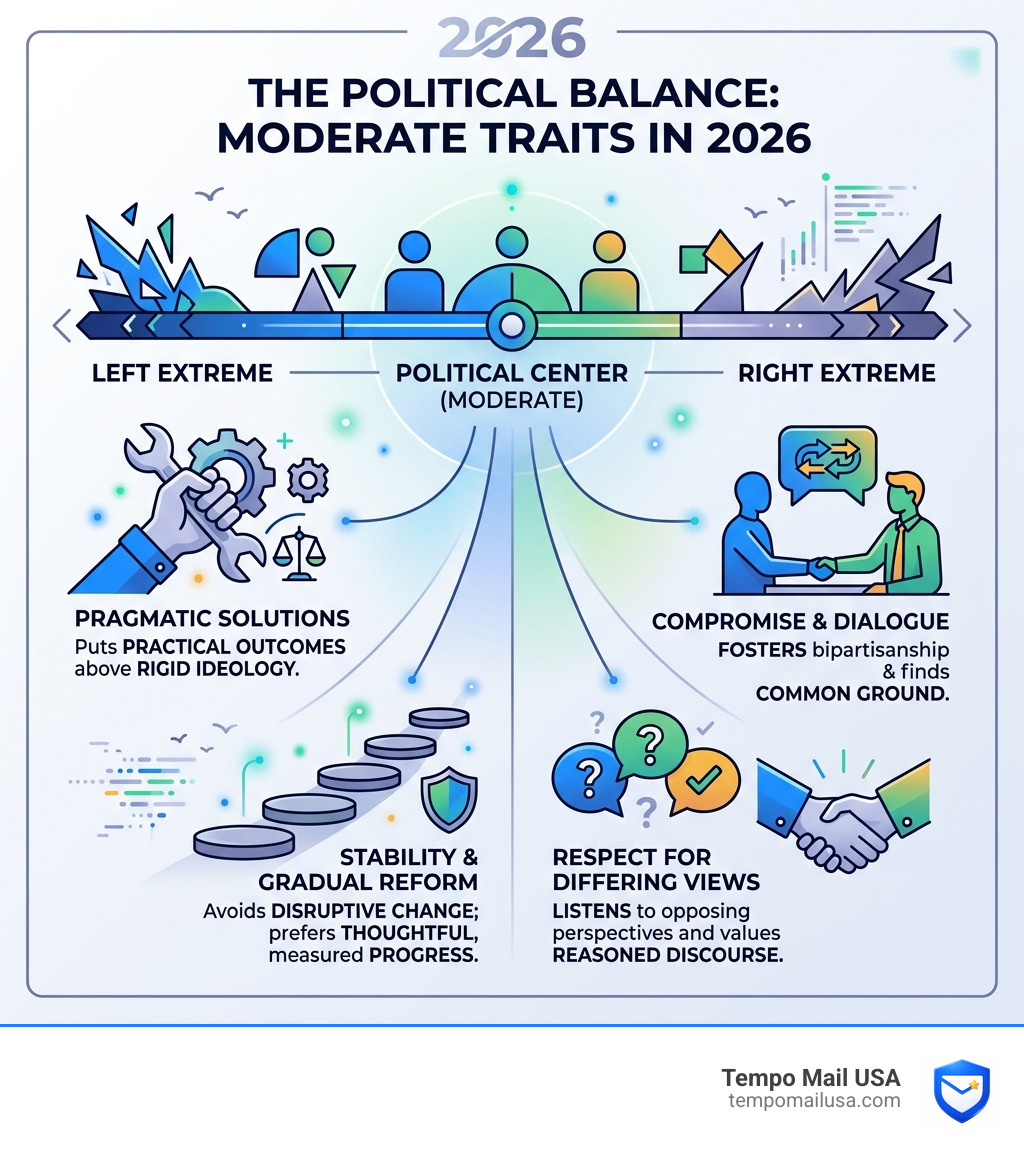
When we ask what does moderate mean in politics, we are essentially looking at the "gravity" of the political spectrum. A Political moderate is defined by a rejection of radical or extreme views. Instead of following a strict party playbook, moderates occupy a centrist position that values pragmatism over purity.
In practice, this means a moderate might support a higher minimum wage but oppose a massive, sudden hike that could destabilize small businesses. They prefer incremental change—steady, evidence-based progress—rather than sweeping, overnight revolutions. This "case-by-case" thinking is a hallmark of the moderate mindset. They aren't looking for a utopia; they are looking for what works.
However, navigating the political world as a moderate in 2026 requires more than just balanced views. As political data becomes a weapon for micro-targeting, many users now rely on advanced security tools and VPN protection to prevent these attacks and keep their ideological leanings private from data brokers.
Understanding What Does Moderate Mean in Politics for the Electorate
For the average voter, identifying as a moderate is often a way to say, "I don't fit into your boxes." Gallup polling has consistently shown that a massive portion of the American public—often between 35% and 38%—refuses the labels of "liberal" or "conservative."
Furthermore, more than 40% of Americans identify as independent voters. While not every independent is a moderate, there is a significant overlap. According to What is a Moderate in Politics? - Political Newscast, these voters provide nuance in policy discussions. They might be socially progressive but fiscally conservative, or vice-versa. They are the "swing" that keeps the political pendulum from getting stuck in one corner.
Core Characteristics of Moderate Politicians
What does a moderate politician actually look like in the halls of power? They typically prioritize bipartisanship and dialogue. Rather than treating the "other side" as an enemy to be defeated, they view them as a partner in negotiation.
Key traits include:
- Scrupulous use of data: Moderates tend to look at the numbers before the rhetoric.
- Focus on unintended consequences: They ask, "If we pass this, what goes wrong tomorrow?"
- Avoidance of dehumanizing rhetoric: As noted by What 'Moderate' means to Liberals & Conservatives | AllSides, moderates often use language that accepts compromise rather than sparking outrage.
The Three Faces of Moderation: Genuine Centrists vs. Inattentive Voters
Not all "moderates" are created equal. Political scientists often struggle to define this group because it’s actually made up of three very different types of people. A landmark study in the Moderates | American Political Science Review | Cambridge Core breaks them down using statistical models:
- Downsian Moderates (The Genuine Centrists): These make up about 72.8% of respondents whose positions are well-described by a single left-right dimension. They are truly in the middle. If a liberal wants a $20 minimum wage and a conservative wants $5, the Downsian moderate is the one arguing for $12.
- Conversians (The Idiosyncratic Thinkers): About 20% of Americans hold views that don't fit a straight line. They might hold "extreme" views on both sides—perhaps they want total deregulation of the economy but also want the government to provide universal healthcare. Their views are consistent to them, but "inconsistent" to a political party.
- Inattentive Voters: Roughly 6.5% of respondents provide what look like "moderate" answers simply because they aren't paying close attention or are providing random responses.
What Does Moderate Mean in Politics for the Democratic Party?
Within the Democratic Party, being a "moderate" often involves balancing social progressivism with fiscal responsibility. These are the "Moderate Democrats" who often belong to groups like the Blue Dog Coalition or the New Democrat Coalition.
According to What is Moderate in Politics? Exploring the Balance Between Extremes, a moderate Democrat might support climate change action but insist on protecting energy sector jobs during the transition. They serve as a bridge, ensuring the party's platform remains palatable to the broader American electorate rather than just the activist base.
The Electoral Power of the Middle: Why Moderates Decide Elections
Moderates are the "kingmakers" of modern democracy. Because they aren't "locked in" to a specific party, their votes are up for grabs every election cycle. This makes them the primary drivers of electoral accountability.
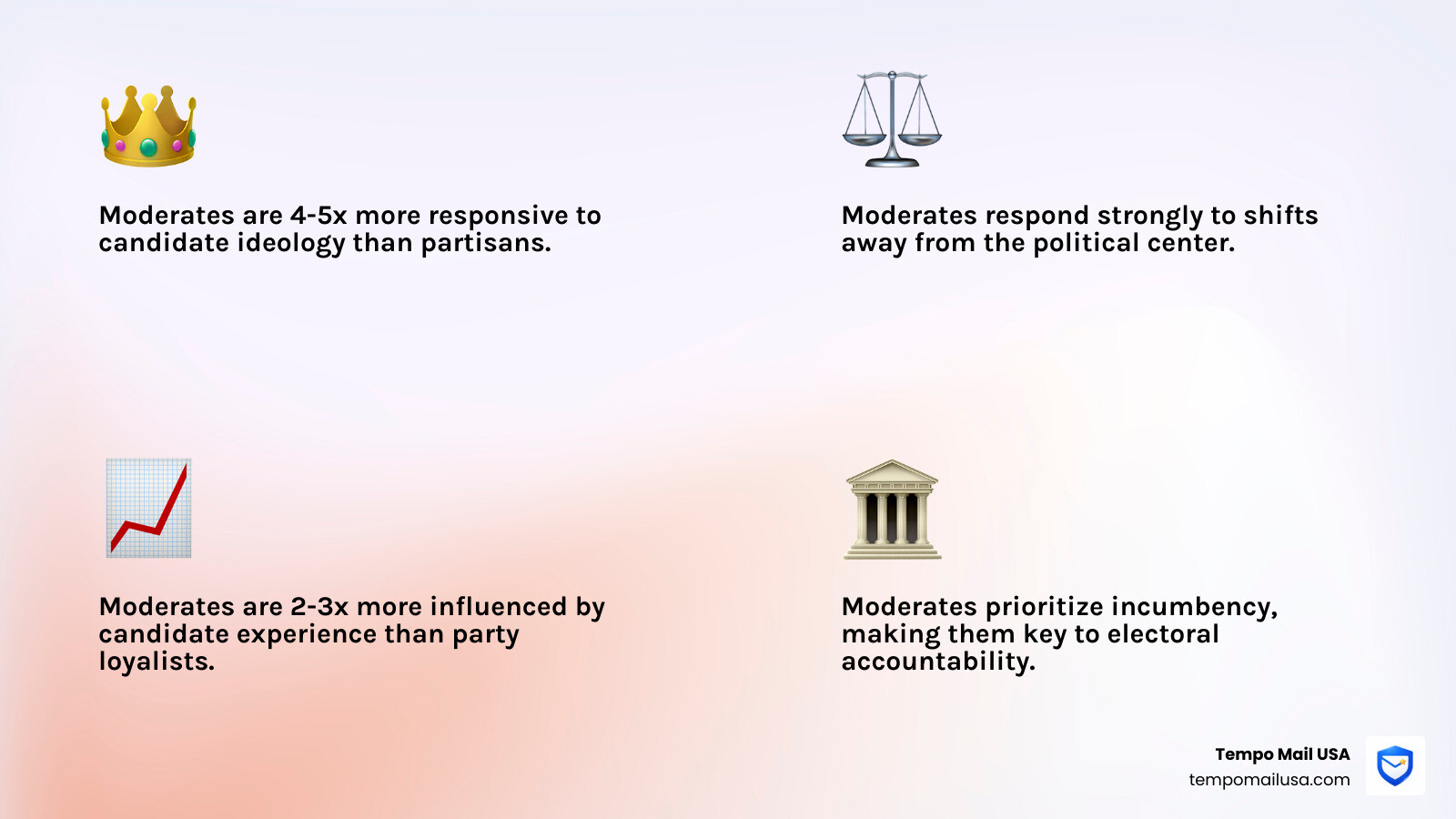
As the table above suggests, moderates are 4 to 5 times more responsive to a candidate's actual ideology than partisans are. If a candidate moves too far to the extreme, moderates are the first to jump ship. They also place a higher premium on candidate experience and incumbency, being 2 to 3 times more likely to weigh these factors than someone who simply votes the "party line." This is why candidates often run to the center during general elections, even if they acted more extreme during the primaries.
Criticisms of the Center: From "Wishy-Washy" to the "Extreme Center"
Of course, the middle of the road isn't always a popular place to be. Critics from both the left and right often label moderates as "wishy-washy" or accuse them of "flip-flopping."
Some, like author Tariq Ali, have coined the term "Extreme Center" to describe a situation where both major parties become so similar that they only serve the interests of crony capitalism and the status quo. In this view, Centrism isn't a virtue; it's a "status quo bias" that prevents necessary, bold reforms from happening. To these critics, the moderate middle is where good ideas go to be watered down until they are no longer effective.
Protecting Your Privacy in a Polarized World: Tools for the Modern Voter
In 2026, your political identity is a valuable commodity. Political campaigns, data brokers, and even foreign actors use data harvesting to build profiles on voters. If you are a moderate or an independent, you are a "high-value target" because your vote is actually winnable. This often leads to an influx of targeted ads, "dark pattern" emails, and even phishing attempts.
To maintain your digital hygiene, it is essential to use top internet security tools in 2026. Protecting your Personally Identifiable Information (PII) is the first step in ensuring your political choices remain your own.
- VPN Protection: Using a service like NordVPN masks your IP address, making it harder for trackers to link your browsing habits (like reading political news) to your physical location.
- Identity Theft Protection: Many users now invest in identity monitoring to ensure their data hasn't been leaked in a campaign-related breach.
- PII Firewall: Protecting your primary email address is crucial. This is where a secure identity proxying strategy comes into play.
How to Choose the Right Privacy Tools for Political Engagement
When you sign up for a political newsletter, a "take action" petition, or even a local town hall, you are often asked for an email address. This is the moment your data enters the "wild."
To stay safe, consider these data protection tools:
- Antivirus Software: Ensure your devices are protected from malware that might be hidden in political "clickbait."
- Temporary Email Aliases: Instead of giving your real email to every political organization, use a service like Tempo Mail USA. We act as a firewall between these services and your personal data. By using a temporary alias, you can receive the information you need without letting your real PII be sold to third-party brokers.
- Identity Monitoring: Regularly check if your credentials have appeared on the dark web after a major political site breach.
Frequently Asked Questions about Moderate Politics
What is the difference between a moderate and an independent?
A "moderate" refers to a person's ideology (their beliefs), while "independent" refers to their partisan affiliation (the "team" they belong to). You can be an independent who holds very extreme views, or a registered Republican or Democrat who is very moderate.
Are moderates just "closet partisans" who won't admit their party?
While some people use the "independent" or "moderate" label to avoid social conflict, research shows that a significant portion of the electorate—the "Downsian moderates"—are genuine centrists. They truly weigh the merits of both sides and are far more likely to switch their vote between parties than "closet partisans" are.
Why are moderates considered the most important voters in U.S. House elections?
Because they are the most responsive to candidate quality. Partisans will often vote for a "blue dog" or a "red dog" simply because of the party color. Moderates, however, care about whether the candidate is actually a "dog" (meaning they care about experience, temperament, and specific policy stances). This makes them the pivotal group that decides who wins in competitive districts.
Conclusion
Understanding what does moderate mean in politics is key to understanding how modern governance actually functions. While the extremes get the most noise, the middle provides the political stability and pragmatic governance that keeps systems running. Moderates aren't just "undecided"; they are often the most scrupulous and data-driven segment of the population.
However, being a moderate or independent voter in a digital age requires a proactive approach to digital hygiene. As you engage with the political process, don't let your personal data become a campaign tool. Using tools like a VPN and temporary email aliases from Tempo Mail USA allows you to participate in the conversation without sacrificing your privacy.