

Why a Secure Email Address Free from Surveillance Matters
A secure email address free from tracking and data mining is no longer a luxury—it's a necessity for anyone who values their privacy. When looking for encrypted services, it's important to find options that protect your communications without costing a dime.
What to Look for in a Free Secure Email Service:
- End-to-end and zero-access encryption
- A business model based on optional paid plans, not data sales
- Jurisdiction in a country with strong privacy laws
- Anonymous sign-up options
Despite being one of our oldest methods of online communication, email remains one of the most popular—and most vulnerable. Billions of messages fly around the world every day, carrying everything from vacation plans to financial data. But here's what most people don't realize: services like Gmail, Yahoo, and Outlook routinely scan your emails for advertising purposes, track your purchases, and in some cases, even provide access to third parties.
The surveillance isn't theoretical. Yahoo was caught scanning emails in real time for US surveillance agencies. Gmail was found giving third parties full access to user emails. These providers operate on a simple model: if the service is free, you're the product.
The good news? You don't need to be a security expert or pay premium prices to protect yourself. Free secure email services now offer powerful encryption that even the provider can't break. Many services use end-to-end and zero-access encryption—meaning not even they can read your messages. And unlike Gmail's "free" model, these providers support themselves through optional paid plans, not by selling your data.
The shift to secure email isn't just about hiding secrets. It's about taking back control of your personal information, protecting yourself from data breaches, and ensuring your private conversations stay private. From journalists and activists to everyday citizens concerned about their digital footprint, millions of people worldwide have already made the switch.
The Hidden Costs of "Free" Email: Why Your Privacy is the Price
When we sign up for "free" email services from large providers, we often don't consider the true cost. These services aren't free because their operators are benevolent; they're free because we are the product. Our data becomes a valuable commodity, mined, analyzed, and often shared with third parties for profit. This business model raises significant concerns for our digital privacy and security.
The main concerns with using these standard free email services stem from their data mining and advertising models. For example, some providers have been caught giving third-party apps extensive access to user emails and even deriving purchase histories from inbox content. In other cases, advertisers are allowed to scan accounts to "identify and segment potential customers by picking up on contextual buying signals, and past purchases." This isn't just about targeted ads; it's about a complete lack of confidentiality in our digital correspondence.
The situation is further complicated by government surveillance programs that collect massive amounts of email data. Some providers have even been compelled to scan emails in real time for surveillance agencies. This pervasive surveillance means that even if we trust the email provider, our communications might still be accessible to government entities, often without our knowledge or consent.
The Myth of "Nothing to Hide"
Some might argue, "I have nothing to hide, so why should I care?" This perspective, however, overlooks the profound value of privacy. Our Personally Identifiable Information (PII) is a treasure trove for malicious actors. Data breaches are rampant, exposing hundreds of millions, if not billions, of records per year. When our email accounts, which often serve as the central hub for our digital lives, are compromised, it can lead to identity theft, financial fraud, and a significant erosion of our digital footprint.
Beyond the immediate risks of data breaches, privacy is also about control. It's about having the autonomy to decide who sees our personal correspondence, our business communications, and even our casual chats. The "nothing to hide" argument often fails to recognize that privacy is a fundamental human right, essential for free expression, personal development, and maintaining healthy relationships. When we lose control over our data, we lose a part of our autonomy.
How Your Inbox is Scanned and Analyzed
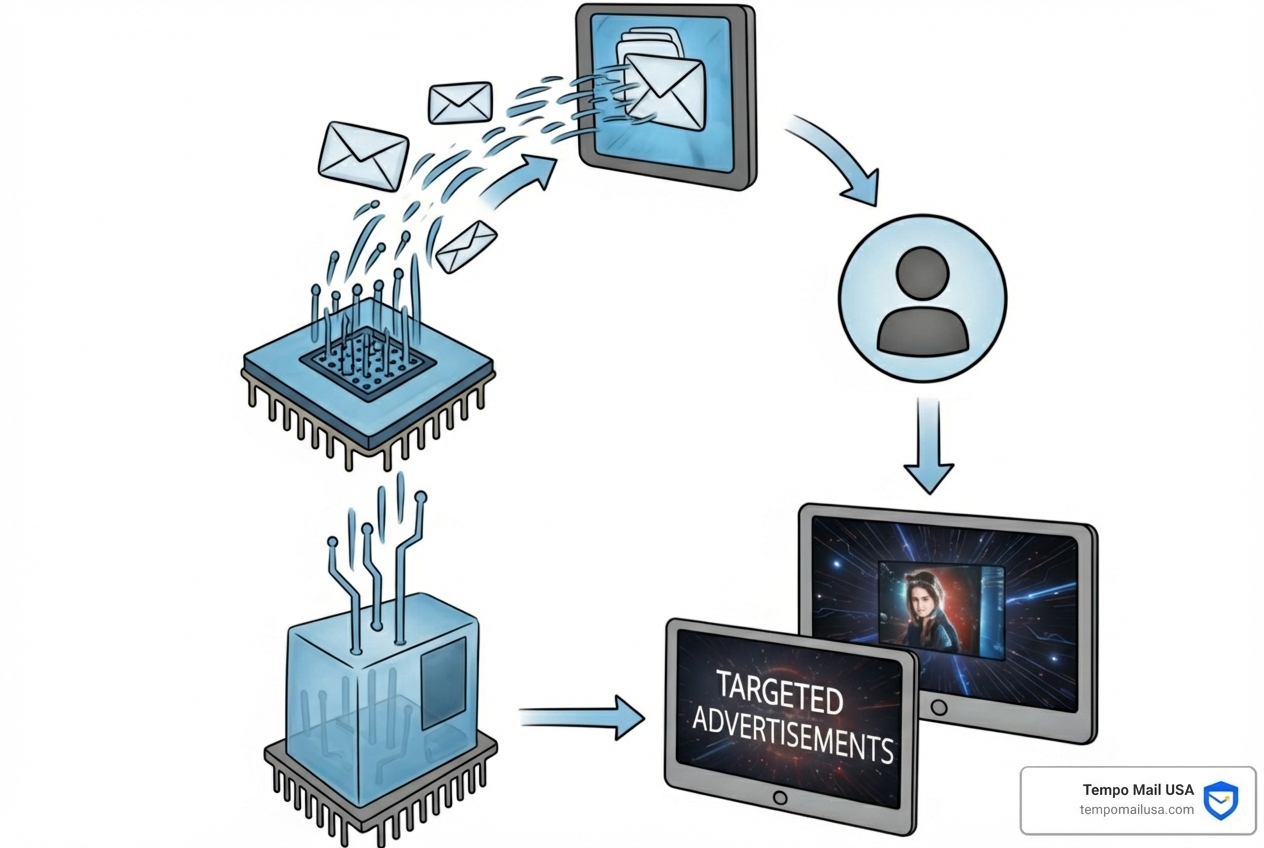
The scanning of our inboxes isn't always overt. It happens through sophisticated algorithms designed to profile us. For instance, some mainstream services read through every message we send or receive looking for information like airline reservations to add to your calendar. Others use automated features that scan messages so they can suggest short replies or categorize content. While these features might seem convenient, they highlight the deep level of access these providers have to our most private communications.
This automated content scanning is used for contextual ad targeting, profiling users based on their interests, habits, and even emotional states. They scan for "buying signals" to better segment potential customers. The end result is a lack of true confidentiality. Our emails, which we might assume are private conversations, are instead treated as data points for commercial exploitation. This is why choosing a secure email address free from these practices is paramount.
How Secure Email Works: A Look Under the Hood
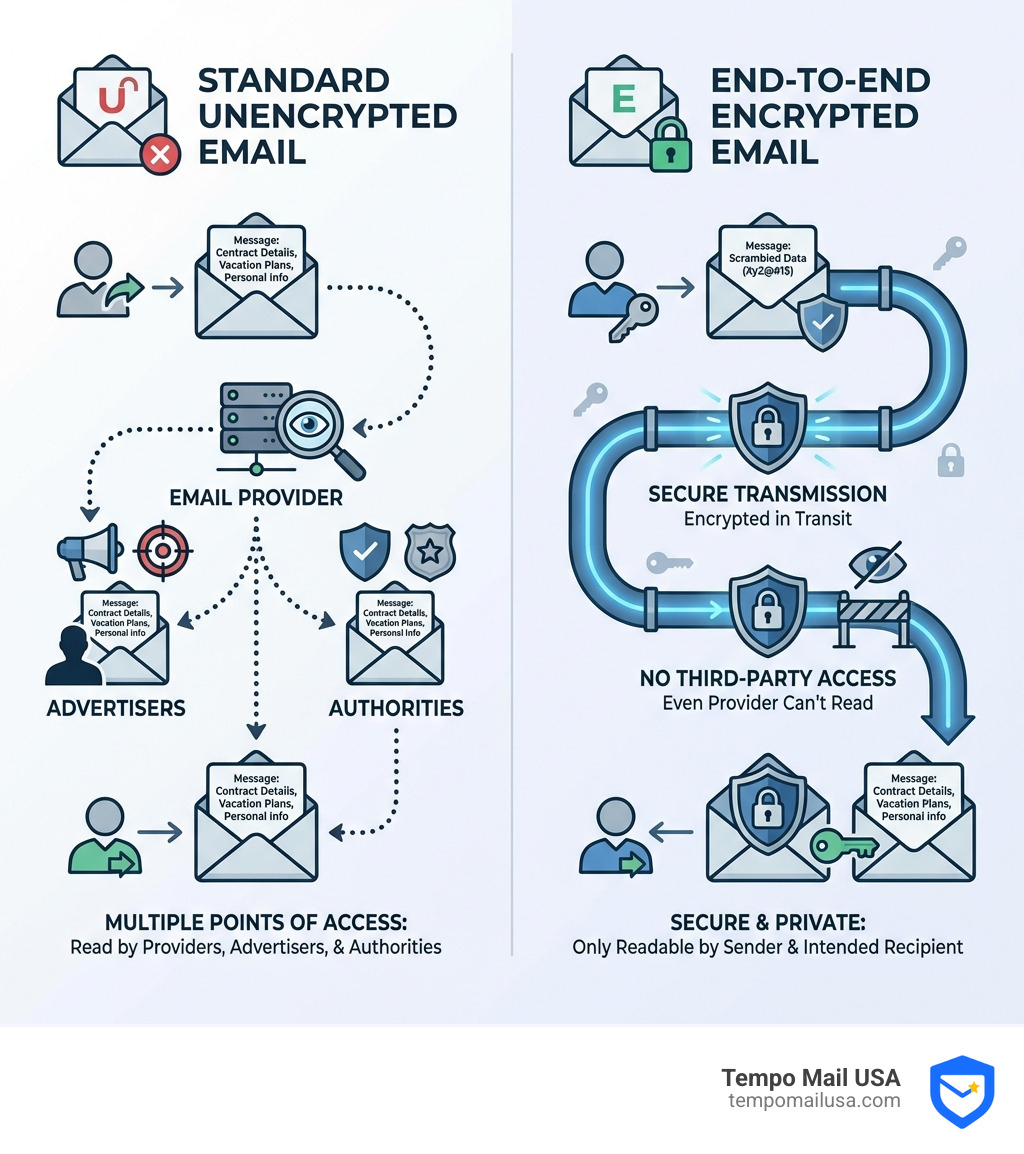
The benefits of using an encrypted email service compared to a standard one are clear: improved privacy, robust data protection, and a greater degree of anonymity. Unlike traditional email, which often sends messages in plain text or with easily breakable encryption, secure email services employ sophisticated cryptographic techniques to scramble your messages, making them unreadable to anyone but the intended recipient.
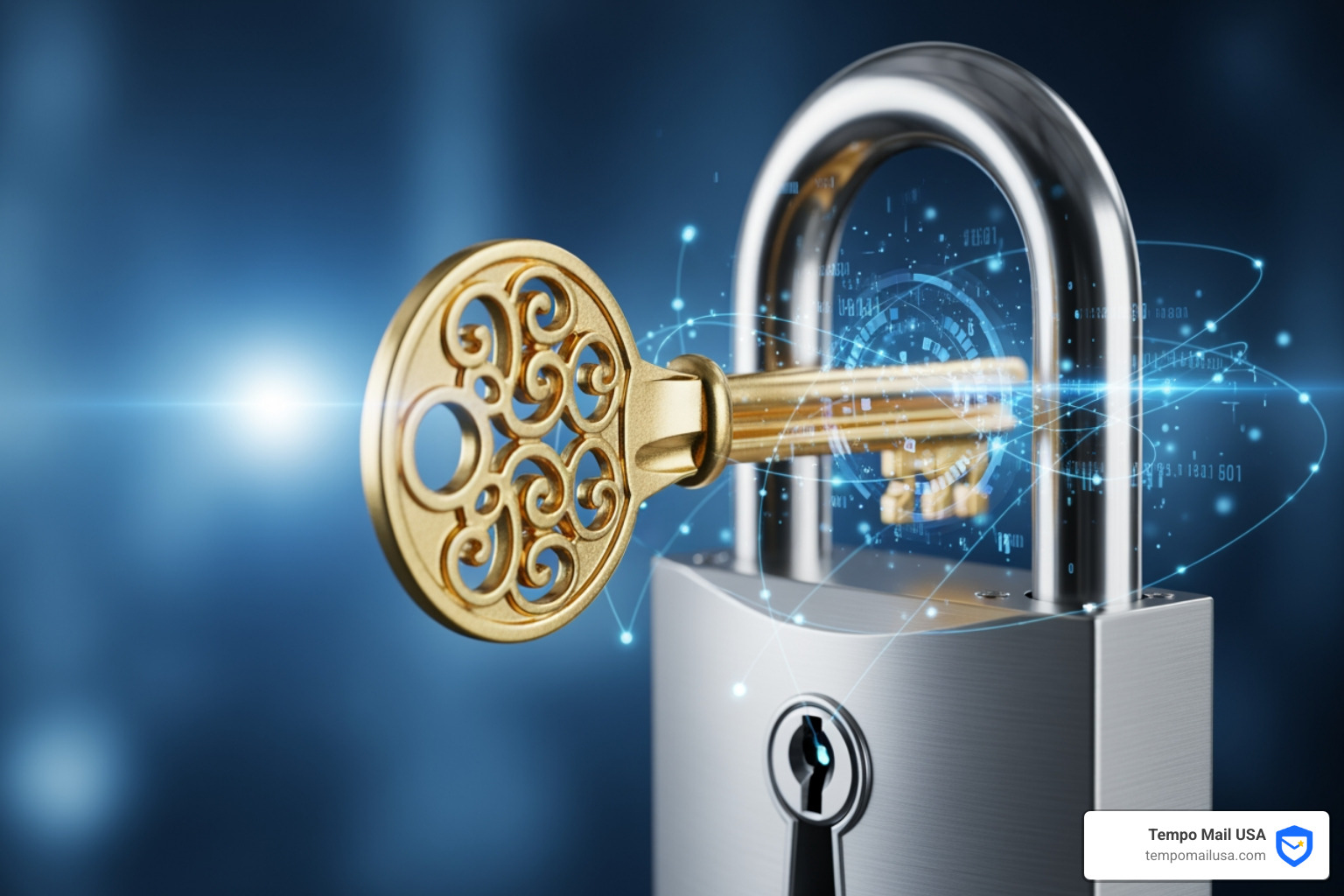
At its core, secure email operates on the principle of encryption. Imagine writing a letter, then locking it in a box before sending it. Only the person with the correct key can open that box and read the letter. In the digital world, this "key" is a complex piece of code, and the "box" is the encryption algorithm that transforms your readable message (plaintext) into an unreadable jumble (ciphertext). This fundamental shift ensures that our communications remain private, even if intercepted.
Understanding Encryption Methods
When we talk about secure email, we're primarily referring to different types of encryption methods. The most robust and widely discussed is End-to-End Encryption (E2EE). With E2EE, your message is encrypted on your device and only decrypted on the recipient's device. This means that no one in between—not your email provider, not your internet service provider, and certainly not any third-party snoopers—can read the content of your message.
Another crucial concept is Zero-Access Encryption. This means that the email provider itself cannot access your unencrypted data. Even if compelled by a court order, they wouldn't be able to hand over readable content because they simply don't have the decryption keys. Many secure services use both end-to-end and zero-access encryption, ensuring that even they cannot read user emails.
Common encryption standards include:
- PGP (Pretty Good Privacy): PGP, which stands for Pretty Good Privacy, is one of the most popular encryption protocols. It's widely supported, but it has a notable limitation: it typically does not encrypt the email subject line or metadata. This means that while the body of your message is secure, information like the sender, recipient, subject, and timestamps can still be exposed, as the email address and subject line of each message are often unencrypted with standard PGP implementations.
- AES (Advanced Encryption Standard) and RSA (Rivest-Shamir-Adleman): Some services use a combination of these robust encryption algorithms. Instead of relying on PGP, some providers combine AES and RSA encryption. By doing this, they are able to encrypt both the email address and the subject line that comprise message headers, a significant advantage over PGP. Furthermore, some providers have updated their encryption protocols to add post-quantum cryptography, preparing for future threats.
- Layered Encryption: Some providers use a layered encryption approach that combines OpenPGP and S/MIME, both intuitively implemented. They also employ advanced security protocols like DNS-Based Authentication of Named Entities (DANE).
While encryption protects the content of your messages, it's harder to conceal metadata—information about who communicated with whom, when, and from where. Many secure email providers address this by stripping IP addresses from messages and implementing strict no-logs policies. This comprehensive approach is how email encryption protects against data breaches and surveillance, by making the content unreadable and minimizing the traceable information about the communication itself.
The Importance of Jurisdiction and Anonymity
When choosing a secure email address free or paid, the physical location of the email service provider—its jurisdiction—is incredibly important. This is because privacy laws vary significantly from country to country, directly impacting how your data is protected from government requests and surveillance.
Advantages of using email services based in privacy-friendly jurisdictions like Switzerland or Germany:
- Strong Privacy Laws: Countries like Switzerland and Germany have some of the world's strictest data protection laws. Choosing a service incorporated and headquartered in such a country means your data is protected by these robust legal frameworks.
- Data Sovereignty: In these jurisdictions, our data is less likely to be subject to foreign government surveillance programs or requests, unlike services based in countries with weaker privacy laws or those part of intelligence-sharing alliances (like the Five Eyes).
- No-Logs Policies: Providers in privacy-friendly regions are often more committed to strict no-logs policies, meaning they don't record metadata that could identify users or their activities. Some strip IP addresses from all messages.
- Anonymous Sign-up: Many secure email services allow for anonymous sign-up, requiring minimal personal information, or even allowing payment with cryptocurrency to further improve privacy.
Contrast this with the situation in the US. The article notes that US-based email services can be a concern. For example, one privacy-focused email service based in the US was forced to shut down when its owner refused to give up encryption keys to government agents. Similarly, another US email service was hit with data requests and forced to comply with warrants under a gag order. These examples highlight the vulnerability of services operating under jurisdictions where legal frameworks can compel providers to compromise user privacy.
When we consider a provider's integrity, we look for transparency, open-source code, and independent audits, but jurisdiction remains a foundational element for true data protection.
Finding the Best Secure Email Address Free for You
Choosing the right secure email address free service can feel overwhelming given the many options available. Our goal is to help you steer these choices by considering your specific needs, evaluating providers, and understanding the differences between free and paid tiers.
When evaluating providers, we look at several factors: their core security features, storage limitations, message limits, and their overall commitment to privacy. While a free tier is an excellent starting point, understanding its limitations can help us decide if an upgrade is necessary or if another provider's free offering better suits our needs.
Key Features of a secure email address free service
Even the free versions of secure email services offer robust protection far beyond what standard providers offer. Here are the essential features we should look for:
- Core Security (End-to-End & Zero-Access Encryption): This is non-negotiable. The best services provide these, ensuring that only you and your intended recipient can read your emails.
- Storage Limitations: Most free tiers come with limited storage, typically around 1 GB. This might be sufficient for casual use but could be a constraint for heavy email users.
- Ad-Free Experience & No Tracking: A hallmark of secure email is the absence of ads and trackers. Unlike mainstream services, these providers do not monetize your data. All core security features should be included in a provider's free version.
- Open-Source Code & Independent Security Audits: Transparency is key to trust. Many top secure email providers are open source, allowing security experts to audit their code for vulnerabilities. This provides an additional layer of assurance regarding their security claims.
- Basic Functionality: Free plans typically include all the basic functionality you expect from an inbox, along with the same level of security as paid plans.
Essential Free Features Checklist:
- End-to-end encryption for message content
- Zero-access architecture, meaning the provider cannot read your emails
- No ads or tracking of your online activity
- Basic storage (usually 1GB or more)
- Anonymous registration options
- Cross-platform compatibility (web, mobile apps)
The Power of Aliases for a truly secure email address free from spam
One of the most powerful features for enhancing our privacy, especially with a secure email address free service, is the use of email aliases. An alias is essentially a different email address that forwards messages to our primary inbox, without revealing our actual primary address.
Here's why aliases are so valuable:
- Protecting Your Primary Address: When we sign up for new websites, newsletters, or online services, using an alias prevents our main email address from being exposed to potential spam lists or data breaches. If an alias starts receiving unwanted mail, we can simply disable it without affecting our primary account.
- Preventing Spam: Aliases act as a buffer. If a service we've signed up for sells our data, only the alias is compromised, not our main identity.
- Phishing Protection: By using unique aliases for critical services (e.g., banking), we can immediately spot phishing attempts that target our main email address.
- Compartmentalizing Your Digital Life: We can create different aliases for different purposes—one for online shopping, another for social media, another for forums. This helps organize our inbox and provides a clearer picture of who is contacting us and why.
- Identity Proxying: For advanced PII protection, services like Tempo Mail USA specialize in identity proxying, generating secure email aliases that act as a "firewall" around our Personally Identifiable Information. This ensures that our true identity remains hidden behind a layer of disposable or purpose-specific email addresses, significantly reducing our digital footprint and vulnerability to data harvesting. Some services also offer features that remove tracking pixels from incoming emails to further protect users from spam and phishing.
Advanced Features Worth Paying For
While a secure email address free offers a fantastic starting point, paid plans typically open up a host of advanced features that improve usability, storage, and control:
- Custom Domains: For professionals or small businesses, the ability to use our own domain (e.g., yourname@yourcompany.com) is crucial for branding and credibility.
- Increased Storage: Free tiers often cap storage at 1-2 GB. Paid plans offer significantly more, sometimes up to 500 GB or more, accommodating years of email history and large attachments.
- Unlimited Messages/Aliases: While free accounts might limit the number of messages or aliases, paid plans often provide unlimited options.
- IMAP/POP/SMTP Support: Many secure email services, especially their paid tiers, offer support for standard email protocols like IMAP, POP, and SMTP. This allows us to use our preferred third-party email clients (like Thunderbird) to access our secure inbox. Some also offer a progressive web app for mobile devices.
- Email Migration Tools: Switching providers can be daunting. Paid plans often include tools or support to help us migrate existing emails and contacts from our old service to the new secure one.
- Secure Calendars & Encrypted Cloud Storage: Many secure email providers integrate encrypted calendars and cloud storage into their paid offerings, creating a comprehensive private ecosystem.
- Priority Support: Paid users typically receive faster and more dedicated customer support.
Frequently Asked Questions about Secure Email
We understand that secure email can bring up many questions. Let's address some of the most common ones to help you feel more confident about making the switch.
Is a free secure email service truly safe?
Yes, absolutely. A secure email address free service can be very safe, often employing the same core encryption technologies as their paid counterparts. For instance, many reputable providers will always offer a free secure email plan that provides all the basic functionality you expect from your inbox with the same level of security as their paid plans. These free versions typically include all essential security features like built-in encryption, session handling, no tracking, and no ads.
The safety comes from their business model. Unlike mainstream providers that rely on selling user data, these services are often supported by optional paid subscriptions from users who want more features or wish to support the mission of privacy. This means their incentive is to protect your data, not exploit it. While free versions might have limitations on storage or the number of aliases, the fundamental encryption and privacy protections remain intact.
Can encrypted emails be hacked?
This is a crucial question. No system is 100% hack-proof, but encrypted emails are significantly more secure than standard ones. Encryption doesn't stop hackers from intercepting your messages. However, if they don't have the private key, all they would get is scrambled data that is completely unreadable. This is the essence of how email encryption protects against data breaches and surveillance: it renders intercepted data useless.
The weakest link in email security is often the user. To maximize your protection:
- Use strong, unique passwords for your email account.
- Enable two-factor authentication (2FA) whenever possible. This adds an extra layer of security, requiring a second verification step beyond just your password.
- Keep your devices secure. Malware or viruses on your computer or phone could potentially compromise your keys before encryption or after decryption.
- Be wary of phishing attempts. Even with encrypted email, a sophisticated phishing attack could trick you into revealing your login credentials.
So, while the encryption itself is robust, our overall security posture depends on diligent user-side practices.
What are the drawbacks of using encrypted email?
While the benefits of encrypted email are substantial, it's fair to acknowledge some potential drawbacks or challenges:
- Compatibility Issues: The biggest challenge often arises when communicating with people who don't use an encrypted email service. If you send an end-to-end encrypted message to a non-encrypted user, the message usually needs to be sent via a secure link (e.g., password-protected) or the recipient won't be able to read it directly in their inbox. PGP, while popular, can also be complex to set up and manage for less tech-savvy users.
- Feature Differences: Some encrypted email services, especially their free tiers, might not support traditional email client protocols like IMAP, POP, or SMTP. This means you might be restricted to using their web interface or dedicated apps. While many now offer desktop and mobile apps for common operating systems, it can be a shift from familiar clients.
- Migration Complexity: Moving all your existing emails and contacts to a new secure service can be a hurdle. However, many providers are addressing this by offering "easy switch" tools to import emails, labels, contacts, and calendars. Some now also offer an import function to address previous limitations.
- Learning Curve: For some, there might be a slight learning curve, especially with PGP, which can involve managing public and private keys. However, many services aim to make encryption seamless and user-friendly, handling much of the complexity in the background.
Regarding alternatives to traditional email for secure communication, for highly sensitive discussions, encrypted messaging apps like Signal, Session, or Wickr are often recommended. These services are designed for real-time, end-to-end encrypted conversations and generally offer stronger anonymity features than email.
Conclusion: Take Back Control of Your Digital Identity
In an age where our digital lives are constantly under scrutiny, where mainstream "free" email services routinely scan our communications and monetize our data, the need for a secure email address free from surveillance has never been more critical. We've seen the hidden costs of convenience, from pervasive data mining and targeted advertising to the unsettling reality of government surveillance. Our privacy is not just a preference; it's a fundamental right that underpins our freedom and autonomy.
The good news is that taking back control of our digital identity is more accessible than ever. Secure email services offer robust encryption, often including end-to-end and zero-access security, ensuring that our messages remain private and unreadable to anyone but the intended recipient. With many providers offering feature-rich free tiers, there's no longer a significant barrier to entry for improved email security. These services empower us to protect our Personally Identifiable Information (PII), safeguard our conversations from data breaches and surveillance, and contribute to a more private and secure internet.
Making the switch is a proactive step towards a more secure digital future. Whether you choose a free plan to start or opt for a paid tier with advanced features like custom domains and increased storage, the journey to a more private email experience begins with a single step.
Learn more about email privacy and cybersecurity