



Why Finding the Best Way to Finance a Car Can Save You Thousands
The best way to finance a car depends on your credit score, down payment, and where you get your loan — but here's a quick answer if you're in a hurry:
Best ways to finance a car (ranked by typical cost):
- Credit union loan — Usually the lowest rates; member-owned, not profit-driven
- Bank preapproval — Competitive rates; gives you negotiating power at the dealership
- Online lender — Fast, convenient, often lower overhead means better rates
- Dealership financing — Most convenient, but often includes a markup on your rate
- Buy-here-pay-here — Last resort only; highest rates and strictest terms
Buying a car is one of the biggest financial decisions most people make — second only to buying a home. And yet, most buyers spend more time picking the car's color than comparing loan offers.
That's an expensive mistake.
As of Q3 2024, the average new car loan was $41,068 at 6.61% APR, with monthly payments averaging $737. Over a typical loan term of around 68 months, the difference between a good rate and a bad one can easily cost you thousands of dollars in extra interest.
Your credit score alone can swing your APR dramatically. Buyers with excellent credit averaged just 5.05% APR on new car loans — while buyers with very poor credit paid 15.43%. On the same loan, that gap can mean paying over $10,000 more by the time you're done.
And it's not just about your credit. Where you get your loan, how much you put down, and what term length you choose all have a major impact on what you actually pay.
This guide walks you through every step — clearly and without the jargon.
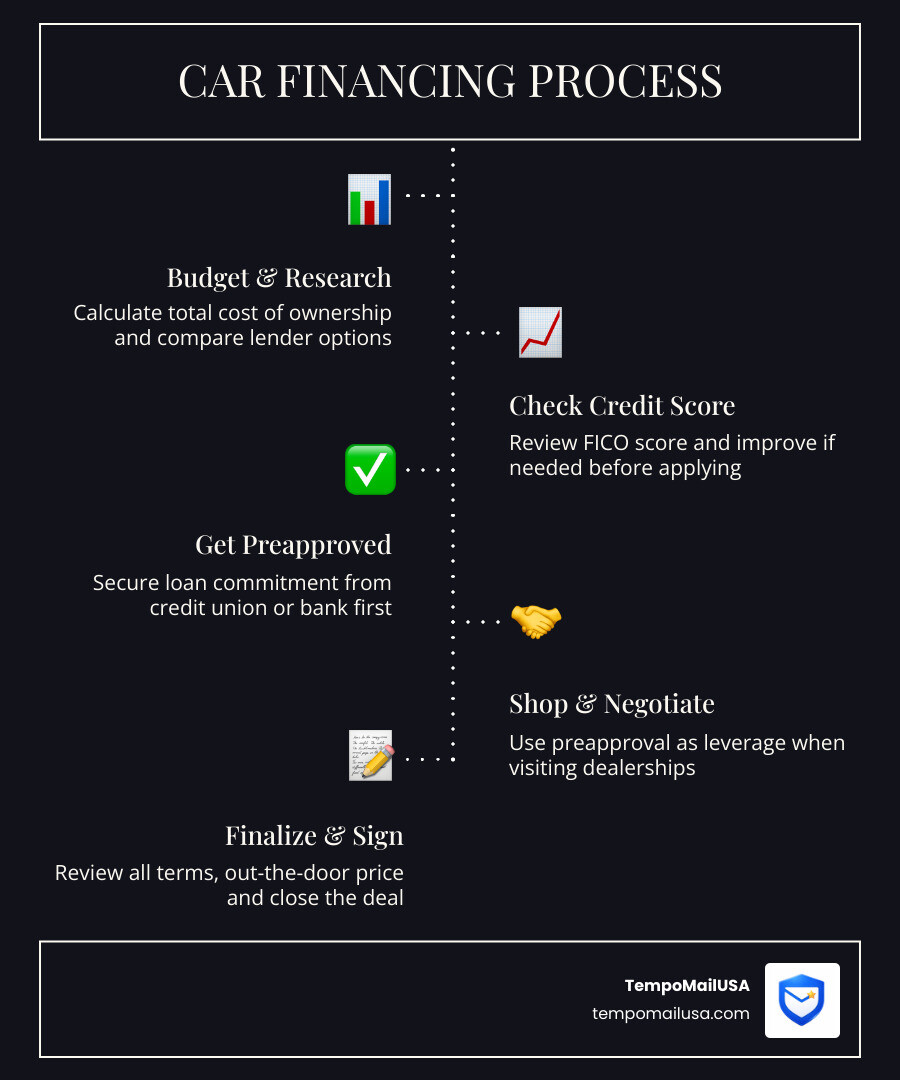
Comparing the Best Ways to Finance a Car
When we look at the landscape in May 2026, the options for car shoppers have never been more diverse. To find the best way to finance a car, we first need to understand the three primary channels: direct lending (banks and credit unions), dealership financing, and online lenders.
Direct lending involves getting a loan directly from a financial institution. You get the money, you go to the dealer, and you pay for the car. Dealership financing, on the other hand, is a "one-stop-shop." The dealer acts as a middleman, collecting your information and shopping it around to various lenders they have relationships with.
Online lenders are the "new kids on the block" (though they’ve been around a while now). These are often fintech companies that don't have physical branches, allowing them to pass overhead savings on to you in the form of lower interest rates. According to How to Finance a Car: Dealer vs. Bank vs. Online Lenders Explained, online lenders can be particularly useful for specialized needs, like financing a used car or refinancing an existing high-interest loan.
Financing Through Banks and Credit Unions
If you are looking for the absolute best way to finance a car in terms of raw interest rates, credit unions are often the champions. Because credit unions are member-owned cooperatives, they aren't trying to maximize profits for Wall Street shareholders. Instead, they return those profits to members through lower loan rates and higher savings yields.
If you’ve been building up your "car fund" in a High Yield Savings Account Rates: Earn More or Miss Out, you might already have a relationship with a bank that offers loyalty discounts. Traditional banks offer stability and a wide range of services, but they can be stricter with credit requirements than credit unions. The personalized service of a local branch can also help if your financial situation is a bit "outside the box."
The Pros and Cons of Dealership Financing
We’ve all seen the flashy "0% APR" signs at the local dealership. This is called "captive financing," where the loan is provided by the car manufacturer’s own finance arm (think Ford Credit or Toyota Financial Services). When you can qualify for these rates, dealership financing is undeniably the best way to finance a car.
However, there is a catch. Most people don't qualify for 0% APR. For everyone else, the dealer often adds a "markup" to the interest rate. If a bank approves you for 6%, the dealer might tell you the rate is 7% and pocket the 1% difference as a commission. This happens in the Finance and Insurance (F&I) office, where they might also try to sell you add-ons like extended warranties or fabric protection. Always negotiate the "out-the-door" price of the car before you even mention how you plan to pay for it.
How to Secure the Best Car Loan Rates
Your credit score is the single most important factor in determining your interest rate. Lenders use your FICO or VantageScore to predict how likely you are to pay them back. In 2026, the tiers remain fairly consistent: "Excellent" credit (740+) gets the red carpet treatment, while "Subprime" (below 600) faces much steeper uphill battles.
As noted in Car Financing: Everything you need to know about financing a car, all in one place | Kelley Blue Book, it is vital to look at the APR (Annual Percentage Rate) rather than just the monthly payment. A dealer can make a $50,000 car "affordable" by stretching the loan out to 84 months, but you'll end up paying a fortune in interest.

The Best Way to Finance a Car with Preapproval
Before you even step foot on a lot, you should have a preapproval letter in your pocket. This is a commitment from a lender to lend you a specific amount at a specific rate.
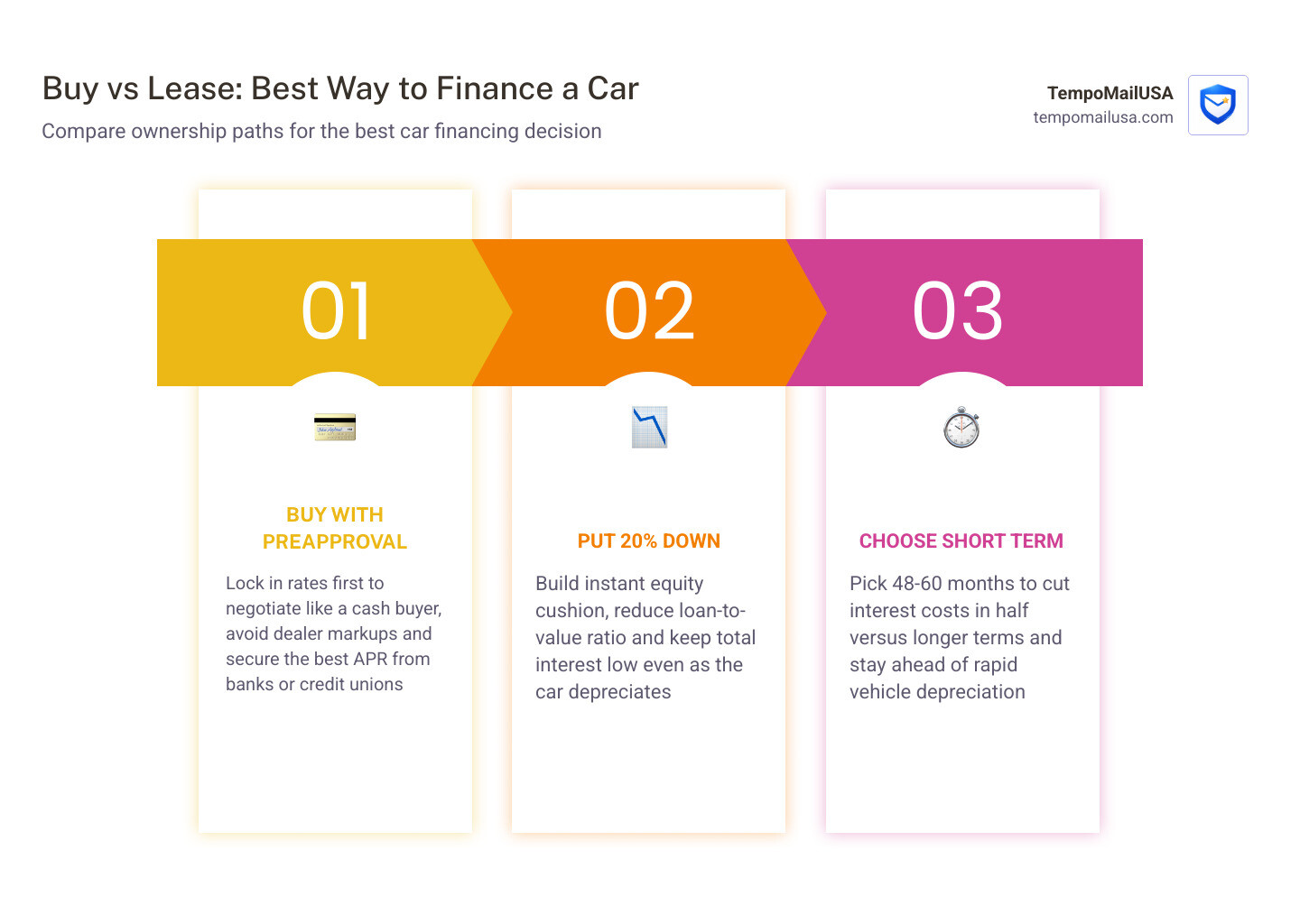
Getting preapproved is the best way to finance a car because it turns you into a "cash buyer" in the eyes of the dealer. It gives you a benchmark; if the dealer wants you to use their financing, they have to beat the rate you already have. Most preapprovals are good for 30 days, and according to The Best Way to Finance a Car, shopping for multiple preapprovals within a 14-day window typically only counts as a single "hard inquiry" on your credit report, protecting your score.
Improving Your Credit Before Applying
If your score isn't where you want it to be, take a few months to polish it. Start by checking your credit report for errors—disputing a single mistake can sometimes boost your score by 20 points or more.
Next, look at your debt-to-income ratio. If you have high credit card balances, use a Credit Card Payoff Calculator to create a plan to bring those balances down. This lowers your "credit utilization," which lenders love to see. If you’re still paying off school, use a Student Loan Repayment Calculator to see how your monthly obligations affect your total car-buying budget.
Optimizing Your Loan Terms and Down Payment
Once you have the rate, you need to structure the loan. This is where many people get "underwater"—meaning they owe more on the car than it is actually worth. Because new cars depreciate rapidly (often losing 20% of their value in the first year), you need a strategy to stay ahead of that curve.
Using a Car Loan Calculator can help you visualize how your down payment and loan term affect the total interest paid over the life of the loan. In 2026, with the average new car price hovering near $49,000, the stakes are high.
Why a 20% Down Payment is the Best Way to Finance a Car
We always recommend a 20% down payment for new cars and at least 10% for used ones. Why? Because it creates an immediate "equity cushion." If the car is totaled in an accident or you need to sell it suddenly, you won't be stuck paying off a loan for a car you no longer have.
If you find yourself with a high-interest loan because you couldn't afford a large down payment initially, don't lose hope. You can always use a Refinance Calculator later to see if a lower rate is available once your credit improves or market rates drop.
Choosing the Right Loan Term Length
The average new car loan term is now over 68 months. While a 72-month or 84-month loan makes the monthly payment smaller, it significantly increases the total cost of the car.
Consider this: A $32,000 loan at 6.8% APR for 48 months results in about $4,600 in total interest. That same loan over 84 months costs over $8,300 in interest. You are effectively paying $3,700 extra just for the "convenience" of a lower monthly payment. The best way to finance a car is to choose the shortest term you can comfortably afford—ideally 48 to 60 months.
Leasing vs. Buying: Which is Right for You?
Leasing is often described as "renting" a car for a long period. You aren't paying for the whole car; you're paying for the depreciation that happens while you drive it. According to How Does Financing a Car Work?, leasing usually results in lower monthly payments and allows you to drive a new car every few years.
However, leasing comes with strict mileage limits (usually 10,000 to 15,000 miles per year) and potential "wear and tear" charges. You also build zero equity. When the lease is over, you have nothing to show for your payments. Buying is generally the better long-term financial move, but leasing can be the best way to finance a car if you prioritize a lower monthly payment and want the latest safety technology every three years.
Frequently Asked Questions about Car Financing
What is the average monthly car payment in 2026?
By mid-2026, average payments have stabilized somewhat after the volatility of previous years, but they remain high. The average new car payment is approximately $737, while used car payments average around $520. We suggest keeping your total car-related expenses (including insurance and fuel) under 15% of your take-home pay.
Can I finance a car with a credit score below 600?
Yes, but it will be expensive. Subprime lenders specialize in this area, but you should expect APRs of 15% to 20%. The best way to finance a car with a low score is to find a co-signer with good credit or provide a much larger down payment (30% or more) to reduce the lender's risk. Avoid "Buy-Here-Pay-Here" lots if at all possible, as they often have predatory terms and may install tracking devices on the vehicle.
Should I focus on the monthly payment or the APR?
Always focus on the APR and the total cost of the loan. Dealers love to ask, "What monthly payment are you looking for?" because they can hide high interest rates and expensive add-ons by simply extending the loan term. Always look at the "bottom line" figure—what the car will cost you in total by the time the final payment is made.
Conclusion
Finding the best way to finance a car requires a bit of homework, but the payoff is worth it. By checking your credit, getting preapproved, and aiming for a solid down payment, you can keep your total costs low and avoid the common pitfalls of the F&I office.
As you navigate the application process, you'll be sharing a lot of sensitive information—Social Security numbers, income details, and addresses—with various lenders. At TempoMailUSA, we know how important your digital footprint is. While you'll need to use your real identity for the final loan documents, using a secure, disposable email for the initial "shopping" and "quote-gathering" phase is a smart way to keep your primary inbox free of spam and protect your privacy from data brokers.
Our identity proxying services act as a secure firewall for your personally identifiable information. Whether you're comparing rates or just browsing inventory, protect your data with TempoMailUSA.
Final Checklist for Success:
- [ ] Check your credit score 3 months in advance.
- [ ] Save for a 20% down payment.
- [ ] Get preapproved by at least one credit union or bank.
- [ ] Negotiate the vehicle price before the financing.
- [ ] Read every line of the contract before signing.
Safe driving and happy financing!
Protect your privacy with TempoMailUSA