
Amazon Return Settlement: The $309.5 Million Refund, the December 1 Deadline — and the Email That Decides If You Get Paid
Amazon Return Settlement: The $309.5 Million Refund, the December 1 Deadline — and the Email That Decides If You Get Paid
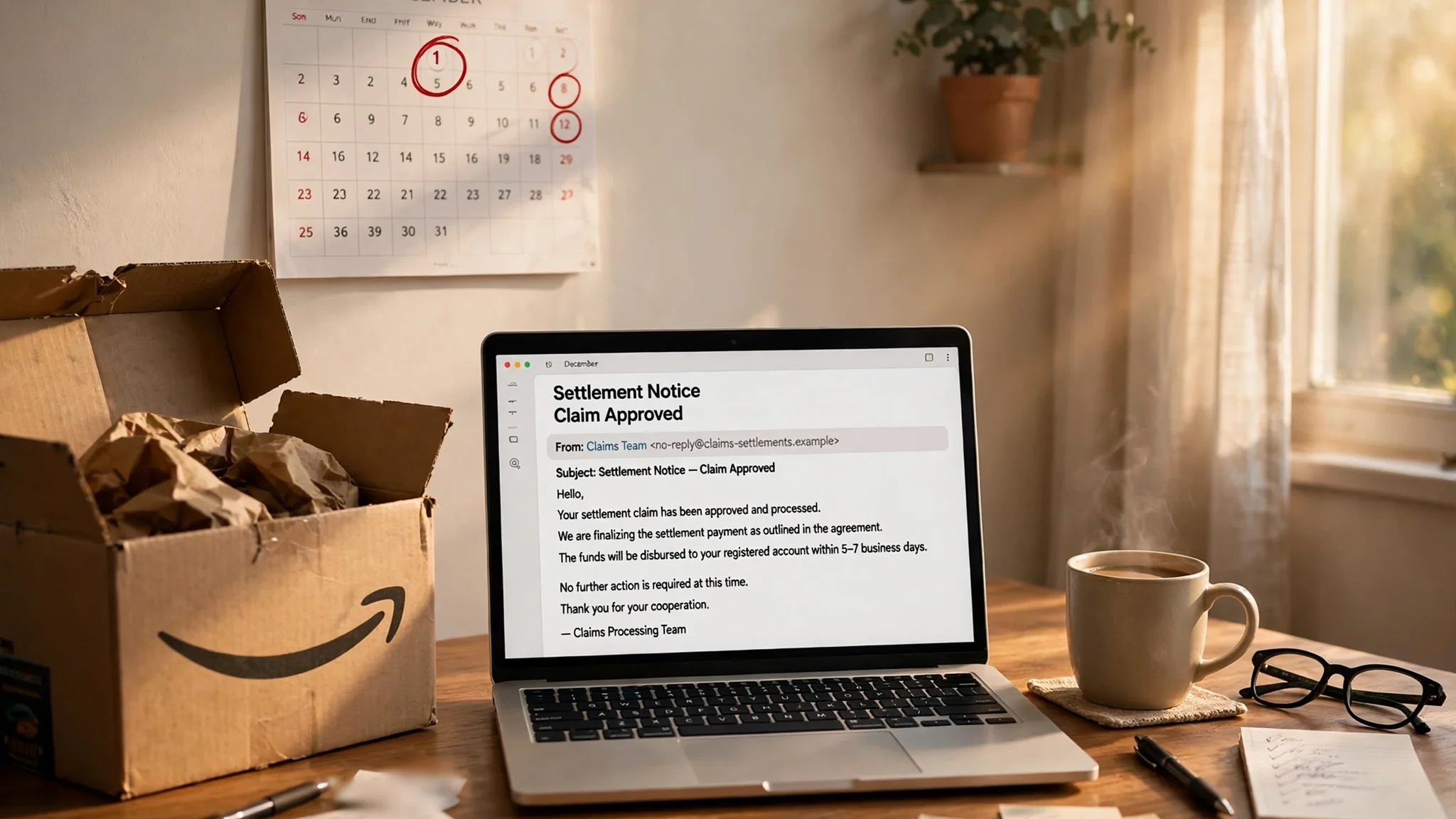
Somewhere in your inbox — or your spam folder, or an inbox you stopped using years ago — there may be an email that decides whether you get a share of $309.5 million. That is not an exaggeration. Under the Amazon return settlement, every class member was supposed to receive an email telling them which of two groups they belong to. One group gets paid automatically. The other has until December 1, 2026 to file a claim with proof, or gets nothing.
Twelve days. That is the gap between today and the deadline, and it is the reason this post exists now instead of next week. The settlement itself has been public since September. The deadline is what is new, and the deadline is what most of the coverage skips past on its way to the big number.
I checked the official settlement site, ReturnSettlement.com, while writing this, and read the settlement FAQ rather than trusting the roundups. Everything below that states a fact about the case comes from that site or from the court record it points to. Where I am describing a scam pattern instead of a documented case, I say so plainly — because the most useful thing this post can do is keep the two apart.
First, don't confuse this with the other Amazon settlement
There are two Amazon settlements in the news right now, and most of what you will read about them mashes the two together. They are different cases, different money, and — this is the part that matters — different things you have to do.
| Return settlement | Prime settlement | |
|---|---|---|
| Case | In re Amazon Return Policy Litigation, No. 2:23-cv-01372-JNW (W.D. Wash.) | FTC v. Amazon over Prime enrollment and cancellation |
| Amount | $309.5 million | $2.5 billion ($1.5B refunds + $1B civil penalty) |
| What it is about | Refunds for returned items that were never paid, paid late, paid wrong, or reversed by a later charge | Prime signups and cancellations the FTC said were deceptive |
| What you do | Subclass A: nothing, paid automatically. Subclass B: file a claim by December 1, 2026 | Nothing. Payments are automatic, up to $200 per person |
| Official place to check | ReturnSettlement.com | ftc.gov/Amazon |
| Status | Final approval hearing March 16, 2027; no payments until the court approves | Payments running November 2025 through April 2027 |
The confusion is not academic. The Prime settlement is the one generating the documented scam wave: fake texts telling people to tap a link to claim a $200 refund. The FTC has said plainly that it will never contact you about that refund, and that nobody from Amazon will ask you for money to release one. The return settlement is the one with a live deadline and a claim form. If you get the two mixed up, you will either file a claim you never needed to file, or miss the one you did.
Amazon denies the allegations in the return case and denies any wrongdoing. The court has made no finding that Amazon broke the law. The settlement exists because both sides preferred to end the litigation, not because liability was established. That distinction does not change what you are owed if you qualify. It does change how you should read any message that claims the court has already decided in your favour — it has not.
The December 1 deadline only bites one group
The settlement splits everyone who qualifies into two subclasses, and which one you are in decides whether December 1 matters to you at all.
Subclass A covers about 92.7% of claimants, according to the settlement reporting. If you are in Subclass A, you do not file a claim. You receive a payment automatically once the settlement is approved and final. The only action on your side is picking a payment method when asked.
Subclass B is everyone else who qualifies. If you are in Subclass B, you must submit an eligible claim form with proof by December 1, 2026. Miss that date and there is no late window described anywhere in the settlement materials. You get nothing.
Here is the part that makes the deadline dangerous: you are supposed to learn which subclass you are in from an email. The settlement reporting says each claimant was expected to receive an email telling them their group. That email went to the email address on your Amazon account. If that address is one you still use, fine. If it is an old address, a work address you lost access to, or a disposable address you used once and forgot, the notice may as well not exist — and the deadline will pass without you knowing you had one.
You qualify if you bought a physical product through Amazon.com, had it delivered in the United States, and initiated a return or asked for a refund between September 5, 2017 and February 12, 2026 — and then either did not receive the refund, received it late or for the wrong amount, or received it and were later charged again for the same item. That is the class definition from the official FAQ, almost word for word. The window is nine years long, which is why the class is so large and why the per-person amounts will be modest. Do not expect a windfall. A $309.5 million fund spread across everyone who returned something to Amazon in nine years is a refund, not a lottery ticket, and any message promising you a large fixed payout from this settlement is lying about the arithmetic.
What a Subclass B claim actually asks for
Filing is not a one-click form. The reporting on the claim process is consistent across the outlets that have covered it: Subclass B members have to provide detailed order information and proof of their refund entitlement on the settlement website before December 1. That means digging up the order, the return, and whatever shows the refund never arrived or was taken back.
Before you start, gather three things. First, the order number and the date of the purchase and return — your Amazon order history has this if the account is still yours. Second, anything showing the refund outcome: the refund confirmation email, the bank or card statement showing no refund or a later re-charge, or the Amazon message thread about the return. Third, the email address the notice went to, because the claim ties to your identity as a class member, not to a username you made up for the occasion.
File only on ReturnSettlement.com, the official site run by the court-appointed administrator, Angeion Group. Type it yourself. Do not click through from an email, a text, or a search ad. The administrator's toll-free number is 1-888-553-4246, and the mailing address is 1650 Arch Street, Suite 2210, Philadelphia, PA 19103. Those details are on the official site, and they are the ones to use if you need to confirm anything. Nobody involved in this settlement will ask you to pay a fee to file, and nobody will ask for your Amazon password, your full card number, or your Social Security number to release a payment.
One more date to hold alongside December 1: the final approval hearing is March 16, 2027, at 10 a.m. in Seattle. Nobody gets paid before the court approves the settlement and it becomes final. If a message tells you your payment is ready now, it is not from this settlement.
The inbox problem: your notice went to an address you may no longer control
This is the part of the story that belongs on this site, because it is the part the news coverage does not write. A settlement notice is an email. Your Amazon account is an email address. And for a lot of people, those two facts stopped lining up years ago.
TempoMailUSA's own Amazon guide worked through what the signup email actually carries on Amazon: order confirmations, delivery updates, refund notices, password-reset links, login alerts, two-step verification codes, rental receipts, channel billing, household invitations, renewal reminders. The email on an Amazon account is not a login detail. It is the recovery path for a financial account, and the settlement notice is one more message that only exists in that inbox.
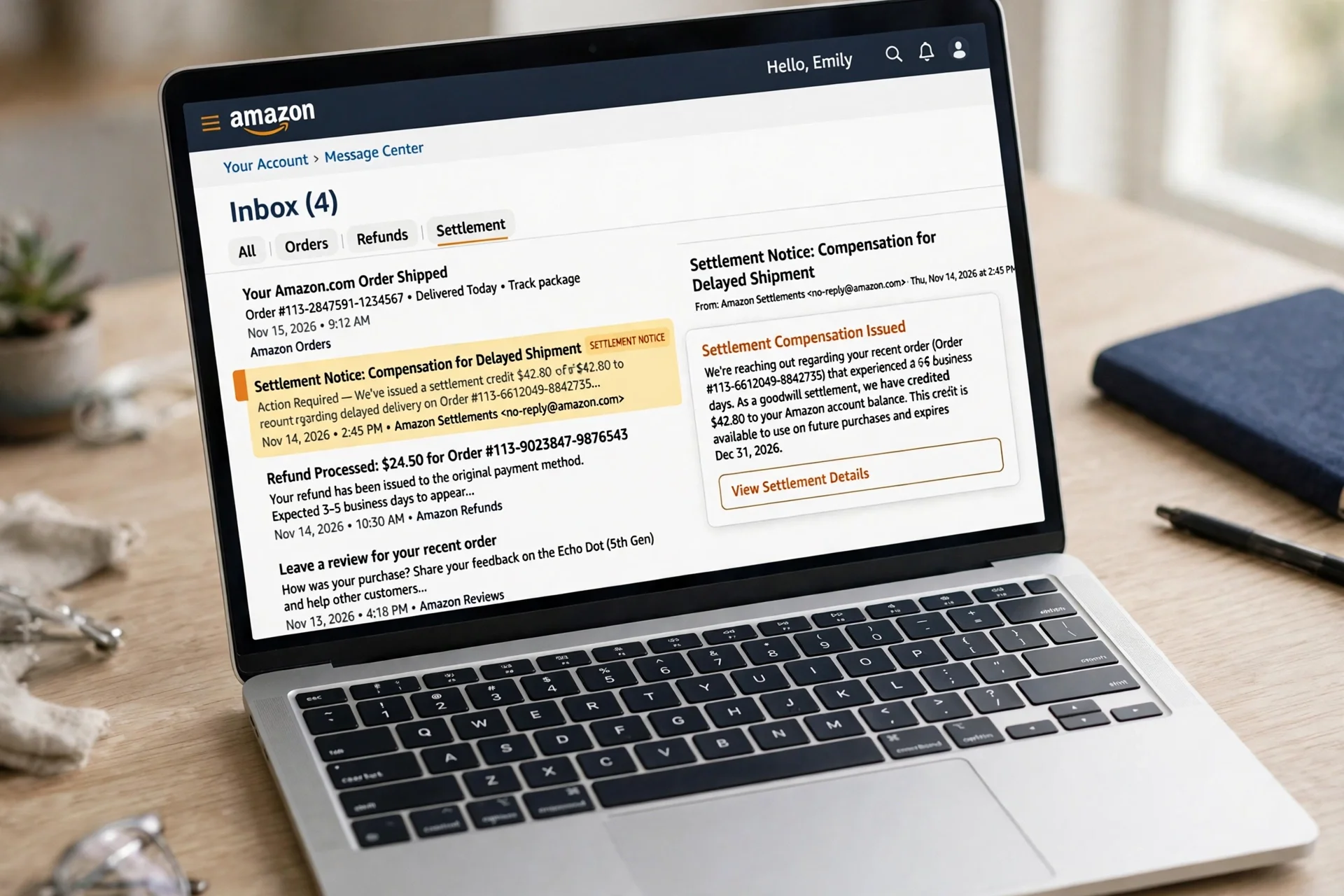
That creates a specific trap for anyone who used a disposable address anywhere near Amazon. Amazon actively blocks known disposable domains at account creation — try to create an account with one and you usually get an error telling you to use a different email address. Some temp-mail domains slip through until Amazon updates its list, which it does constantly. So there are Amazon accounts out there whose registered email is a disposable address that expired months or years ago. If the settlement notice went to one of those, it went nowhere. There is no forwarding, no recovery, and no second notice to a different address, because Amazon has no other address for that account.
I tested the tool side of this while writing. I opened TempoMailUSA this evening, November 19, 2026. The page generated an address automatically with no sign-in, showed an empty inbox with auto-refresh running, and the counters on the page read 484,548 emails created and 609,973 messages received. The free inbox reads its first message free; Pro reads every message and offers 365-day inboxes. And the site's own FAQ says the quiet part out loud: "Do not use a temporary address for account recovery or important messages." That is the vendor telling you, in its own help pages, that a disposable inbox is the wrong place for anything that has to reach you again. A settlement notice is exactly that kind of message.
The rule that follows is the same one our Google Assistant settlement post landed on, for the same reason: use a disposable address when the service does not need to reach you again — a newsletter, a download, a trial. When money, identity, or a legal deadline is involved, use an address you control and will still control in six months. The short version of what disposable email is for lives here, and the settlement is the case that proves the boundary.
If you are unsure whether your Amazon account email is still yours, check it now, not on November 30. Sign in to Amazon, open Account, and look at the email on the account. If it is an address you cannot open today, change it to one you can — and then go to ReturnSettlement.com and check your subclass status there instead of waiting for an email that may never arrive.
Real or fake? Five checks before you click
I searched for a documented fake-email campaign impersonating this specific settlement and did not find one. That is worth stating plainly, because inventing one would be easier than admitting it. What is documented is the scam pattern around the other Amazon settlement, and the generic refund-phishing pattern that predates both. Here is how to run any Amazon settlement message against the facts.
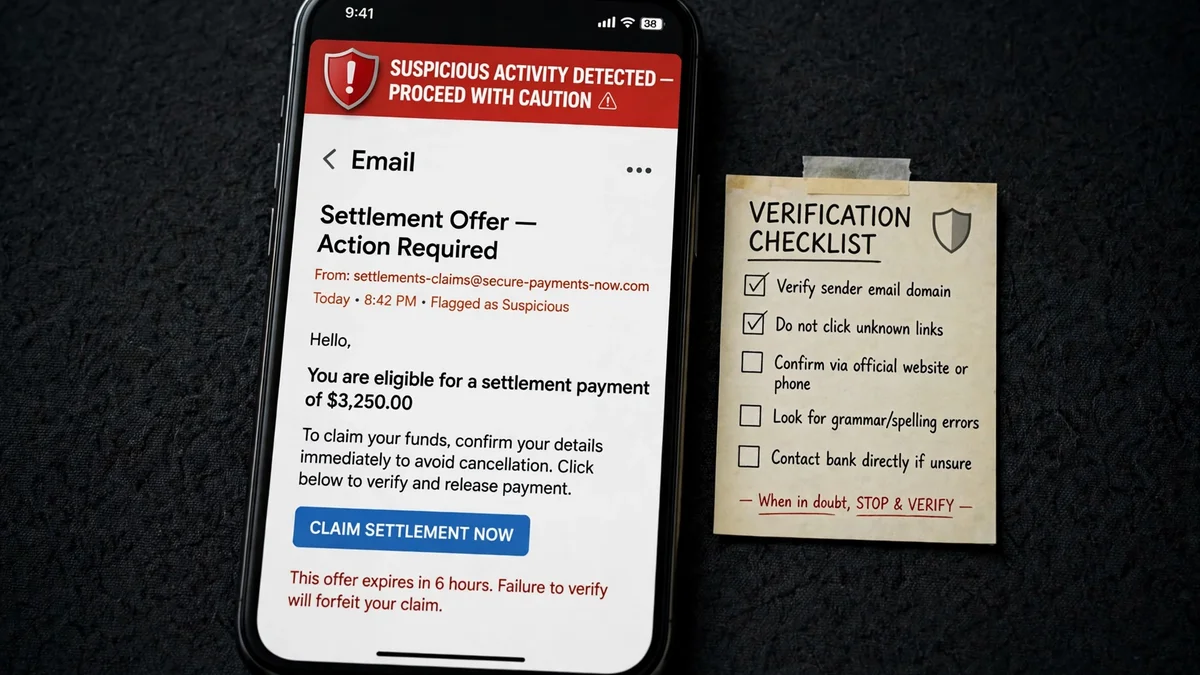
1. The domain is the whole test. The only official site for the return settlement is ReturnSettlement.com. A link to any other domain — a lookalike with an extra word, a hyphen, a different ending — is fake. Type the address yourself. The Prime settlement's official page is ftc.gov/Amazon. Anything else claiming to be either settlement's claims page is not part of either settlement.
2. Nobody charges you to file. There was never a fee to submit a claim form for the return settlement, and there is no fee to receive a payment. A "processing fee," a "release fee," or a request for card details to unlock your refund is the scam. The FTC has said the same about the Prime refunds: no one from Amazon will ask you for money to get one.
3. The deadline is the tell. Any message telling you to file a return-settlement claim urgently is only plausible until December 1, 2026. After that date, a message telling you to file is lying about a deadline that has passed — the same way messages still telling people to file Google Assistant claims are lying about a deadline that ended on August 27. And any message telling you to file a Prime claim at all is fake on its face, because the Prime refunds need no claim.
4. The payout is not a fixed number. Nobody can promise you a specific amount from the return settlement, because the fund is divided among the class and the court has not approved it yet. The Prime refunds top out at $200 per person. A message promising hundreds or thousands of dollars from either settlement is fake.
5. Verify inside your account, not inside the email. A real Amazon refund notice will also show up in your Amazon account — Returns and Orders, then Refunds, and the Message Center. If the email claims a refund was issued and your account shows nothing, the email is almost certainly fake. Amazon also runs a verification channel: since September 2026 you can forward a suspicious message to verify@amazon.com and get back a confirmed, not-from-Amazon, or unable-to-verify answer. Use it instead of guessing.
The documented scam wave is worth describing, because it is the shape the return settlement's fakes will take if they come. The FTC's consumer alert on the Prime refunds describes texts that look like they are from Amazon, say a refund is waiting, and include a link. The link leads to a phishing page built to steal money or personal information. The FTC says it is not contacting people about these refunds at all. The defence is boring and it works: never tap a link in a message about money you were not expecting, forward suspicious texts to 7726 (SPAM), and report the message at ReportFraud.ftc.gov.
Do this in the next ten minutes
If you have ever returned anything to Amazon, do not leave this to the weekend. The deadline is December 1, and the checks below take less time than reading this post did.
- Open your Amazon account and confirm the email on it is one you can open today. If it is not, change it now.
- Search that inbox — including spam — for "Amazon Return Policy Litigation" and "ReturnSettlement." That is the notice telling you your subclass. If you find it, you know whether December 1 applies to you.
- If you are Subclass B, go to ReturnSettlement.com (typed, not clicked) and start the claim now. Gather the order number, the return date, and whatever shows the refund outcome before you sit down to file.
- If you are Subclass A, do nothing except pick a payment method when asked. Anyone telling you to file a claim for an automatic payment is not helping you.
- Forward anything suspicious to verify@amazon.com, and report texts to 7726. Then delete the message. Do not reply to it, and do not click anything in it to "unsubscribe" — that only confirms your number is live.
FAQ
Am I in the Amazon return settlement? You are a class member if you bought a physical product through Amazon.com, had it delivered in the U.S., and initiated a return or requested a refund between September 5, 2017 and February 12, 2026 — and you either did not receive the refund, received it late or for the wrong amount, or received it and were later charged again for the same item. The official FAQ on ReturnSettlement.com states the definition, and the site is the authority if you are unsure.
What is the deadline to file a claim? December 1, 2026, for Subclass B members — the group that must file a claim with proof. Subclass A members, about 92.7% of claimants, are paid automatically and do not file. The final approval hearing is March 16, 2027, and no payments go out before the court approves the settlement.
How much will I get? Nobody knows yet, and anyone promising a fixed amount is not telling the truth. The $309.5 million fund is divided among the class after fees, costs, and administration, and the court has not approved the settlement. Expect a modest refund, not a windfall.
Is ReturnSettlement.com the real site? Yes. It is the official settlement website, run by the court-appointed administrator, Angeion Group, reachable toll-free at 1-888-553-4246. Type the address yourself rather than clicking a link in an email or text.
I used a temporary email for my Amazon account. Am I still in the settlement? Your eligibility does not depend on your email address — it depends on the purchase and the refund. But the notice telling you your subclass went to the email on your account, and if that inbox is gone, you will not have seen it. Check your subclass status directly on ReturnSettlement.com, and change the email on your Amazon account to one you control.
How is this different from the Amazon Prime refund texts? The Prime settlement is a separate $2.5 billion FTC case with automatic refunds of up to $200 and no claim to file. The fake texts offering Prime refunds are a documented phishing wave — the FTC says it never contacts people about those refunds. The return settlement is the one with a December 1 claim deadline, and its official site is ReturnSettlement.com.
Settlements used to be a legal story. They are an inbox story now. The GoodRx settlement's claim window is still open until December 29, and the scam emails are already riding it. The Google Assistant settlement's window closed on August 27, and the fake emails are still circulating. Amazon's return settlement is the live one, with twelve days on its clock. Check the email on your account, check your subclass, and file before December 1 if you are in the group that has to. The money is real. The deadline is real. The only thing standing between you and either one is an inbox you can still open.
Need a disposable temporary email?
Protect your real inbox from spam and promotional clutter instantly and free.
Received a suspicious email, text, or charge alert?
Verify whether the sender domain is disposable, spoofed, or unverified before clicking links.