



Why the Social Security Data Breach 2026 Matters to Every American
The social security data breach 2026 refers to a series of critical data security incidents involving the Social Security Administration (SSA), where sensitive personal information of hundreds of millions of Americans was improperly accessed, shared, and stored on unsecured servers. Here's what you need to know:
Key Facts:
- What happened: SSA employees associated with the Department of Government Efficiency (DOGE) secretly copied and shared sensitive data without following security protocols
- Data at risk: Social Security numbers, names, dates of birth, addresses, and other personally identifiable information (PII) for potentially 300+ million Americans
- Timeline: Initial incidents occurred in early 2025, with whistleblower disclosures and court filings emerging throughout 2025-2026
- Major related breaches: Conduent ransomware attack (15.4 million in Texas, 10.5 million in Oregon), National Public Data breach (2.9 billion records)
- Current status: Multiple lawsuits filed, congressional investigations pending, SSA unable to determine full scope of data shared
The situation came to light when Chuck Borges, the SSA's chief data officer, filed a whistleblower complaint alleging that DOGE staffers uploaded a complete copy of the Social Security database to an unsecured Cloudflare server in June 2025. The Trump administration later acknowledged in court filings that DOGE members accessed and shared sensitive data without agency officials' knowledge, potentially violating the Privacy Act and Hatch Act.
"The unauthorized release of Americans' personal data represents a profound violation of public trust," according to the Alliance for Retired Americans. This isn't just about government inefficiency—your Social Security number in the wrong hands can lead to identity theft, fraudulent credit accounts, tax fraud, and medical identity theft that may not surface for years.
What makes this particularly concerning is the lack of transparency. The SSA has repeatedly stated it cannot determine what specific data was shared, whether it still exists on unauthorized servers, or who accessed it. For privacy-conscious individuals, this represents a worst-case scenario: your most sensitive government-held data potentially exposed with no clear path to accountability.
I'm Mohammad Waseem, and through building secure web platforms and studying data protection practices, I've closely followed the unfolding details of the social security data breach 2026 and its implications for online privacy. In this comprehensive guide, I'll break down exactly what happened, who's responsible, what data is at risk, and—most importantly—the specific steps you can take right now to protect yourself.
Understanding the Social Security Data Breach 2026
When we talk about the social security data breach 2026, we're referring to a complex web of events that highlight significant vulnerabilities in government data security. At its core, the incident centers around the alleged mismanagement and unauthorized access of highly sensitive data held by the Social Security Administration (SSA). This wasn't a traditional hack where external bad actors forced their way in (though we'll cover some of those later). Instead, it appears to be an internal breakdown, where employees associated with a government initiative improperly handled and shared data, circumventing established security protocols.
The problem began when employees of the Department of Government Efficiency (DOGE) secretly and improperly shared sensitive personal data last year. A whistleblower alleged that a dataset containing the sensitive information of more than 300 million Americans was copied into a virtual database without adhering to required security protocols. This included Social Security numbers, applicant names, places and dates of birth, among other critical data points. To make matters worse, this sensitive Social Security database was uploaded to an unsecured cloud server in June 2025. This server, we're told, lacked proper security oversight and, alarmingly, had no way to track who accessed it. The SSA itself has admitted it hasn't been able to determine what data was shared by the DOGE team on the Cloudflare server or if it still exists there. This creates a "latent risk" situation – control over the data was lost, opening the door for potential future misuse, even if no immediate exfiltration has been confirmed.
This incident, while unique in its internal nature, isn't happening in a vacuum. The broader landscape of data security reveals a concerning trend. According to the 2025 Data Breach Report from the Identity Theft Resource Center, 2025 saw the highest number of breaches to date. Interestingly, the number of victim notices decreased by 79% year-over-year, suggesting that malicious actors might be moving away from the "mega-breaches" of previous years towards more frequent, precise attacks. However, the incidents we're discussing, particularly those involving third-party contractors, still demonstrate the potential for massive exposure.
Let's look at the types of Personally Identifiable Information (PII) that were compromised or at risk in these incidents:
- Social Security Numbers (SSNs): The cornerstone of identity in the U.S., making them invaluable to criminals.
- Applicant Names: Full names associated with SSNs.
- Places and Dates of Birth: Essential for identity verification.
- Mailing Addresses: Physical addresses linked to individuals.
- Email Addresses and Phone Numbers: Often used for phishing and account takeovers.
- Medical Data and Health Insurance Information: Highly sensitive data that can be exploited for medical fraud.
The scale of these exposures is staggering. For instance, in related incidents, a breach at government technology giant Conduent in January 2025 potentially affected dozens of millions of people across the United States. This ransomware attack compromised individuals' names, Social Security numbers, medical data, and health insurance information. Similarly, the National Public Data breach allegedly exposed up to 2.9 billion records with highly sensitive personal data of up to 170 million people in the US, UK, and Canada, including full names, Social Security Numbers, mailing addresses, email addresses, and phone numbers. These incidents collectively paint a grim picture of the fragility of our personal data.
Immediate Steps for a Social Security Data Breach 2026
Given the potential for your Social Security data to be compromised, taking proactive steps is not just recommended, it's essential. We cannot stress this enough: do not wait for a notification. Act now.
Here’s what we can do immediately to protect ourselves if our Social Security data has been compromised in the social security data breach 2026:
- Place a Credit Freeze: This is your strongest defense. A credit freeze restricts access to your credit report, making it difficult for identity thieves to open new accounts in your name. You'll need to do this with all three major credit bureaus:
- Transunion fraud alerts
- Equifax fraud alerts
- Experian fraud alerts Don't forget to also freeze your credit with the National Consumer Telecom & Utilities Exchange (NCTUE), as it’s used by telecommunications and utility companies.
- Place Fraud Alerts: While not as strong as a freeze, a fraud alert tells businesses to verify your identity before extending credit. This is often a free service offered by the credit bureaus.
- Regularly review your credit report: You are entitled to a free credit report from each of the three major bureaus annually. We recommend taking advantage of this and even signing up for free weekly credit reports to keep a close eye on any suspicious activity. Look for accounts you didn't open or inquiries you didn't authorize.
- Create/Secure your "my Social Security" account: If you haven't already, create an online "my Social Security" account at the SSA website. If you have one, ensure it has a strong, unique password and enable two-factor authentication (2FA). This prevents criminals from creating an account in your name and potentially diverting your benefits. The SSA provides helpful guidance on How You Can Help Us Protect Your Social Security Number and your information.
- Obtain an IRS Identity Protection PIN (IP PIN): This six-digit number prevents someone else from filing a fraudulent tax return using your Social Security number. You can request one from the IRS website.
- Monitor Financial Accounts: Keep a vigilant eye on all your bank statements, credit card bills, and investment accounts for any unauthorized transactions.
- Be Wary of Phishing Attempts: Data breaches often lead to an increase in phishing emails, texts, and calls. Never click on suspicious links or provide personal information to unverified sources. If your Social Security number was compromised, contact the Social Security Administration directly at https://www.ssa.gov/agency/contact/.
- Check for Dark Web Exposure: Microsoft offers a free identity scan using Microsoft Defender to find out if your personal data is exposed on the dark web. It’s free and takes only a few minutes.
The SSA and DOGE Controversy: Whistleblower Allegations
The heart of the social security data breach 2026 saga lies in the controversial actions of the Department of Government Efficiency (DOGE) and the courageous revelations of a whistleblower. This isn't just about a technical glitch; it's about alleged systemic mismanagement and potential political motivations behind the handling of America's most sensitive data.
The individual at the center of these revelations is Chuck Borges, who served as the chief data officer at the Social Security Administration (SSA) until his resignation in August 2025. Borges filed a damning whistleblower complaint that month, alleging that the government mismanaged the private data of anyone with a Social Security number. His complaint stated that the private data of every American who has or ever had a Social Security number was at risk after employees uploaded a copy of the SSA’s database to a cloud environment that lacked oversight. He also filed a separate complaint alleging retaliation for raising these ethical concerns.
So, who or what is DOGE? The Department of Government Efficiency (DOGE) was an initiative during the Trump administration, ostensibly aimed at streamlining government operations. However, court filings and whistleblower accounts suggest that DOGE employees, while embedded within the SSA, engaged in activities far beyond mere efficiency. Their role in this incident involved the alleged mishandling and potential breach of SSA data, with motivations that appear deeply intertwined with political agendas, particularly regarding voter fraud narratives.
The core of the allegations against DOGE is that they secretly and improperly shared sensitive personal data. A court filing last Friday, January 2026, from the Social Security Administration acknowledged that U.S. DOGE Service members accessed and shared sensitive Social Security data without the knowledge of agency officials. This admission only deepened questions about the DOGE effort and the extent of the violations.
Here's a breakdown of the alleged improper access and sharing:
- Unsecured Cloud Server: In June 2025, DOGE allegedly uploaded a Social Security database, brimming with sensitive information—Social Security numbers, applicant names, places and dates of birth—to an unsecured cloud server. This server reportedly lacked security oversight or a way to track who accessed it, which is like leaving the keys to Fort Knox on your doorstep.
- Circumvention of Security Protocols: DOGE employees were accused of circumventing IT rules to improperly share data on outside servers. This included using links to share data through an unapproved third-party server called Cloudflare between March 7 and March 17, 2025. The SSA has since stated it cannot determine what data was shared or if it still exists on that server.
- Political Motivations: A significant motivation behind DOGE's data access efforts appears to have been to find evidence of voter fraud. This is highlighted by incidents where two SSA DOGE employees were referred to a federal watchdog for potentially violating the Hatch Act by conferring with a political advocacy group about matching Social Security data with state voter rolls. Groups like True the Vote had publicly made "An Appeal to DOGE: Audit the Voter Rolls" through social media posts on X. Antonio Gracias, an ally of Elon Musk, working with DOGE at the SSA, gave shifting numbers of alleged noncitizens finded by DOGE, from "well over a thousand" to "thousands," but ultimately stated that only 57 cases "may or may not have voted." This suggests a fishing expedition rather than a robust fraud investigation.
- Broader Data Consolidation: The Trump administration was also actively pursuing broader data consolidation efforts, including taking steps to share sensitive Medicaid and IRS data with the Department of Homeland Security (though a federal court has blocked most IRS data sharing for now). These efforts, combined with the overhaul of the SAVE data system into a centralized national citizenship tool, underscore a desire for extensive government data access.
The implications of this incident for public trust in government data security are profound. When an agency entrusted with the most sensitive personal data of every American is accused of such mishandling, it erodes the very foundation of that trust. Chuck Borges himself stated that if the SSA's data were to get out, it would be a "catastrophic risk to the American public."
The government's response to the whistleblower's claims and court filings has been mixed. While acknowledging that DOGE employees improperly accessed and shared sensitive data, the SSA has repeatedly stated its inability to verify the full extent of the violations. This lack of clarity leaves millions of Americans in limbo, unsure if their data has been compromised. Congress and other government agencies are being urged to investigate this data security issue thoroughly to provide answers and accountability.
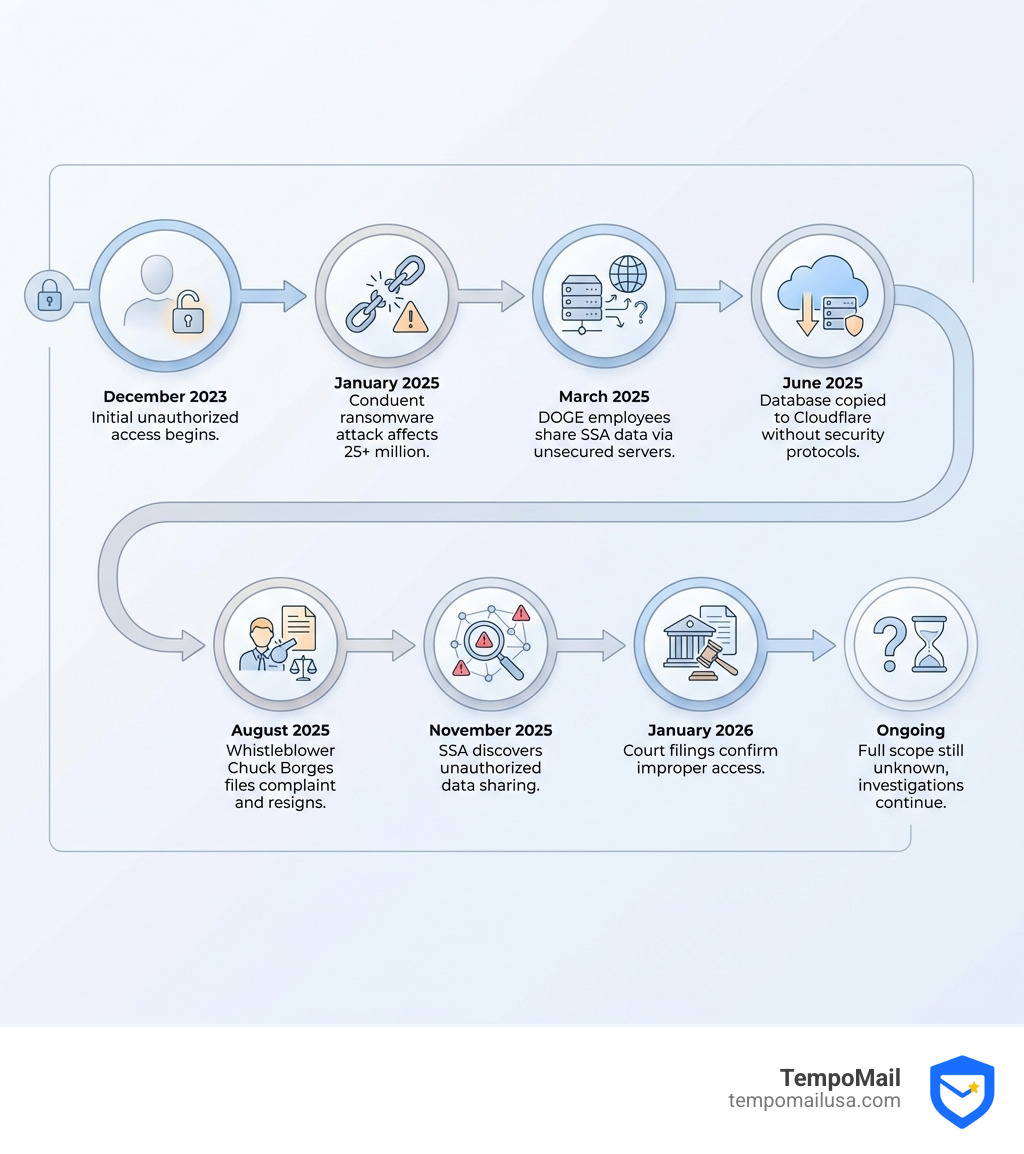
Timeline of the Social Security Data Breach 2026
Understanding the chronology of these events helps us grasp the full scope of the social security data breach 2026. It wasn't a single event, but a series of overlapping incidents and disclosures:
- December 2023: Malicious actors gained initial access in what would become known as the National Public Data breach.
- Early 2024: The National Public Data breach came to light, exposing billions of records of up to 170 million people.
- January 2025: The Conduent ransomware attack occurred, knocking out the company's systems and eventually affecting tens of millions of people across multiple states.
- March 2025: SSA DOGE employees allegedly used links to share data through an unapproved third-party server (Cloudflare) between March 7 and 17. A federal judge temporarily blocked DOGE's work on March 20 due to concerns about unfettered access to data.
- June 2025: The Social Security database, containing sensitive information for over 300 million Americans, was allegedly uploaded to an unsecured cloud server by DOGE.
- August 2025: Chuck Borges, the SSA's chief data officer, resigned and filed his whistleblower complaint, detailing the alleged data mismanagement and security lapses.
- November 2025: The SSA finded that DOGE employees had secretly and improperly shared sensitive personal data.
- Early 2026: Conduent plans to conclude alerting individuals about its data breach, nearly a year after the initial attack.
- January 2026: Court filings from the SSA officially acknowledge that DOGE employees improperly accessed and shared sensitive data, though the full extent remains unknown.
This timeline illustrates a disturbing pattern of data mishandling and delayed disclosures, underscoring the urgent need for individuals to take control of their own data security. For more information about tools that can help you protect your privacy, you can explore More info about tools.
Major Incidents: Conduent and National Public Data
Beyond the internal SSA data mishandling, the social security data breach 2026 context is further complicated by other large-scale incidents involving highly sensitive data. These breaches, while separate from the DOGE controversy, highlight the pervasive threat to our personal information and the critical role of Social Security numbers in identity theft.
First, let's look at the massive breach at Conduent, a government technology giant. Conduent is a contractor that handles and processes vast amounts of personal and sensitive information on behalf of large corporations, government departments, and several U.S. states. Its technology and operational support services reach more than 100 million people in the United States across various government healthcare programs.
- The Incident: In January 2025, Conduent was hit by a ransomware attack, claimed by the Safeway ransomware gang. This attack knocked out the company’s systems, resulting in outages to government services across the United States.
- Scale of Impact: The number of victims from the Conduent breach appears far greater than initially disclosed, potentially stretching to dozens of millions. At least 15.4 million people in Texas alone were affected, accounting for about half of the state's population. Another 10.5 million people are affected across Oregon. Conduent has also notified hundreds of thousands of people across Delaware, Massachusetts, New Hampshire, and other states.
- Data Compromised: The stolen data from Conduent includes individuals’ names, Social Security numbers, medical data, and health insurance information. The Safeway ransomware gang claimed to have stolen over 8 terabytes of data. In a later SEC filing, the company acknowledged that the stolen datasets "contained a significant number of individuals’ personal information associated with our clients’ end-users," referring to its corporate and government customers.
- Notification Timeline: Conduent plans to conclude alerting individuals about the data breach by early 2026, nearly a year after the initial attack. This extended notification period leaves many in limbo, highlighting the challenges of managing such a large-scale event.
Then, we have the National Public Data (NPD) breach, a truly staggering incident that underscores the risks posed by data aggregators.
- The Incident: In early 2024, National Public Data, an online background check and fraud prevention service, experienced a significant data breach. This breach allegedly exposed up to 2.9 billion records with highly sensitive personal data of up to 170 million people in the US, UK, and Canada.
- Data Compromised: The NPD breach exposed full names, Social Security Numbers, mailing addresses, email addresses, and phone numbers. Further investigation by security researchers like KrebsOnSecurity’s Brian Krebs suggested a related vulnerability involving a third-party data broker, RecordsCheck.net, which allegedly exposed NPD’s backend database passwords in plain text. Talk about leaving the door wide open!
- Cost of Compromise: While the exact cost of the NPD scenario is unknown, IBM’s authoritative Cost of a Data Breach Report provides context. The 2024 report found the global average cost of a data breach reached a record high of $4.88 million, a 10% increase year-over-year. This staggering figure reflects not just the technical cleanup but also lost business, reputational damage, and customer turnover.
These major incidents, combined with the internal SSA data mishandling, paint a concerning picture. They demonstrate that whether data is compromised by external ransomware gangs or internal mismanagement, the outcome for individuals is the same: increased risk of identity theft, financial fraud, and a profound sense of vulnerability. The sheer volume of compromised Social Security numbers and medical data in these cases makes the social security data breach 2026 a multifaceted and deeply troubling issue for millions.
Frequently Asked Questions about Social Security Data Breach 2026
We know you have questions, and we're here to provide clarity on the social security data breach 2026 and its wider implications. Let's tackle some of the most common concerns.
What is the Social Security Data Breach 2026?
The social security data breach 2026 refers to a series of incidents, primarily stemming from the alleged improper access and sharing of sensitive Social Security Administration (SSA) data by employees associated with the Department of Government Efficiency (DOGE). A whistleblower revealed that a complete copy of the Social Security database, containing the personal information of hundreds of millions of Americans, was uploaded to an unsecured cloud server without proper security oversight. This creates a significant risk of identity theft and other fraudulent activities. This internal mishandling occurred alongside other massive breaches by third-party contractors like Conduent and National Public Data, which also exposed millions of Social Security numbers.
What specific SSA data was improperly accessed?
The SSA data specifically compromised or improperly accessed by DOGE employees included Social Security numbers, applicant names, places and dates of birth, among other sensitive details. The SSA has not been able to definitively determine the full scope of what data was shared or if it still exists on the unauthorized servers. In related incidents, breaches like Conduent exposed names, Social Security numbers, medical data, and health insurance information, while National Public Data exposed full names, Social Security Numbers, mailing addresses, email addresses, and phone numbers. The common thread is the exposure of highly sensitive Personally Identifiable Information (PII), with Social Security numbers being the most critical.
What is the current status of the lawsuits related to this incident?
There are multiple legal actions underway related to the social security data breach 2026. The Trump administration, in a January 2026 court filing, acknowledged that U.S. DOGE Service members accessed and shared sensitive Social Security data without the knowledge of agency officials. This admission came after a federal judge had already temporarily blocked DOGE's work in March 2025 due to concerns about unfettered access to data. Whistleblower Chuck Borges has not only filed a complaint about the data mismanagement but also a separate complaint alleging retaliation for his actions. Calls for congressional investigations are mounting, and the Office of Special Counsel is reviewing potential Hatch Act violations by DOGE employees. The full legal ramifications and accountability measures are still unfolding, but these court filings and whistleblower actions are crucial steps toward demanding transparency and justice.
If you are concerned about your data and want to explore options for protection, we invite you to Register for protection.
Conclusion
The social security data breach 2026 is more than just a headline; it's a stark reminder of the fragile nature of our digital identities and the profound responsibility government agencies and their contractors bear in protecting our most sensitive information. The revelations of internal mismanagement within the SSA by DOGE, coupled with the staggering scale of breaches at entities like Conduent and National Public Data, paint a concerning picture for public trust in government data security.
The implications for public trust are immense. When the very institutions entrusted with safeguarding our Social Security numbers—the bedrock of our financial and personal lives—demonstrate such lapses, it erodes confidence in the entire system. We have a right to expect transparency, accountability, and robust security measures. The current inability of the SSA to fully determine what data was shared, or whether it still exists on unauthorized servers, is simply unacceptable. While confirmed instances of data exfiltration or misuse are still being investigated, the fact of unauthorized access and sharing creates a monumental risk for identity theft and fraud, potentially affecting millions for years to come.
This incident underscores the urgent need for government accountability. We must demand comprehensive investigations, clear answers, and concrete actions to prevent future occurrences. It's time for our leaders to prioritize PII protection with the same rigor they apply to national security.
In an increasingly interconnected world, where our Personally Identifiable Information (PII) is constantly at risk, taking personal responsibility for our data security has never been more critical. This is where services like TempoMail can help. We understand the value of your privacy and the need for a strong firewall between your sensitive information and the online world. Our identity proxying services generate secure aliases, protecting your PII from online services, helping you regain a sense of control in an environment where data breaches are becoming all too common.
We encourage you to stay informed, remain vigilant, and take proactive steps to protect your digital footprint. Your privacy is worth fighting for. For more information about how our services can help you safeguard your identity, please visit More info about services.