



Wire Fraud Is One of the Most Prosecuted Federal Crimes in the U.S.
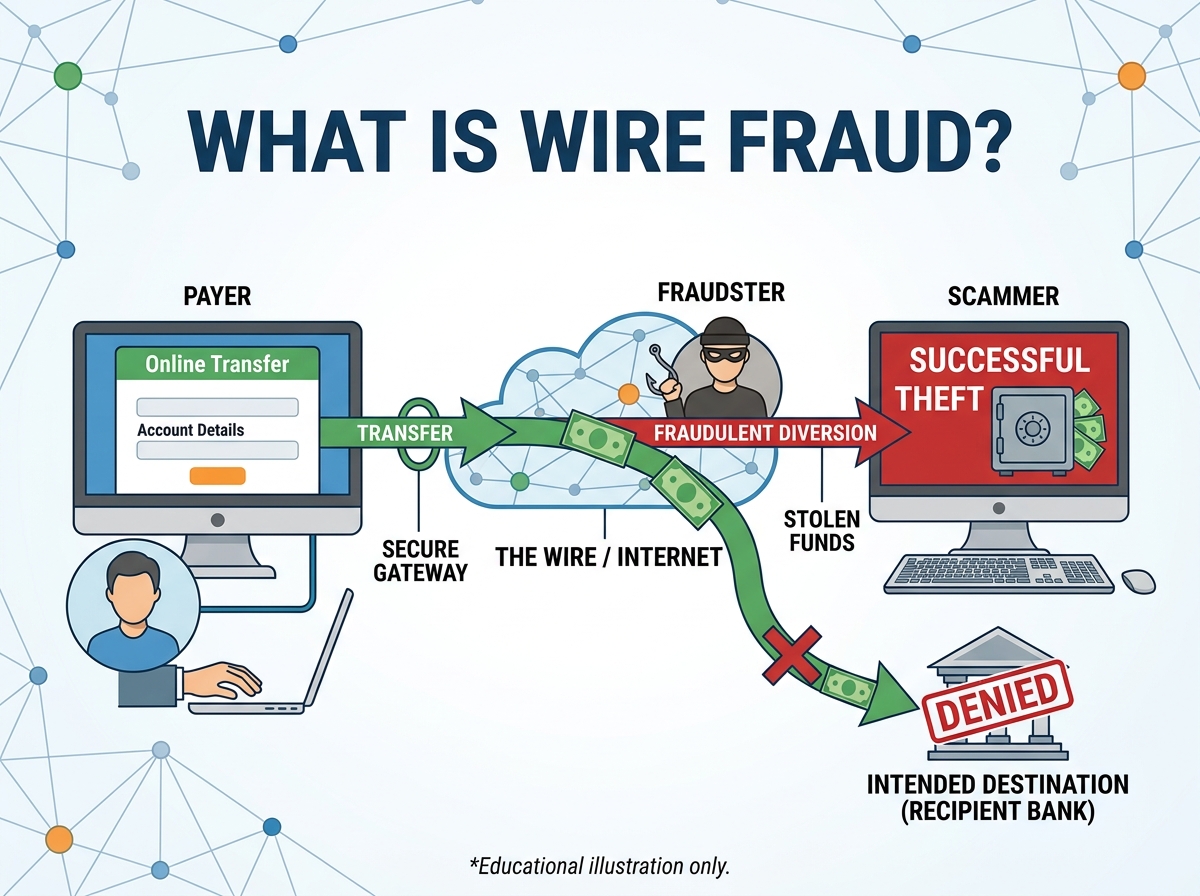
What is wire fraud? It is a federal crime where someone uses electronic communications — like email, phone calls, or wire transfers — to run a scheme to steal money, property, or services from others.
Here is a quick breakdown:
| Element | What It Means |
|---|---|
| The scheme | A plan to deceive someone for financial gain |
| The intent | The person knowingly tried to defraud |
| The wire | Electronic communication was used (email, phone, internet) |
| Interstate reach | The communication crossed state or national borders |
Under 18 U.S.C. § 1343, federal prosecutors do not need to prove the scheme actually succeeded. Intent and use of electronic communications are enough for a conviction.
The scale of the problem is staggering. In 2023 alone, internet crimes including wire fraud caused $12.5 billion in losses across the United States. Real estate buyers, business owners, and everyday people are all targets.
Wire fraud is not a niche legal concept — it touches anyone who sends money or sensitive information online. And as scams grow more sophisticated with AI and deepfake technology, understanding what it is (and how to spot it) has never been more important.
What is Wire Fraud? Legal Definition and Elements
To truly understand what is wire fraud, we have to look at the legal backbone that defines it. According to the Justia page on Wire Fraud Law, wire fraud is a federal offense involving the use of electronic communications to intentionally deceive someone. This isn't just a "small-time" scam; it is a heavyweight white-collar crime prosecuted under 18 U.S.C. § 1343.
At its core, wire fraud requires a "scheme or artifice to defraud." This means there must be a plan designed to deprive a victim of money, property, or even "honest services" (like a public official taking a bribe). The Wex Definitions Team emphasizes that the communication must cross state or national borders—what we call "interstate commerce"—to fall under federal jurisdiction.
One of the most surprising things about wire fraud is that the electronic communication itself doesn’t even have to be fraudulent. If a scammer sends a perfectly "honest" email to a co-conspirator to coordinate a meeting about a heist, that email can be the basis for a wire fraud charge because it was sent "in furtherance" of the scheme.
The Four Elements of a Federal Conviction
For a prosecutor to win a case, they must prove four specific elements beyond a reasonable doubt:
- A Scheme to Defraud: The defendant created or participated in a plan to obtain money or property through false pretenses.
- Intent to Defraud: This wasn't an accident. The person acted with the specific goal of cheating someone.
- Foreseeable Use of Wires: It was reasonable to expect that wire, radio, or television communications would be used during the scam.
- Actual Transmission: A transmission (like an email, a Slack message, or a wire transfer) actually occurred in interstate or foreign commerce.
18 U.S.C. § 1343 vs. Mail Fraud
We often hear "mail and wire fraud" mentioned in the same breath. While they are siblings, they have different birthdays. The mail fraud statute is a classic, dating back to 1872. Wire fraud was codified much later, in 1952, to account for the rise of the telephone and telegram.
The main difference lies in the medium. Mail fraud involves the U.S. Postal Service or private carriers (like FedEx), while wire fraud covers the digital world.
| Feature | Wire Fraud (18 U.S.C. § 1343) | Mail Fraud (18 U.S.C. § 1341) |
|---|---|---|
| Primary Medium | Email, Phone, Internet, TV, Radio | Physical letters, packages |
| Jurisdiction | Interstate or Foreign Commerce | Any use of the Postal Service |
| Year Created | 1952 | 1872 |
| Key Requirement | Electronic transmission | Physical delivery |
Common Scams: BEC, EAC, and Real Estate
Scammers are creative, but they usually stick to a few "greatest hits" that have proven effective over the years. According to the FBI’s Business E-mail Compromise reports, these scams are becoming more expensive every year. We are seeing a massive shift toward "social engineering," where the fraudster doesn't hack a computer, but rather "hacks" a human being by gaining their trust.
What is Wire Fraud in Real Estate Transactions?
Real estate is a "holy grail" for fraudsters. Why? Because it involves massive, one-time transfers of life savings. In 2020 alone, about 13,638 people were victims of wire fraud in the real estate and rental sector. These victims lost more than $213 million—a 17% increase over the previous year.
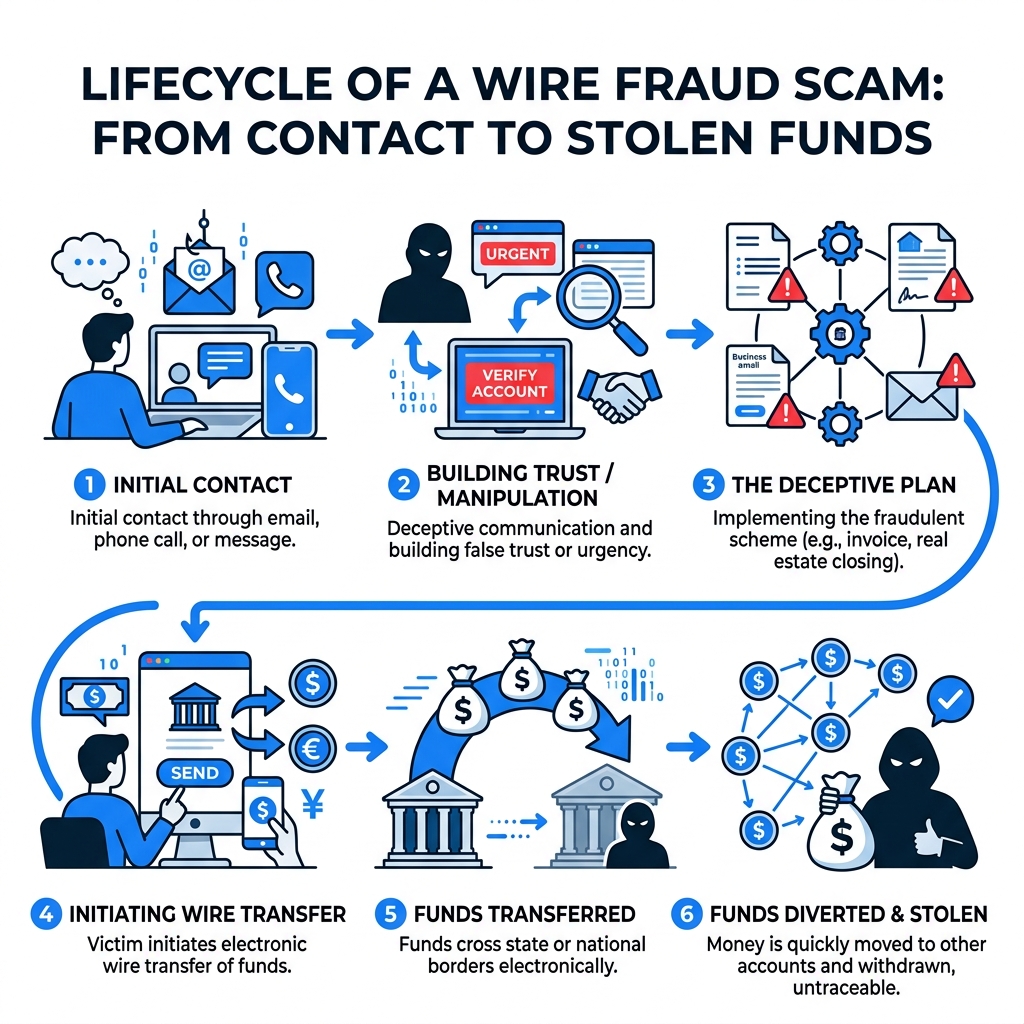
In a typical real estate scam, a fraudster hacks the email account of a title agent or a real estate lawyer. They wait until the very last minute—just before the buyer is supposed to send the down payment—and send a "corrected" email with new wiring instructions. The buyer, thinking they are talking to their trusted agent, sends their life savings directly into a criminal's offshore account. Organizations like the Coalition to Stop Real Estate Wire Fraud are working hard to educate the public, but the numbers continue to rise. Between 2015 and 2017, there was a staggering 1100% rise in victims reporting a real estate angle to their fraud.
Business Email Compromise (BEC) and Phishing
While real estate scams target individuals, Business Email Compromise (BEC) and Email Account Compromise (EAC) target the big fish. In these scenarios, a scammer might spoof the email address of a CEO or a CFO. They send an "urgent" request to the accounting department to pay a "vendor" invoice immediately.
Because the email looks official, the employee often bypasses standard security protocols. The IC3 2023 Internet Crime Report notes that total victim losses from internet crimes reached $12.5 billion in 2023. BEC is a huge driver of that figure because the individual "payouts" from a single corporate wire can be in the millions.
Penalties, Sentencing, and Federal Investigations
If you're wondering how serious the government takes this, the answer is: very. Wire fraud is a federal felony, and the Department of Justice doesn't play around. In fiscal year 2023, wire fraud prosecutions reached record levels, with approximately 88% of cases resulting in a conviction.
Sentencing Guidelines and Record Conviction Rates
The penalties for wire fraud are designed to be a major deterrent. A standard conviction can lead to up to 20 years in federal prison and significant fines. However, if the fraud involves a financial institution (like a bank) or relates to a presidentially declared disaster, the penalty can jump to 30 years in prison and a $1 million fine.
According to the US Sentencing Commission 2018 Quarterly Data Report, the average sentence for fraud, theft, and embezzlement offenses was 23 months. However, this is just an average. The actual time served depends heavily on the "loss table" found in USSG §2B1.1. The more money stolen, the higher the "offense level" and the longer the prison stay. For example, stealing $250,000 might add 12 levels to a sentence, while stealing over $65 million could add 24 levels.
Interestingly, judges often have some wiggle room. In 2018, there were 2,118 "downward variances" (sentences lower than the guidelines) compared to only 110 upward ones. Roughly one out of six people charged with fraud received a sentence of probation rather than jail time, usually in cases where the loss was small or the defendant had no prior record.
Who Investigates and Prosecutes These Crimes?
Because wire fraud is a federal crime, it is investigated by the big guns:
- FBI (Federal Bureau of Investigation): The primary agency for most internet and financial fraud.
- IRS (Internal Revenue Service): Often involved if the fraud includes tax evasion or money laundering.
- U.S. Secret Service: They don't just protect the President; they are experts in financial infrastructure and electronic crimes.
- U.S. Postal Inspection Service: Involved if the scheme also touched the mail system.
If you suspect you are being targeted, you should contact your local FBI office immediately.
Prevention and Response Strategies
We believe that the best defense is a good offense. You don't have to be a tech genius to protect yourself; you just have to be a bit more skeptical of your inbox.
The Evolution of What is Wire Fraud in the Age of AI
The game has changed. Fraudsters are now using Generative AI to make their scams nearly indistinguishable from reality. We are seeing:
- Deepfakes: Scammers can create video or audio of a CEO or a family member asking for money.
- Voice Cloning: A quick 3-second clip of your voice from social media is all an AI needs to "clone" you and call your bank or your relatives.
- Automated Phishing: AI can write thousands of perfectly phrased, personalized emails that don't have the typical "broken English" red flags of older scams.
Scammers also use Personal Identifiable Information (PII) harvested from the dark web to make their "stories" more believable. This is why protecting your real email address is so critical.
What to Do if You Are Targeted
If you realize you’ve sent a fraudulent wire, every second counts. There is a "Financial Fraud Kill Chain" that authorities can trigger, but it usually only works if you act within a 72-hour window.
- Contact Your Bank Immediately: Ask them to issue a "Wire Recall" or "SWIFT Recall."
- Contact the Receiving Bank: If you can identify where the money went, call that bank's fraud department to freeze the account.
- File an IC3 Complaint: Go to ic3.gov (the FBI’s Internet Crime Complaint Center) and file a report. This is the fastest way to get federal agents involved.
- Report to the FTC: Use ReportFraud.ftc.gov to help the government track the scammers and protect others.
Frequently Asked Questions about Wire Fraud
What is the statute of limitations for wire fraud?
For most wire fraud cases, the statute of limitations is 5 years under 18 U.S.C. § 3282. However, if the scheme "affects a financial institution," the window for the government to bring charges expands to 10 years. This gives prosecutors a long time to follow the money trail.
Can you go to jail for wire fraud if no money was lost?
Yes. This is a common misconception. The law punishes the intent and the execution of the scheme. If you send a fraudulent email trying to steal $1 million, but the bank catches it and stops the transfer, you can still be convicted of wire fraud. The "success" of the crime is not a required element for a conviction.
Is wire fraud a felony or a misdemeanor?
It is always a federal felony. Specifically, it is a Class C felony. A conviction means a permanent criminal record, the loss of your right to own a firearm, and significant hurdles for future employment.
Conclusion
Understanding what is wire fraud is the first step in staying safe in an increasingly digital world. From real estate transactions to corporate emails, the risks are everywhere, and the "bad actors" are getting smarter with AI.
At Tempo Mail USA, we know that your PII (Personally Identifiable Information) is the fuel that scammers use to build their profiles. By using temporary email aliases, you create a digital firewall between your real identity and the services you use. This secure proxying prevents your real email from being leaked in data breaches, making it much harder for fraudsters to target you with sophisticated phishing or BEC scams.
Don't wait until you're a statistic in next year's FBI report. Take control of your digital footprint today.