
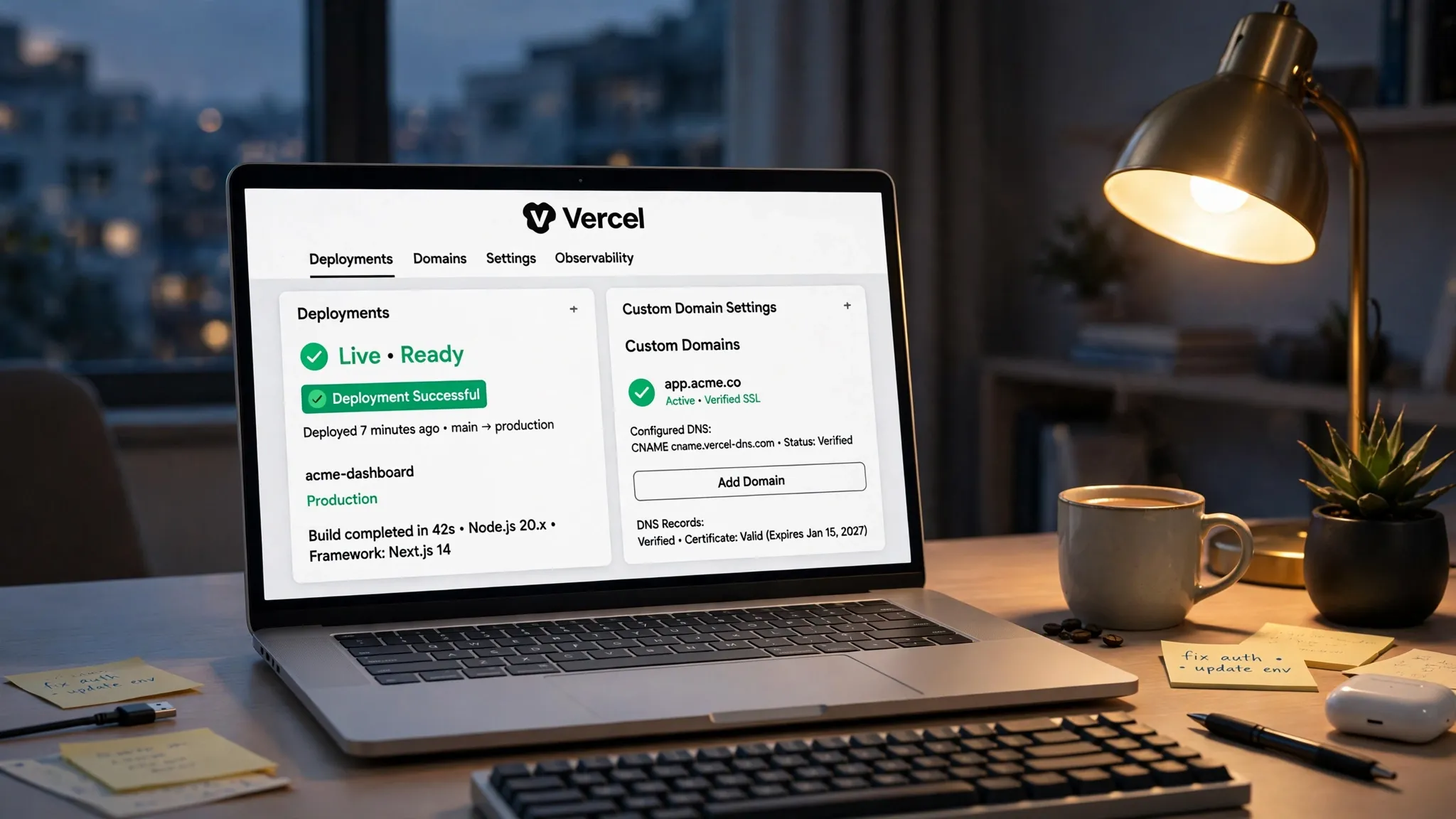
Temp Email for Vercel Signup: a Free Hobby Tier, a Six-Digit Code, and the Deployments That Answer to One Inbox
The deploy button is free. The account is the asset.
Vercel has the cleanest pitch in developer tools: push to Git, and your site is live on a global CDN in seconds, with HTTPS, preview deployments for every branch, and a free subdomain under your project name. The Hobby plan costs nothing, asks for no card, and never expires. It is, on paper, the most generous free tier a developer will ever touch.
The paper is honest. The catch is somewhere else entirely, and it is the same catch this whole series keeps finding: the thing that is free is the deployment, and the thing that owns the deployment is the email address you signed up with. Every project, every custom domain, every SSL certificate, every billing notice, and every recovery path answers to that one inbox. A temporary email gets you through the door in under a minute. What it cannot do is hold the door open for the year after, when the project you threw up on a Tuesday afternoon turns into the portfolio link on your resume, or the client site, or the domain you paid a registrar for.
This post is about that gap, measured against what Vercel actually publishes. The pricing and limits below were read on November 19, 2026, from Vercel's own pricing page and plan documentation as tracked by independent pricing guides. The signup and account rules come from Vercel's own account-management documentation. Where Vercel publishes no policy — and on disposable email, it publishes none — this post says so plainly instead of inventing one.
What the signup actually asks for
Signing up for Vercel takes about ninety seconds, and the form asks for almost nothing. You can sign up with an email address, in which case Vercel sends a six-digit one-time password to that address and you type it back in. Or you can continue with a Git provider — GitHub, GitLab, or Bitbucket — and skip the code entirely. There is no card on the Hobby plan, no trial countdown, and no phone number. Passkeys are supported as a login method, and Vercel Drop, launched in June 2026, lets you deploy a site with no Git and no command line at all — but it still requires a Vercel account, which still requires the email.
That six-digit code is the entire gate, and it is worth understanding what it does and does not prove. It proves that somebody controlled that inbox at the moment of signup. It proves nothing about who will control it in a month, and Vercel's system treats the address as the account's identity from that moment on. The email you verify is where password resets go, where team invitations go, where usage warnings go, and where the verification link goes when you try to change the email itself. The code is small. The commitment behind it is not.
The Hobby tier, read November 19, 2026
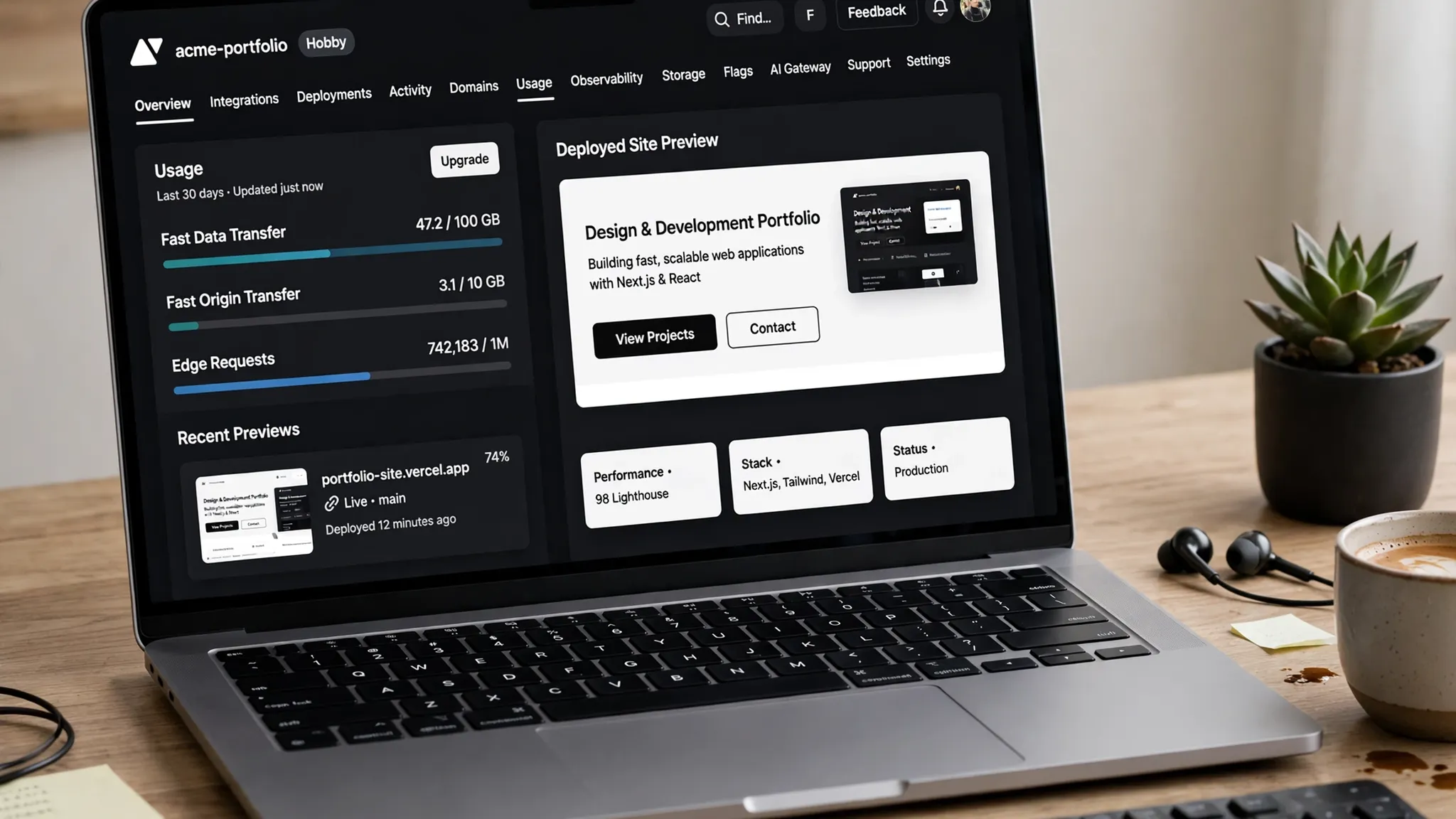
Hobby is free forever, and the allowances are real. Here is the tier as Vercel documents it, checked against the pricing page and plan documentation on November 19, 2026.
| Resource | Hobby includes |
|---|---|
| Fast Data Transfer | 100 GB per month |
| Edge Requests | 1,000,000 per month |
| Function invocations | 1,000,000 per month |
| Build minutes | 6,000 per month |
| Projects | 200 |
| Deployments | 100 per day |
| Concurrent builds | 1 |
| Custom domains | 50 per project |
| Seats | 1 |
| Support | Community forums only |
Two things in that table deserve more attention than the numbers. First, Hobby ships more than it used to: the Web Application Firewall, DDoS mitigation, Fluid compute, and the global CDN are all included on the free plan, and every project gets a free `.vercel.app` subdomain with automatic HTTPS from the first deploy. Custom domains are free to connect — up to 50 per project — and Vercel issues the SSL certificate through Let's Encrypt and renews it 14 to 30 days before it expires. You still pay your registrar for the domain itself; nobody gives away a `.com`.
Second, the limits are hard caps, not soft ones with a bill attached. Hobby has no paid overages. If you exceed an included allowance, the feature generally pauses until the 30-day window resets, or you upgrade to Pro. You cannot buy more usage on Hobby — Vercel says so directly in its pricing FAQ. A portfolio that suddenly goes viral does not get a surprise invoice; it gets a paused feature and a month-long wait. For a personal project, that is a fair trade. For anything with an audience that matters, it is a deadline you did not choose.
The sentence that matters more than every limit
Every pricing guide that reads Vercel's documentation carefully lands on the same line, and it is not a number. Vercel's fair-use guidelines say Hobby teams are restricted to non-commercial personal use only, and all commercial usage of the platform requires either a Pro or Enterprise plan. Donations explicitly do not count as commercial use, so a personal project with a tip jar is fine. Everything else with money in it is not.
This is the line that pushes most people to Pro before any usage limit ever bites. A portfolio or a student project qualifies. A site you were paid to build does not. A site that shows ads, sells services, takes bookings, or generates leads does not. A SaaS, even a tiny one with three paying users, does not — Vercel's terms call that out specifically, and the day you turn on Stripe on a Hobby project is the day you are in violation. Pro costs $20 per deploying seat per month, includes $20 of monthly usage credit, 1 TB of Fast Data Transfer, 10 million Edge Requests, and unlimited viewer seats, and it is the cheapest legal way to host anything commercial on the platform.
The reason this matters for a temp-email signup is timing. The Hobby tier is so generous that it is easy to build something real on it before you notice you have crossed the line — a side project that gets its first customer, a portfolio that starts taking freelance inquiries, a demo that becomes the product. By the time the project is commercial, the account that owns it is the one you created with an inbox that expired in ten minutes. The upgrade path exists, but it runs through the email you no longer control.
What a temp email actually gets you at the door
Here is the honest answer, with the uncertainty left in. Vercel publishes no policy on disposable or temporary email addresses. We checked: the account documentation describes the six-digit code flow and the Git-provider flow, and says nothing about which domains it accepts or rejects. Third-party temp-mail guides that cover Vercel are blunt about the same gap — acceptance is Vercel's decision, it changes over time, and nobody outside Vercel can promise it.
What that means in practice is simple. A temporary inbox can receive the six-digit code, because the code is an ordinary email and temp inboxes receive ordinary email. If Vercel's systems do not block the domain you used, the account opens and the Hobby tier works exactly as it would with a permanent address. If the domain is blocked, the signup fails at the form, and no amount of retrying with the same provider will change that. Do not try to disguise the address. If Vercel rejects it, that is its policy, and the correct move is an address you control.
There is a second, quieter reason the door matters less than the hallway. Vercel's signup has no trial to game. Hobby is free forever — there is no seven-day window to stretch, no credit balance to reset, no Pro trial to harvest. The temp email does not unlock anything extra, because there is nothing extra to unlock at signup. It buys privacy and a look around. That is a legitimate use, and for a twenty-minute exploration it is the right tool. It buys nothing else.
The three-email rule and the recovery ladder
Vercel's account system gives you more room to fix a bad signup choice than most platforms in this series, and less room than you might assume. You can add up to three email addresses per account, with a single email domain shared by two emails at most. Adding an address sends a verification link to the new address; once verified, any of the addresses can log you in, and you can set any verified address as your primary. The primary address is the one that receives notifications — preview comments, team invitations, usage warnings.
The recovery ladder, from Vercel's own documentation, runs like this. If you can no longer reach the email you log in with but another login method still works — a connected Git provider, a passkey, or another verified email address — you log in with that method, add a new email, follow the verification link, and set it as primary. If you cannot log in with any method, the only route is the Account Recovery form, which opens a ticket with a specialized team and a review process with strict criteria. Community moderators are explicit that nothing in the community can remove two-factor authentication or change a login email for you; only a limited group at Vercel can, and they need to be sure you are who you claim to be.
Two hard edges sit at the bottom of that ladder. You cannot leave a team if you are the last remaining owner or the last confirmed member. And deleting your account is permanent: Vercel deletes all of your projects, along with their deployments, domains, SSL certificates, activity, and every other resource that belongs to your account. There is no undo, no grace period in the documentation, and no support ticket that restores a deleted account. A temp-email signup that you abandon is not just an account you cannot get back into — if you ever delete it in frustration, it is a set of deployments that ceases to exist.
Four ways a disposable inbox breaks a Vercel account
The failure modes are specific, and they arrive on a schedule. The first is custom domains. The moment you attach a domain you own to a Vercel project, the verification records, the DNS instructions, and any renewal or configuration notice go to the signup email. Lose the inbox and you lose the ability to re-verify, re-point, or prove ownership of the binding between your domain and your deployment. The domain itself still belongs to you at the registrar — but the project it points to answers to an account you cannot open.
The second is teams. Hobby has one seat, which means the account is for you alone. The moment a project needs a second person — a collaborator, a client who wants to see the dashboard, a co-founder — you need Pro, and Pro's team invitations go to the owner's primary email. An invitation you cannot receive is a team you cannot form, and the workaround is a new account, which means re-deploying everything under a different owner.
The third is billing. Pro is $20 a month per deploying seat, and the invoices, the usage-credit balance, and the overage warnings all go to the primary email. A temp inbox that expired in January cannot tell you in March that your credit ran out. You find out when a feature stops working or a card charge appears that you cannot explain, because the receipts went nowhere.
The fourth is the pause. Exceed a Hobby allowance and the feature pauses for roughly 30 days. The notice goes to the signup email. With a dead inbox, there is no notice — the first sign is the site going down or a deployment failing, and the fix is a wait you cannot shorten or an upgrade you cannot authorize, because the upgrade confirmation also goes to the dead inbox. Every one of these four failures has the same shape: the system works as designed, and the design assumes the email address is permanent.
The DNS trap nobody warns you about
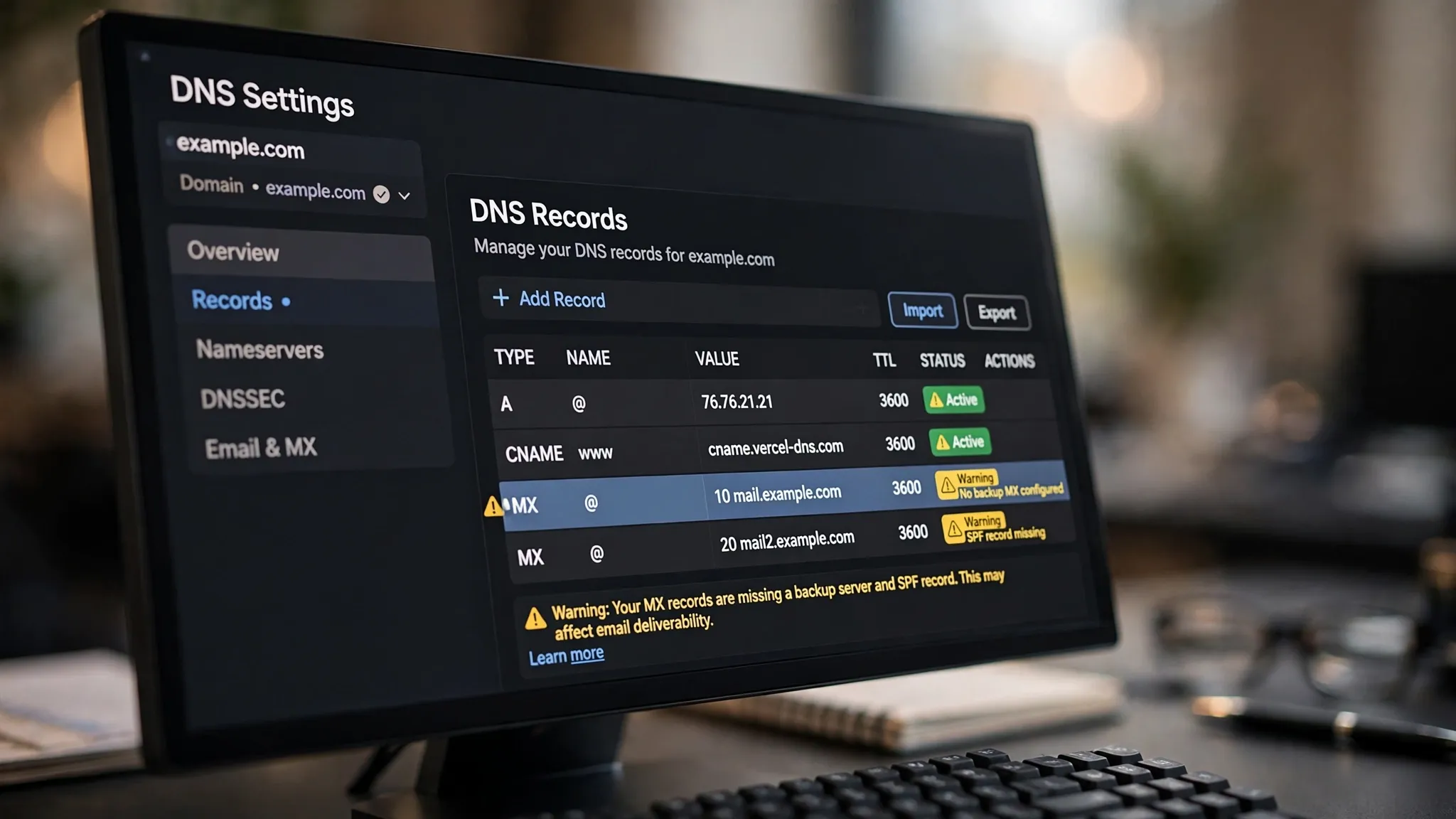
The sharpest Vercel failure we found while researching this post has nothing to do with temp email directly, and everything to do with why a disposable signup makes it worse. When you move a domain's nameservers to Vercel, DNS control moves with them — and every existing record moves out, including the MX records that route your email. A freelancer posted about exactly this in September 2026: after migrating a client's website to Vercel and switching nameservers, the site got faster and the client's Google Workspace email stopped working completely. The fix took two minutes once diagnosed — re-add the five Google Workspace MX records inside Vercel's DNS settings — but the diagnosis took far longer, because nobody expects a hosting migration to kill email.
Vercel hosts the website, not the emails. That sentence is worth memorizing before you touch a production domain. If your Vercel account itself was created with a temp inbox, the trap doubles: the registrar account that owns the domain and the Vercel account that hosts it are both gated by email addresses you may no longer control, and the recovery instructions for one are sitting in the inbox of the other. A permanent signup email does not prevent the DNS mistake, but it leaves you with one working key instead of none.
Hobby vs Pro, side by side
| Hobby | Pro | |
|---|---|---|
| Price | $0, free forever | $20 per deploying seat per month |
| Commercial use | No — personal only | Yes |
| Fast Data Transfer | 100 GB per month | 1 TB per month |
| Edge Requests | 1 million per month | 10 million per month |
| Projects | 200 | Unlimited |
| Deployments per day | 100 | 6,000 |
| Seats | 1 | 1 deploying seat, unlimited viewers |
| Custom domains | 50 per project | Unlimited per project |
| Support | Community forums only | Email support |
| Over the limit | Feature pauses, about 30 days | Billed on demand after $20 credit |
The table makes the upgrade decision look like a capacity question. It is mostly a legal one. Hobby is the better tier for almost every personal project, and Pro is the only tier for anything that earns money. The $20 is not buying bandwidth — 100 GB is plenty for a portfolio — it is buying the right to run a business on the platform, plus the email support that answers when something breaks. If your project will never earn a dollar, stay on Hobby and spend the $20 elsewhere. If it might, budget for Pro from the start, under an email address you will still own when the first invoice arrives.
When a throwaway is the right tool
A temporary inbox is the right tool for Vercel in exactly the situations where you can afford to lose the account. Twenty minutes of looking around the dashboard. A test deploy from a tutorial. Checking whether the Hobby limits fit a side project before you commit. Kicking the tires on Vercel Drop without handing over your primary address. In each of those cases, the account holds nothing you care about, and losing it costs you nothing.
It is the wrong tool the moment the account holds anything with a future. A portfolio you will show employers in a year. A custom domain you paid a registrar for. A project with a client, a collaborator, or a single dollar of revenue. A deployment whose URL is printed on a business card or linked from a resume. The test is simple and it never changes across this whole series: if losing the account would cost you more than the five minutes it took to create it, sign up with an address you will still control in a year.
There is a middle path that Vercel's own three-email rule makes easy, and it is the one we recommend. Sign up with the temp inbox to look around, and if the project survives the first weekend, add your permanent address in Account Settings, verify it, and set it as primary before you attach a domain or invite anyone. The temp address stays on the account as a login method; the permanent address becomes the one that receives the notices that matter. It takes three minutes and it removes the entire failure class this post describes.
Vercel against the other AI tools
Vercel is the sharpest version of a pattern this series has now documented six times. On Replit, the signup email owns an app, a database, and a credit meter that bills whether the build works or not. On Midjourney, there is no free trial to game at all — the door is $10 a month and a card on file, and the images answer to one inbox. On ElevenLabs, the free tier is 10,000 credits a month and the reset trick stops working after two or three accounts. On Perplexity, search is free with no account, and then Pro, Comet, and your history all want the real inbox. On Suno, the free plan is 50 credits a day with no downloads and no commercial rights, and free songs never become commercial even after you upgrade.
Vercel differs in one respect that matters more than the rest: the work is infrastructure, not content. A lost Midjourney account costs you images you can regenerate. A lost Suno account costs you songs you can re-create. A lost Vercel account costs you deployments, domains, DNS records, and SSL certificates — the address the world uses to reach the thing you built. The signup email is not a formality on this platform. It is the load-bearing wall, and a disposable inbox is a load-bearing wall made of paper.
The bottom line
Hobby is genuinely free and genuinely useful, and that is not faint praise — 100 GB of transfer, a million edge requests, free SSL, and a global CDN for zero dollars is a remarkable offer, and Vercel deserves credit for keeping it free forever instead of turning it into a trial. The platform is honest about what it costs and what it forbids. The only thing it does not do is warn you, at signup, that the email address is the account.
So the rule is the same one this series keeps arriving at, with the stakes raised one more notch. Use a temp inbox to look. Use an address you will own in a year to build. And if you already built something real on a throwaway, open Account Settings today, add your permanent address, verify it, and set it as primary — three minutes now, or a recovery ticket later that no community moderator can file for you.
Questions people actually ask
Can I sign up for Vercel with a temp email?
Usually, yes — Vercel publishes no disposable-email policy, and signup is a six-digit code sent to whatever address you enter. But acceptance is Vercel's decision and it changes over time, so nobody can promise it, and if the address is rejected, use an address you control instead of trying to disguise it.
Does Vercel Hobby really cost nothing?
Yes. Hobby is $0 a month, free forever, with no card and no trial countdown. It includes 100 GB of Fast Data Transfer, a million Edge Requests, a million function invocations, and 6,000 build minutes a month. The restriction is use, not price: personal, non-commercial projects only.
What happens if my Hobby project exceeds the free limits?
The feature pauses, generally until the 30-day window resets. Hobby has no paid overages and you cannot buy more usage — the only way to keep going immediately is to upgrade to Pro at $20 per deploying seat per month.
Can I change the email on my Vercel account later?
Yes. You can add up to three email addresses per account, verify the new one through the link Vercel sends, and set it as primary. If you have lost access to the login email but still have a Git provider, a passkey, or another verified email, you can log in that way and add a new address. If every login method is gone, the Account Recovery form is the only route.
Can I use Vercel Hobby for a client website or a store?
No. Hobby is restricted to non-commercial personal use only — a portfolio or a student project qualifies, but a client site, a store, anything with ads, or anything that takes payments requires Pro. Donations explicitly do not count as commercial use.
What happens to my deployments if I delete my Vercel account?
Deleting your account is permanent. Vercel deletes all of your projects, along with their deployments, domains, SSL certificates, activity, and every other resource that belongs to your account. There is no undo.
Need a disposable temporary email?
Protect your real inbox from spam and promotional clutter instantly and free.
Received a suspicious email, text, or charge alert?
Verify whether the sender domain is disposable, spoofed, or unverified before clicking links.