
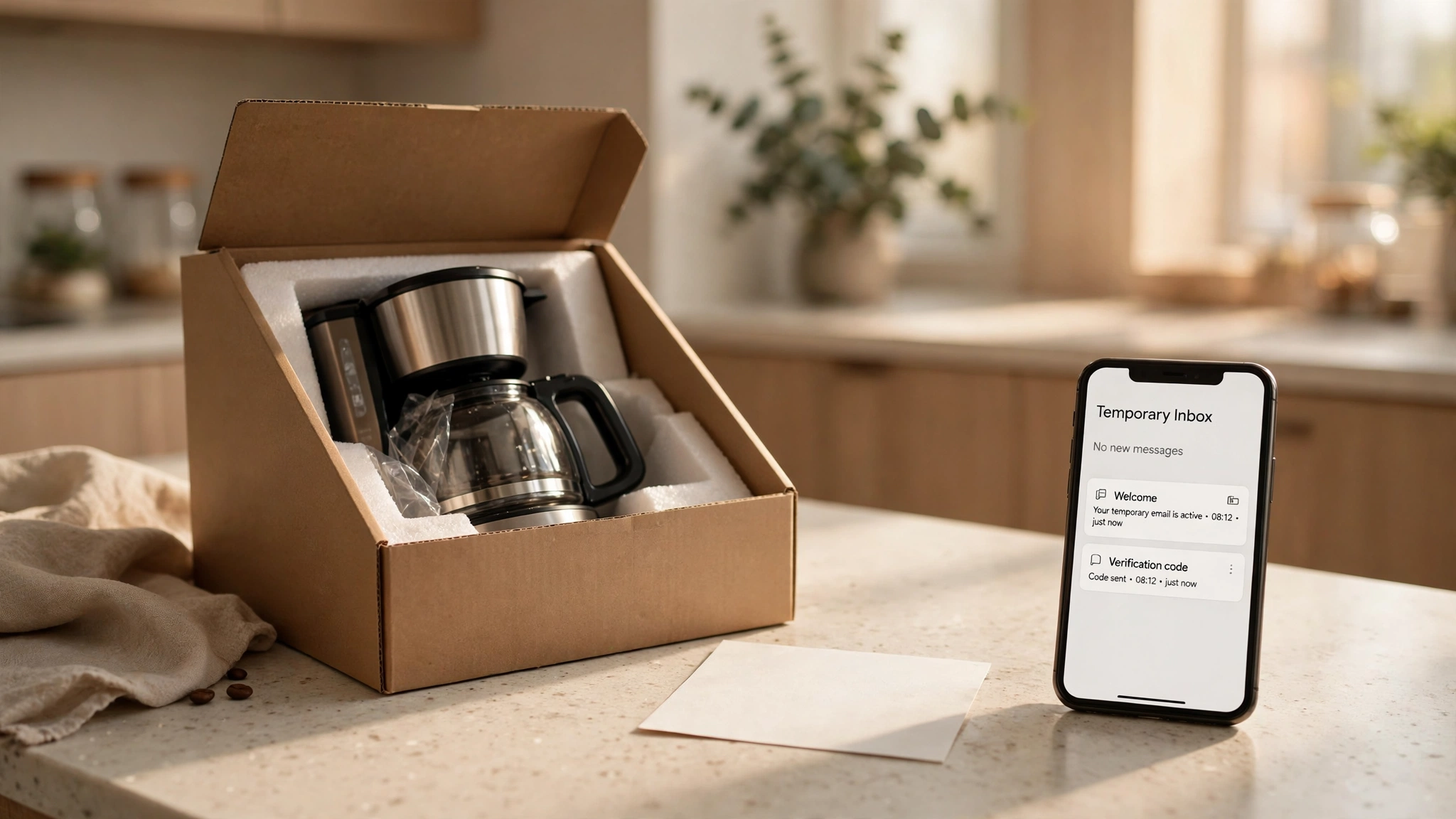
Temp Email for Product and Warranty Registrations: Register the Gadget, Not Your Inbox
There is a small card in every box. Sometimes it is paper, tucked under the foam. Sometimes it is a QR code on the quick-start guide that opens a form. Either way it asks for the same things: your name, your email, your phone number, the date you bought it, and, if the form is feeling bold, your birthdate, your household income bracket, and how many children live with you.
The card calls itself a warranty registration. Read the fine print and it is usually something else: a permission slip to market to you, dressed up as paperwork you are afraid to skip. I have registered exactly one product with my real email in the last three years — a space heater, for a reason I will get to — and everything else went through a disposable address. Nothing has broken that I could not get fixed. The card is not the warranty. The receipt is.
The card is not the warranty
This is the part most people get backwards, and the confusion is profitable for manufacturers, so nobody rushes to correct it. In the United States, your standard warranty starts the day you buy the product, not the day you fill in a form. The Magnuson-Moss Warranty Act governs how written warranties work, and a manufacturer generally cannot make you return a registration card as a condition of honoring a standard warranty. The Federal Trade Commission's own consumer guidance on warranties is careful on this point: it notes that some limited warranties do require you to send in a registration card to qualify for service — so you should read the actual warranty text — but the default is not "no card, no coverage."
What the company actually asks for when something breaks is proof of purchase. The receipt proves the date, the seller, and that you are the original owner. The registration confirmation proves almost nothing; plenty of people have registered products and still been asked for the receipt at claim time, because the receipt is the document the warranty department trusts.
So the card does two jobs, and only one of them is yours. Your job is the warranty, and the receipt already covers it. The company's job is building a contact list of verified buyers — people who demonstrably own a product in a category, with a home address attached — which is a far more valuable list than a random newsletter signup. That is why the form asks about income and household size. A warranty form has no legitimate need to know your income bracket. A marketing database does.
What the form actually collects

Open any major appliance or electronics registration form and count the fields. The honest ones ask for name, email, product, serial number, and purchase date. The greedy ones add phone number, mailing address, birthdate, gender, household size, income range, where you bought it, and what other brands you own. Each extra field is a column in a profile, and profiles get shared. Manufacturer privacy policies routinely allow sharing registration data with "service providers," "marketing partners," and "affiliates" — three words that cover an enormous number of companies you have never heard of.
The email address is the key that makes the rest of it work. It is the one field that stays constant when you move, change phone numbers, or switch carriers, and it is the same string in the appliance maker's database, the retailer's database, and the data broker's file. Handing it over on a registration form is how a toaster purchase turns into a decade of "exclusive offers" from companies that sell extended warranties, water filters, and cookware sets.
A disposable address breaks that chain at the cheapest possible point. The form gets a working inbox — the confirmation email lands, the registration completes, the serial number is on file — and when the marketing starts, it starts in an inbox you can abandon. You lose nothing the warranty needs, because the warranty never needed your email in the first place. It needed the receipt and the serial number, both of which you keep yourself. The same logic applies to newsletter signups: sample the list, skip the lifetime subscription.
The recall exception: the one good reason to register
Here is where I have to argue against my own advice, because there is one legitimate reason to register a product, and it matters. Recalls.
When a product turns out to be dangerous — a heater with a faulty thermostat, a battery that swells, a crib with a failing latch — the manufacturer notifies registered owners directly. The Consumer Product Safety Commission's recall system works best when the company can reach the people who actually own the thing, and registration is the main way it does that. A disposable inbox that you abandon in a week cannot receive a recall notice in year two.
So I draw a line, and it is a simple one. If the product can hurt you when it fails, register it with an address you will still read in two years. Space heaters, lithium-battery devices you charge indoors, baby gear, power tools with lithium packs, anything that plugs into a wall and heats up — those get a real address, ideally an email alias you control rather than your primary inbox, so you get the recall notice without the marketing living in your main mail. Everything else — the coffee maker, the blender, the headphones, the TV, the vacuum, the microwave — gets the disposable address. The risk profile of a blender recall notice is not worth a decade of marketing, and if a blender ever is recalled, you will hear about it from the news before you hear about it from the manufacturer anyway.
This is also why the "never register anything" crowd is wrong in the other direction. Refusing to register a space heater out of privacy principle is a bad trade. Privacy advice that ignores physical safety is not advice, it is a posture.
The two-address rule for the box

The practical method takes about ninety seconds per product, and it is the same every time:
- Photograph the receipt and the serial-number label before you throw the box away. Put both photos in a folder you actually keep — a cloud album called "receipts" works fine.
- Register the product with a disposable address. Use it for the confirmation email and any setup the product needs.
- Save the registration confirmation somewhere durable only if the warranty offers something extra for registering — an extended term, a free accessory, a service agreement. Otherwise, let the disposable inbox expire and forget about it.
- If the product is on the dangerous-if-it-fails list above, register it with a durable alias instead, and set a calendar reminder to check that alias twice a year. A recall notice sitting in an unread alias is no better than one sent to an abandoned inbox.
If a registration form rejects your disposable address outright, it is usually a domain blocklist at work, not a problem with your inbox. The point of the system is separation. The warranty lives in your receipt folder. The marketing lives in an inbox you control the lifespan of. The safety notices live in an address you actually check. Three jobs, three places, and none of them is your primary email.
One more honest caveat: some brands genuinely do offer something extra for registering within a window, usually 30 days. Tool brands are the classic example — one major power-tool maker ties its extended lifetime service agreement to registration, which goes well beyond its standard three-year warranty. If the registration page promises an extended term, read the terms before you use a throwaway: an extended warranty you cannot prove or be contacted about is worth less than the standard warranty you already have. When the extra is real, register with a durable alias and keep the confirmation email. When the "extra" is a coupon for accessories, use the disposable address and take the coupon.
What not to register with a throwaway
Beyond the safety list, there are two more cases where a disposable address backfires — and the broader rule, when a disposable address is the wrong tool entirely, is worth knowing before you rely on one. First, products tied to an account you will need later: a smart TV, a robot vacuum, a security camera. If the product's app account is keyed to the registration email, losing that inbox can mean losing the account, the device history, and the ability to reset the password. Use a durable address for anything with an app you will open more than once.
Second, anything you might claim under an extended or premium plan. If you paid extra for a three-year protection plan, the claim process will ask for the email on file, and a dead inbox turns a simple claim into a phone call with a support agent. The disposable address is for free standard warranties, not for plans you paid for.
This is the same split I have argued for with free trials: the disposable address is for the parts of a transaction you want to walk away from, not for the parts you want to keep. If you are still deciding whether a registration is worth your real address, the free-trial rules apply almost exactly — use the throwaway for the audition, the durable address for the commitment.
The form will keep asking. You do not have to keep answering
Manufacturers are not going to stop asking for your email on warranty cards, because the card works. Most people fill it in without thinking, and every completed form is a verified buyer profile. The form's design counts on the fear that skipping it voids the warranty, and that fear is mostly misplaced — your receipt is the warranty's foundation, and the registration is, for most products, a marketing form with a warranty costume on.
So register the gadget. Just do not register your inbox with it. Give the form an address built to be abandoned, keep the receipt somewhere safe, and save your real address for the short list of products that could actually hurt you if they fail. That is the whole trick: the card gets what it asks for, and you keep what matters.
Frequently asked questions
Does skipping product registration void my warranty?
Generally no. Under the Magnuson-Moss Warranty Act, a manufacturer usually cannot require you to return a registration card as a condition of honoring a standard warranty. Some limited warranties do require registration to qualify for service, so read the warranty text for your specific product. In every case, keep your receipt — that is the proof a warranty claim actually runs on.
Can I use a temp email for a warranty registration form?
Yes, for most products. The form needs a working address to send the confirmation, and a temporary inbox receives it fine. Use a durable address instead for products where a recall notice matters (heaters, lithium-battery devices, baby gear) and for products with an app account or a paid protection plan you will need to claim later.
What happens if a product I registered with a temp email gets recalled?
You will likely miss the manufacturer's direct notice, because the disposable inbox is gone by then. That is why the safety list in this article matters: register anything that can cause a fire, a burn, or an injury with an address you will still read in two years. For low-risk products, recalls are also widely reported in the news and on the CPSC site.
Do manufacturers sell registration data?
Many share it. Manufacturer privacy policies commonly permit sharing with service providers, marketing partners, and affiliates. The registration form's extra fields — income, household size, other brands owned — exist to make that data more valuable, not to service your warranty.
Is a photo of my receipt enough for a warranty claim?
In most cases, yes. A clear photo showing the retailer, the date, the product, and the price is accepted by most warranty departments, and it is far more durable than a paper receipt that fades in a drawer. Photograph the serial-number label too, since claims often ask for it.
What is the difference between registering and activating a product?
Registration tells the manufacturer you own it and hands them your contact details. Activation — signing into an app, linking a device to an account — ties the product to an identity you will need to keep. Registration can safely use a disposable address; activation should use a durable one.
Need a disposable temporary email?
Protect your real inbox from spam and promotional clutter instantly and free.
Received a suspicious email, text, or charge alert?
Verify whether the sender domain is disposable, spoofed, or unverified before clicking links.