



The Truth About Life Insurance Scams (And Why It Matters)
Is life insurance a scam? No — life insurance itself is a legitimate financial product, but scams within the industry are real and costly.
Here's the quick answer:
| Life Insurance as a Product | Life Insurance Scams | |
|---|---|---|
| Legitimate? | Yes | No |
| Regulated? | Heavily, by state agencies and NAIC | Illegal activity by bad actors |
| Common? | Millions of valid policies exist | Fraud costs Americans $40B+ per year |
| Risk to you? | Low if buying from licensed insurers | High if you skip verification steps |
Life insurance pays a death benefit to your family when you die. It's a straightforward promise — you pay premiums, your loved ones get financial protection. That part isn't a scam.
But the industry does attract bad actors. Consumers lost more than $8.8 billion to fraud in 2022, and insurance fraud alone accounts for over $40 billion in losses per year. Some of that is fake policies. Some is agents pocketing your premiums. Some is misleading sales tactics that push you into overpriced products.
The product isn't the problem. The people selling it sometimes are.
This guide breaks down exactly what's legitimate, what's predatory, and how to protect yourself — including how to keep your personal information safe while shopping for coverage.
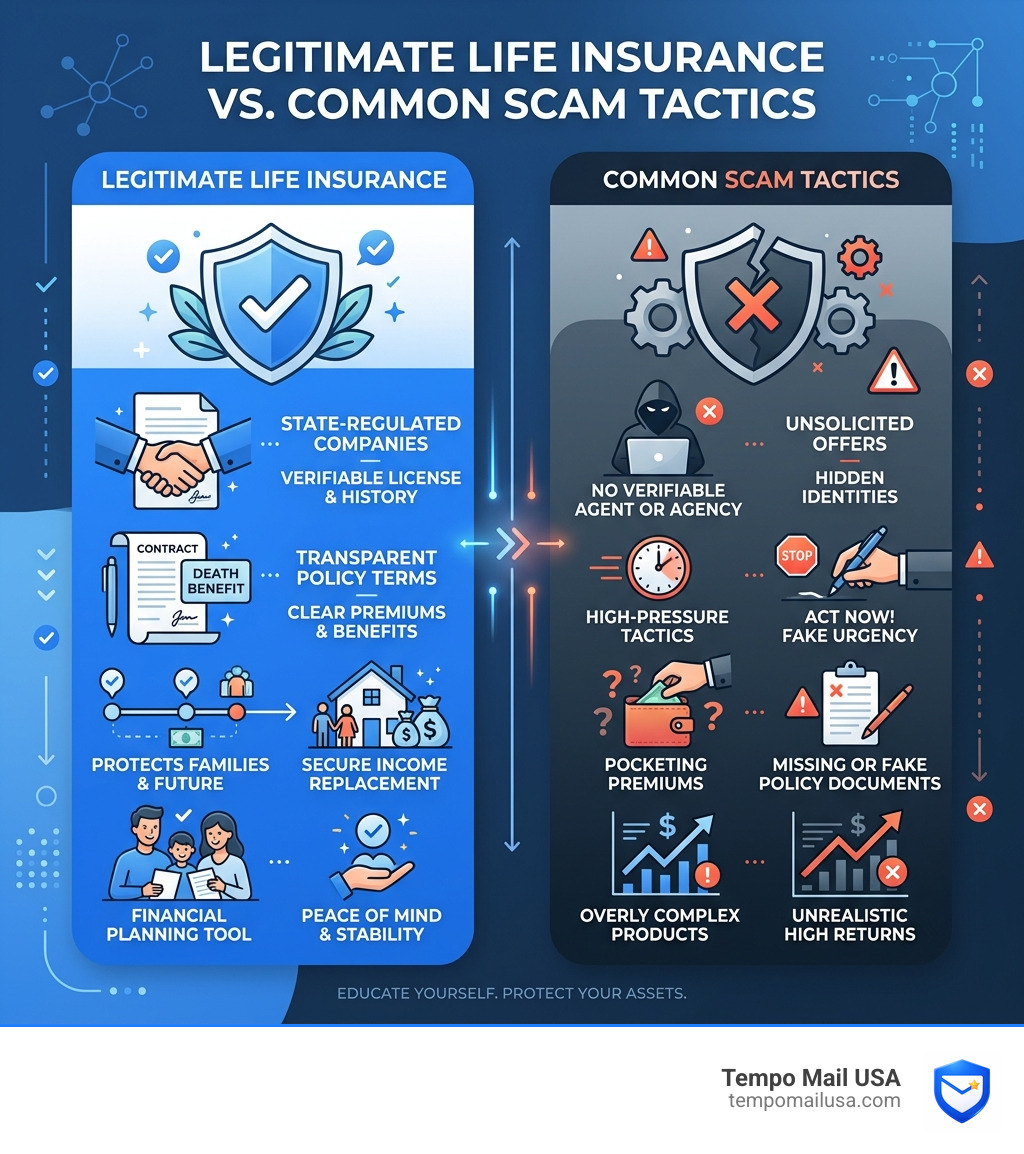
Is Life Insurance a Scam or a Legitimate Financial Tool?

When we ask, "is life insurance a scam?", we have to look at what the product actually does. At its core, life insurance is a contract. You pay a premium, and in exchange, the insurance company provides a death benefit to your beneficiaries. This money can be a literal lifesaver, covering funeral costs—which averaged $7,848 in 2021—replacing lost income, or paying off a mortgage so a grieving spouse doesn't lose their home.
According to Is Life Insurance a Scam?, the product is a cornerstone of financial planning. For the 68% of policyholders with dependents who report feeling financially secure, it is clearly not a scam. It is a tool for:
- Income Replacement: Ensuring your children or spouse can maintain their standard of living.
- Debt Coverage: Paying off student loans, car notes, or credit cards.
- Estate Planning: Providing liquidity to pay estate taxes (relevant for estates over $13.61 million) or equalizing inheritances among heirs.
- Final Expenses: Covering burial and administrative costs so the family doesn't have to crowdfund a funeral.
However, the "scam" label often comes from how these policies are sold. To understand why some people feel cheated, we have to look at the two primary types of insurance.
Comparing Term Life vs. Whole Life Insurance
| Feature | Term Life Insurance | Whole Life (Permanent) |
|---|---|---|
| Duration | Fixed period (10, 20, 30 years) | Entire lifetime |
| Cost | Very affordable (Avg. $26/mo for $500k) | Expensive (up to 10x higher) |
| Cash Value | None | Yes, builds over time |
| Complexity | Simple | High |
| Best For | Income replacement during working years | Estate planning / High net worth |
Why Whole Life is Often Called a Scam
If you’ve heard someone shout that life insurance is a "money-sucking scam," they are almost certainly talking about Whole Life or other forms of permanent insurance (like Universal or Variable Universal Life).
As explored in Is Whole Life Insurance a Scam or a Smart Investment?, these products are often criticized not because they don't pay out, but because they are "sold, not bought." Here is why they get a bad reputation:
- High Fees and Commissions: A huge portion of your first-year premiums often goes directly into the agent’s pocket as a commission. This is why agents push them so hard compared to low-commission term policies.
- The "Cash Value" Trap: Salespeople pitch the cash value as a "savings account." In reality, for the first 10 years, your money is essentially "on vacation." If you cancel early, you might get back $0 due to high surrender charges.
- Opportunity Cost: If a 40-year-old spends $350 a month on a whole life policy, they might only see a 1.5% to 3.5% return. If they bought a $26 term policy and invested the remaining $324 in an S&P 500 index fund, they could end up with hundreds of thousands of dollars more over 30 years.
- Complexity as a Cloak: By bundling insurance and investing, companies make it nearly impossible for the average person to see the actual fees. It’s like a "triple play" cable bundle where you’re paying for a landline you never use just to get the "deal."
While not a legal scam, many experts view whole life as a predatory product for the average middle-class family who would be better served by "buying term and investing the difference."
Common Life Insurance Scams and How to Spot Them
Beyond the debate over policy types, there are actual criminal enterprises designed to steal your money. We need to be vigilant because scammers exploit our desire to protect our families.
One of the most frequent issues involves is globe life insurance a scam the evidence, where bad actors might impersonate reputable brands to harvest your data. Here are the most common "hard" scams:
- Premium Diversion: This is the most common type of insurance fraud according to the FBI. An agent pockets your premium payments instead of sending them to the insurance company. You think you're covered, but your policy actually lapses.
- Churning: An agent convinces you to trade in your current policy for a "better" one. In reality, the new policy has higher fees and a fresh round of commissions for the agent, while you lose the benefits you built up in the old one.
- Beneficiary Fraud: Scammers monitor obituaries and contact grieving families, claiming the deceased had a secret policy but a "final fee" or "unpaid premium" must be settled before the millions can be released.
- Phishing Scams: You receive an email or text claiming there is an issue with your policy. When you click the link and "log in," the scammers steal your Social Security number and banking details.
- Fake Job Offers: Sometimes the scam isn't about buying insurance, but "selling" it. We've seen reports of ao globe life scam fake job offers mlm truth red flags, where people are lured into multi-level marketing schemes under the guise of a high-paying insurance career.
Red Flags: Is This Life Insurance a Scam?
Knowing the red flags can save you from a world of financial hurt. If you encounter any of the following, walk away:
- High-Pressure Sales: Legitimate agents want you to be comfortable. If they say "this deal expires tonight" or "you won't be insurable if you wait," they are likely trying to bypass your critical thinking.
- Unlicensed Agents: Every agent must be licensed in your state. If they can't provide a license number you can verify with the National Association of Insurance Commissioners (NAIC), it's a scam.
- Requests for Cash or Direct Payment: You should never write a check to an agent or pay them via apps like Venmo. Payments must always go directly to the insurance company.
- Unsolicited Offers: If someone calls you out of the blue about a policy you never applied for, be extremely cautious. This is often a lead-in to identity theft.
- Vague Policy Details: If the agent can't explain the fees, the death benefit, or the "guaranteed" versus "non-guaranteed" portions of a policy, they are hiding something. This is a common tactic used by some debt collectors, as seen in the halsted financial scam real debt collector or fraud cases, where confusion is used as a weapon.
When Life Insurance is Worth It (and When It’s Not)
Determining if is life insurance a scam for you personally often depends on your stage in life. Life insurance isn't a "one size fits all" product.
When It Is Essential:
- You Have Dependents: If your spouse, children, or aging parents rely on your income to survive, you need life insurance.
- Significant Debt: If you have a mortgage or co-signed private student loans that would fall on someone else's shoulders, a policy is a must.
- Business Owners: If your death would cause your business to collapse, "key person" insurance can keep the lights on while your partners figure out next steps.
- High Net Worth Estate Planning: For those with estates over the $13.61 million exemption limit, insurance can provide the cash needed to pay the tax bill without selling off family assets.
When It Might Not Be Worth It:
According to Is Life Insurance Worth It? Exploring When It Might Not Be, there are several scenarios where you should skip the premiums:
- No Dependents: If you are single with no kids and no one relies on your paycheck, you probably don't need a massive policy. A small "final expense" plan might be plenty.
- You Are "Self-Insured": If you have $2 million in the bank and your house is paid off, your family is already protected. Why pay premiums to an insurance company?
- Tight Budgets: If you are struggling to buy groceries or pay rent, do not prioritize life insurance. Your immediate survival is more important than a future payout.
- High-Interest Debt: It often makes more sense to pay off a credit card with 25% interest than to put that money into a low-return whole life policy.
How to Protect Yourself and Verify Legitimate Policies
We want you to be empowered, not afraid. Protecting yourself starts with due diligence. You wouldn't buy a car without checking the title; don't buy a policy without checking the company.
- Verify the Agent and Company: Use the NAIC Consumer Insurance Search Results to check for licenses and complaints. If they aren't in the system, they aren't legal.
- Check Financial Strength: Use AM Best or Standard & Poor’s to see the company's "grade." You want an A or A+ rating. This ensures the company will actually have the money to pay out in 30 years.
- Read the Fine Print: As mentioned in Why Life Insurance Is Not a Scam and How It Can Help You, you must understand the "exclusions." For example, most policies won't pay out if the death is due to fraud or certain high-risk activities in the first two years (the contestability period).
- Protect Your PII: When you shop for quotes, you are often asked for your name, address, phone number, and even your SSN. This is where identity theft begins. Using a proxy service like Tempo Mail USA can help you get the information you need without exposing your primary email to a barrage of spam and potential phishing attempts.
What to Do if You’ve Been Scammed
If you suspect you are a victim:
- Stop all payments immediately.
- Contact your state’s Department of Insurance. They have the power to investigate and fine bad actors.
- File a report with the FTC at ReportFraud.ftc.gov.
- Alert your bank. If you gave out your banking info, you need to freeze your accounts and potentially change your account numbers.
Frequently Asked Questions about Life Insurance Scams
What should I do if I suspect I’ve been a victim of a scam?
First, gather all your documentation—emails, brochures, and bank statements. Contact the actual insurance company (find their number on their official .com website, not the number the agent gave you) to see if your policy even exists. Then, report the fraud to your state insurance regulator and the FTC.
How can I verify if an insurance agent is licensed?
Ask the agent for their National Producer Number (NPN). You can then plug this number into the NAIC’s "State Based Systems" website to see their license status, which states they are authorized to work in, and if they have any disciplinary actions against them.
Why do scammers target seniors with life insurance fraud?
Seniors are often targeted because they may have significant savings, a genuine concern about leaving burial costs to their children, and sometimes a higher level of trust in "professional" sounding callers. Scammers also take advantage of cognitive decline or the isolation some seniors feel to build a false sense of rapport.
Conclusion
Life insurance is a vital part of a secure financial future, but it requires a "trust but verify" mindset. While the product itself is a legitimate way to provide for your loved ones, the surrounding industry is unfortunately a playground for scammers and high-pressure salespeople.
At Tempo Mail USA, we believe that your privacy is your first line of defense against fraud. When you are out there comparing quotes and researching whether a specific policy is a fit, don't leave your personal data exposed. Our temporary email aliases act as a PII firewall, protecting your real identity from the data harvesters and scammers who frequent the insurance world.
By staying informed, checking credentials, and securing your digital footprint, you can ensure that your quest for peace of mind doesn't turn into a financial nightmare.