



What You Need to Know About Health Insurance Plans Before You Enroll
Health insurance plans are agreements between you and an insurer that help cover the cost of medical care — from routine checkups to emergency surgery.
Here's a quick breakdown of your main options in 2026:
| Plan Type | Best For | Premium Cost | Deductible |
|---|---|---|---|
| Bronze | Healthy individuals with few doctor visits | Lowest | Highest |
| Silver | Average healthcare users; subsidy-eligible | Moderate | Moderate |
| Gold | Frequent healthcare users | Higher | Lower |
| Platinum | High medical needs | Highest | Lowest |
The four most common plan network types are:
- HMO — requires a primary care doctor and referrals; lower cost
- PPO — more provider flexibility; higher premiums
- EPO — no referrals needed, but limited to network providers
- POS — hybrid of HMO and PPO features
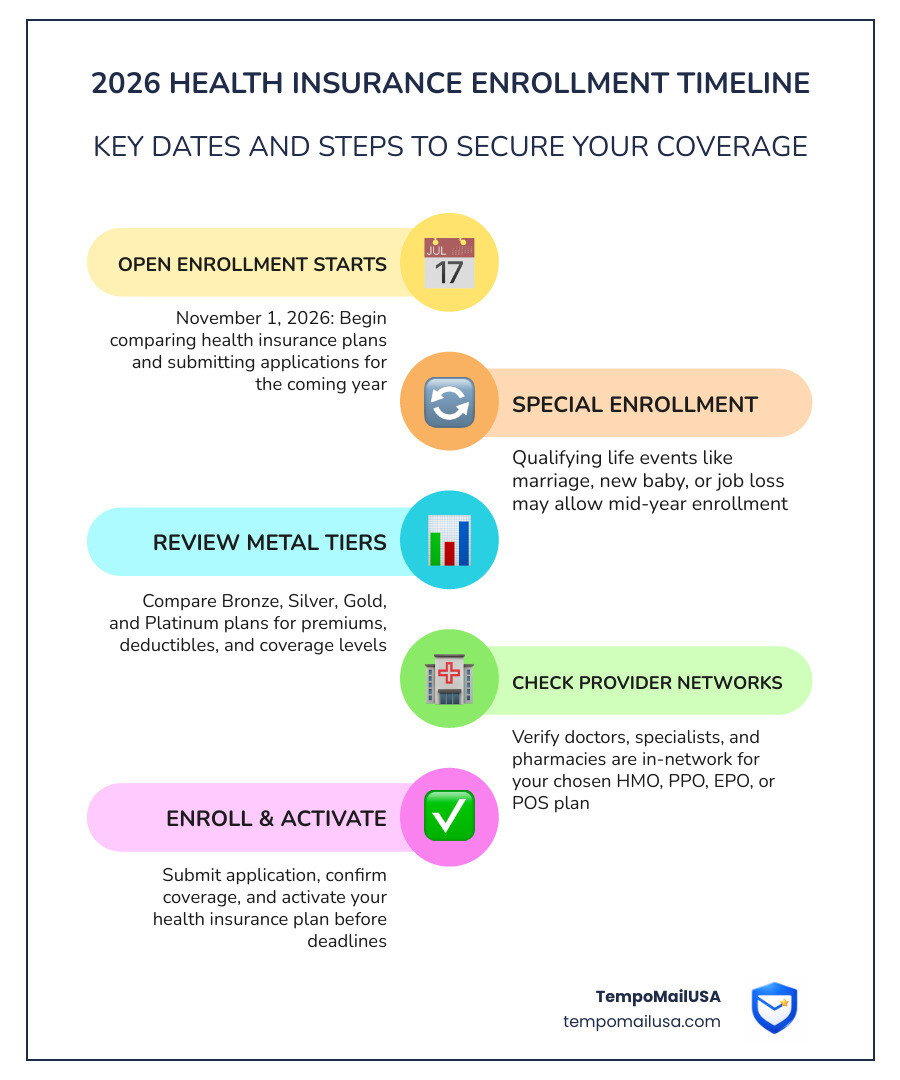
Quick answer: If you need coverage now, check if you qualify for Special Enrollment due to a qualifying life event (like marriage, a new baby, or a job loss). Open Enrollment for 2027 starts November 1, 2026.
Choosing the right plan affects how much you pay every month, how much you pay when you get care, and which doctors you can see. Most people focus only on the monthly premium — but the deductible, copays, and out-of-pocket maximum matter just as much.
This guide walks you through everything: plan types, metal tiers, subsidies, enrollment windows, and what to look for when comparing coverage.
Understanding the Main Types of Health Insurance Plans
When we start looking at health insurance plans, the alphabet soup of acronyms can feel like a secret code. But once we peel back the jargon, these plans are really just about how much freedom you have to choose your doctors and how much you're willing to pay for that freedom.

Health Maintenance Organization (HMO)
An HMO is usually the most budget-friendly option. We like to think of it as a "closed-loop" system. You pick a Primary Care Physician (PCP) who acts as your health quarterback. If you need to see a specialist, you generally need a referral from your PCP first. Except for emergencies, you must stay within the plan's network, or the insurance company won't pay a dime. This structure keeps costs low but requires a bit more coordination on your part.
Preferred Provider Organization (PPO)
If you value flexibility above all else, a PPO is likely your best bet. These plans allow you to see any doctor you want, though you’ll pay significantly less if you stay "in-network." You don’t need a referral to see a specialist, which is a huge plus for those of us who don't want to wait for an extra appointment just to get permission. Companies like Anthem offer various PPO options that cater to this need for flexibility.
Exclusive Provider Organization (EPO)
An EPO is a bit of a hybrid. Like an HMO, it generally doesn’t cover out-of-network care except for emergencies. However, like a PPO, you usually don’t need a referral to see a specialist as long as they are in the network. It’s a middle-ground option for those who want lower premiums but hate the referral process.
Point of Service (POS)
A POS plan is another hybrid where you might be required to choose a PCP and get referrals, but you still have the option to see out-of-network providers for a higher cost. It’s less common today but still available in certain regions.
When we compare these, the common thread is the "network." Insurance companies negotiate lower rates with specific doctors and hospitals. By staying in-network, we benefit from those lower rates. If you're curious about specific providers and their network reach, checking out Cigna Healthcare can give you a clear picture of how these networks function across different states.
Comparing Metal Tiers: Bronze, Silver, Gold, and Platinum
The Affordable Care Act (ACA) simplified the way we look at costs by categorizing health insurance plans into "metal tiers." These tiers don't represent the quality of care you get—a doctor doesn't treat you differently because you have a Bronze plan—they represent how you and the insurance company share costs.
| Metal Tier | Insurance Pays (Avg) | You Pay (Avg) | Monthly Premium | Out-of-Pocket Cost |
|---|---|---|---|---|
| Bronze | 60% | 40% | Lowest | Highest |
| Silver | 70% | 30% | Moderate | Moderate |
| Gold | 80% | 20% | High | Low |
| Platinum | 90% | 10% | Highest | Lowest |
For example, Bronze plans are designed for people who don't expect to go to the doctor often. You get the lowest monthly payment, but if you do end up in the hospital, your deductible—the amount you pay before insurance kicks in—will be quite high. Interestingly, many Bronze plans in 2026 allow you to see a doctor for the first three visits with just a copay, even before you've met that big deductible.
Silver plans are the "Goldilocks" of the insurance world. They offer a balance of moderate premiums and moderate deductibles. More importantly, if you qualify for "extra savings" (cost-sharing reductions) based on your income, you must choose a Silver plan to get them.
Choosing the Right Health Insurance Plans for Your Budget
When we're picking a plan, we have to play a bit of a guessing game with our own health. If we’re generally healthy and just want protection against a "catastrophic" event, a Bronze plan with a low premium makes sense.
However, if we have a chronic condition, take expensive medications, or are planning to start a family, a Gold or Platinum plan might actually save us money in the long run. Even though the monthly premium is higher, the lower deductible and out-of-pocket maximum mean the insurance company starts picking up the bill much sooner.
Key Benefits of Modern Health Insurance Plans
As we move through 2026, health insurance plans have evolved to include some pretty fantastic perks that weren't standard a decade ago.
- $0 Virtual Care: Many plans from major providers now offer 24/7 virtual urgent care for $0. This is a lifesaver for those 2:00 AM earaches or skin rashes that don't require an ER visit.
- Preventive Services: Under the ACA, things like annual wellness exams, vaccinations, and many screenings are covered at 100%—meaning you pay $0, provided you stay in-network.
- Prescription Drug Coverage: We're seeing a trend toward $0 to $3 copays for preferred generic drugs.
- Insulin Caps: In a major win for diabetic patients, many plans now cap out-of-pocket insulin costs at $25 for a 30-day supply.
On-Exchange vs. Off-Exchange Coverage and Subsidies
You might hear people talk about "on-exchange" and "off-exchange" plans. It sounds like stock market talk, but it's much simpler.

On-Exchange Plans are those sold through the official government Marketplace (HealthCare.gov or your state’s equivalent). These are the only plans where you can use federal subsidies (Premium Tax Credits) to lower your monthly bill. Most people who shop here find that they qualify for some level of financial help.
Off-Exchange Plans are purchased directly from an insurance company or through a private broker. They must still follow ACA rules (like covering pre-existing conditions), but you cannot use government subsidies to pay for them. Why would someone choose this? Sometimes, an insurer offers a specific network or a niche plan that isn't available on the public exchange.
Providers like UnitedHealthcare offer a wide range of Marketplace options, including "Advantage" plans that mirror the benefits often found in employer-sponsored coverage.
Enrollment Periods and Eligibility for 2026
Timing is everything. We can't just buy a health insurance plan the day we get sick.
- Open Enrollment: This is the annual window (typically November 1 to January 15) when anyone can sign up for or change their plan. For the 2026 plan year, this window has already closed.
- Special Enrollment Period (SEP): If you missed the window, you’re not necessarily out of luck. If you experience a "qualifying life event," you get a 60-day window to enroll.
Common Qualifying Life Events include:
- Getting married or divorced.
- Having a baby or adopting.
- Losing other health coverage (like leaving a job).
- Moving to a new state or a different ZIP code.
- Becoming a U.S. citizen.
For 2026, major plans are widely available in states like AZ, CO, FL, GA, IL, IN, MS, NC, TN, TX, and VA. If you live in one of these states and have had a life change, you should check your eligibility immediately to ensure your coverage is activated as soon as possible.
Essential Factors for Choosing Coverage
When we sit down to compare health insurance plans, we suggest looking past the "sticker price" of the premium and checking these four critical areas:
1. The Provider Network
Is your favorite doctor in the network? If you have a specialist you trust, call their office and ask which plans they accept for 2026. Don't rely solely on the insurer's website, as these directories can sometimes be outdated.
2. The Drug Formulary
A "formulary" is just a fancy list of the drugs a plan covers. If you take specific medications, make sure they are on the list and check which "tier" they fall into. A Tier 1 drug might cost $5, while a Tier 4 drug could cost hundreds.
3. Out-of-Pocket Maximum
This is the most important number you might be ignoring. It is the absolute most you will have to pay in a year for covered services. Once you hit this limit, the insurance company pays 100% of everything else. For 2026, individual out-of-pocket maximums can be as high as $9,800, so make sure you have a plan for how you'd cover that in a worst-case scenario.
4. Added Perks
Does the plan offer a free gym membership? Do they have a rewards program that pays you for getting your annual flu shot? Some plans even offer "Guided Customer Care" to help you navigate complex medical diagnoses.
Frequently Asked Questions about Health Insurance
What is a qualifying life event for Special Enrollment?
A qualifying life event is a major change in your life circumstances that allows you to sign up for health insurance outside of the standard Open Enrollment period. This includes things like losing your job-based insurance, getting married, having a baby, or moving to a new area. You usually have 60 days from the date of the event to enroll in a new plan.
How do Bronze and Silver plans differ in cost-sharing?
Bronze plans generally have lower monthly premiums but much higher deductibles. On average, a Bronze plan pays about 60% of your medical costs, and you pay 40%. Silver plans have moderate premiums and pay about 70% of costs. Crucially, Silver plans are the only ones eligible for "Cost-Sharing Reductions," which can lower your deductible and copays significantly if your income falls within a certain range.
Are virtual urgent care visits covered at $0?
In 2026, many major health insurance plans include $0 virtual urgent care as a standard benefit. This allows you to speak with a board-certified doctor via phone or video at any time of day for minor issues like cold, flu, or allergies without paying a copay. However, always check your specific Summary of Benefits to be sure.
Conclusion
Navigating health insurance plans doesn't have to be a headache. By understanding the difference between an HMO and a PPO, and knowing which metal tier fits your health needs, you can make a choice that protects both your physical well-being and your bank account.
As we manage our health in an increasingly digital world, we also need to think about our digital health. When you're shopping for insurance, you're often asked to provide a lot of personal information. This is where we at TempoMailUSA can help.
We provide free, disposable email addresses that act as a secure firewall for your personally identifiable information. Our identity proxying technology generates secure aliases and recovery keys, preventing your real data from ending up in the hands of spammers or being exposed in data breaches. Just as health insurance protects your body, we protect your digital identity.
Protect your identity with a secure email proxy and keep your private information private while you search for the perfect coverage. Stay healthy, stay secure, and remember that the best plan is the one that gives you peace of mind.