
Google Click Fraud Is Draining Your Budget — Here’s How to Stop It

What Is Google Click Fraud and Why Should You Care?
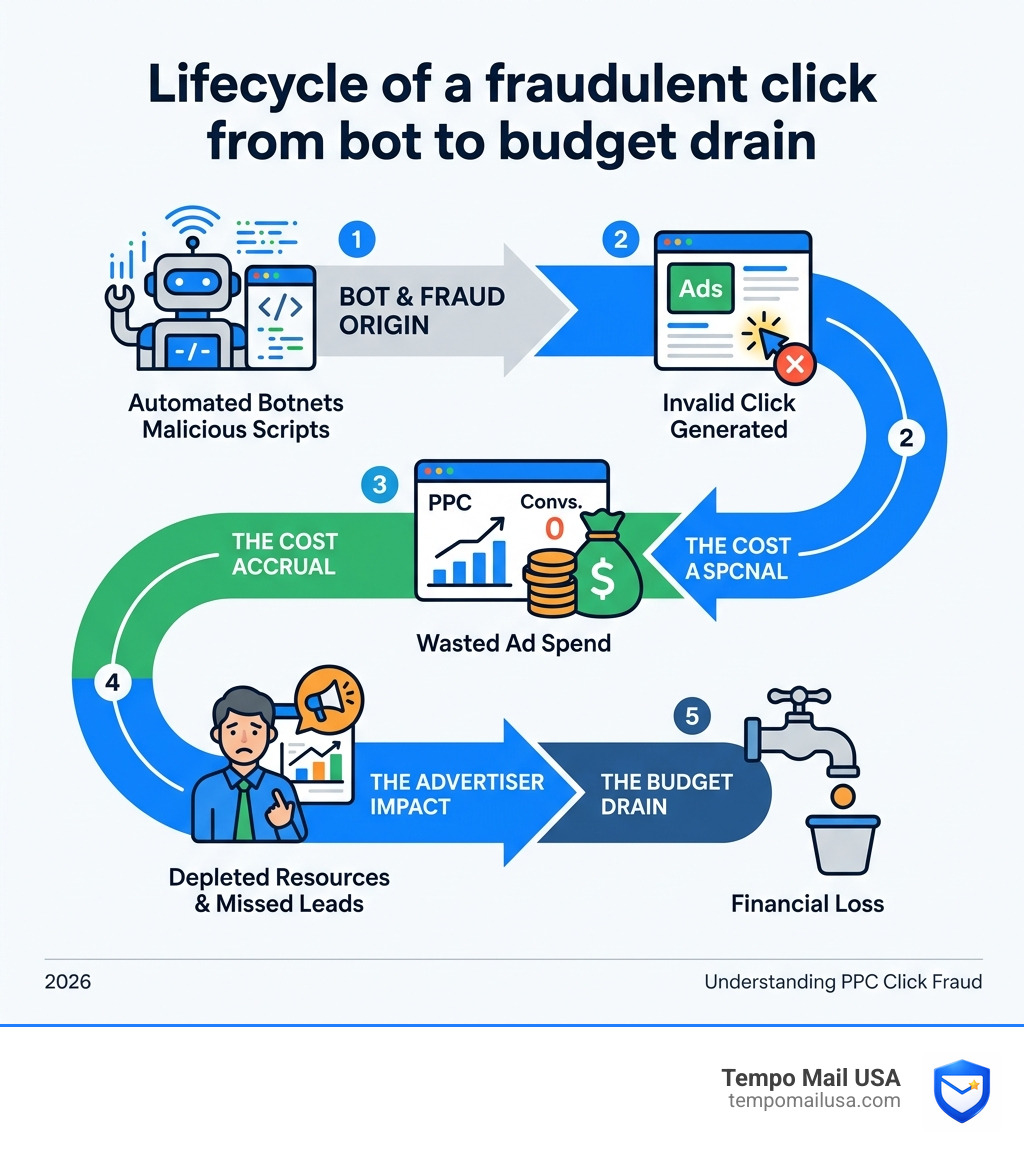
Google click fraud is when clicks on your Google Ads come from sources with no real interest in your product — bots, competitors, click farms, or automated scripts — wasting your budget without delivering any real customers.
Here's a quick summary of what you need to know:
- What it is: Fake or invalid clicks on Google Ads that drain your budget without genuine user intent
- Who does it: Automated bots, botnets, competitor sabotage, click farms, and unethical publishers
- How bad is it: The average invalid click rate across Google Ads sits at 11.4% — and in some industries it can exceed 50%
- What it costs: Global ad fraud losses are projected to surpass $172 billion annually by 2028
- What Google does: Filters most invalid clicks automatically, but sophisticated fraud still slips through
- What you can do: Tighten targeting, monitor analytics, use IP exclusions, and consider third-party protection tools
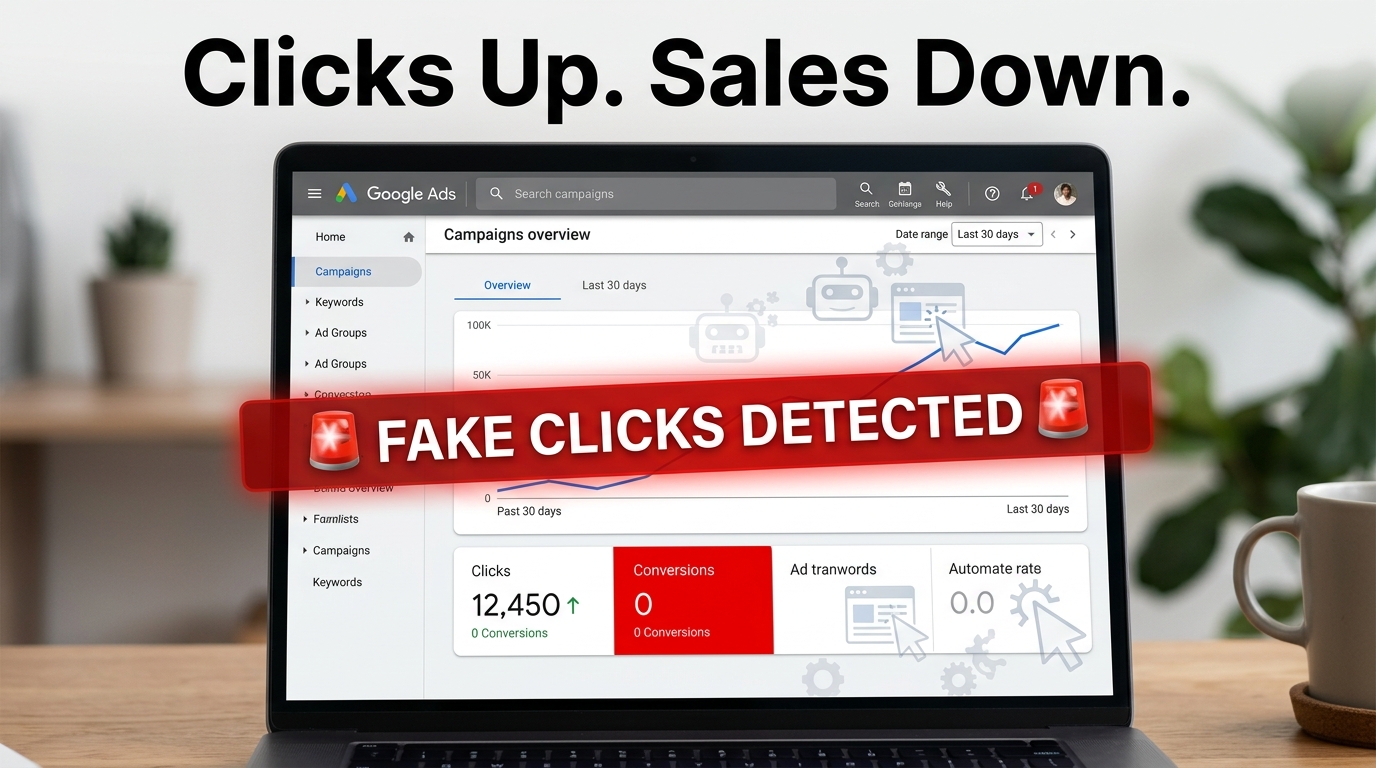
If you've ever stared at a Google Ads dashboard wondering why your clicks are climbing but your leads have flatlined, you're not alone.
One advertiser in a Reddit thread put it bluntly: "I'm honestly starting to lose my mind with Google Ads." Their roofing campaign — meticulously set up with local targeting and solid landing pages — was showing close to 90% invalid clicks and zero conversions.
That's an extreme case. But the underlying frustration is widespread.
Click fraud isn't a fringe problem. It's a structural issue baked into how pay-per-click advertising works. Every time someone — or something — clicks your ad without any intention of buying, you pay. And in high-value industries like legal services, insurance, and real estate, those clicks can cost tens of dollars each.
Google does filter a significant volume of invalid traffic. In 2023 alone, it reportedly filtered $84 billion in ad fraud. But its own data shows invalid click rates have more than doubled since 2010, climbing from 5.9% to 12.3% in 2024. The problem isn't shrinking — it's growing, driven by increasingly sophisticated AI-powered bots that mimic real human behavior.
This guide breaks down exactly how click fraud works, where your campaigns are most exposed, what Google catches (and what it misses), and what you can do about it.
Understanding the Mechanics of Google Click Fraud and Invalid Traffic
To fight google click fraud, we first need to understand what it actually looks like under the hood. Google generally groups these issues under the umbrella term "invalid traffic" (IVT). According to Google Ads Help, invalid clicks are interactions that aren't the result of genuine user interest.

This includes a wide range of activity, from the innocent to the malicious:
- Accidental Clicks: We’ve all done it—trying to close a popup on a mobile site and accidentally hitting the ad instead. Google also counts the second click of a "double-click" as invalid.
- Manual Fraud: This is often driven by competitors who want to exhaust your daily budget so their ads show up higher, or by unethical publishers clicking ads on their own sites to boost their earnings.
- Automated Scripts and Bots: These are programs designed to mimic human behavior. They can range from simple "auto-clickers" to massive botnets consisting of thousands of hijacked computers.
- Deceptive Software: Malware installed on a user's computer without their knowledge can generate clicks in the background, often using "ad stacking" where ads are layered on top of each other, but only the top one is visible.
Accidental vs. Deliberate: A Comparison Table
| Feature | Accidental Invalid Traffic | Deliberate Click Fraud |
|---|---|---|
| Intent | None; user error or poor ad placement | Malicious; intended to drain budget or steal revenue |
| Source | Real human users | Bots, competitors, or click farms |
| Pattern | Random and sporadic | Often shows high-frequency spikes or rhythmic timing |
| Primary Victim | The Advertiser | The Advertiser and the Ad Network's integrity |
| Detection Ease | Relatively easy for Google to filter | Harder; requires behavioral analysis |
The Financial Impact of Google Click Fraud on ROI
The numbers are staggering. Industry data suggests that the average invalid click rate across Google Ads is roughly 11.4%. However, certain sectors are hit much harder. In highly competitive niches like sports betting, invalid traffic can skyrocket to between 29% and 55% of all activity.
When google click fraud hits your account, the damage is three-fold:
- Budget Depletion: Your daily budget is eaten up by "junk" clicks, meaning your ads stop showing to real potential customers early in the day.
- Skewed Analytics: Your Click-Through Rate (CTR) might look great, but your conversion rate will plummet. This makes it nearly impossible to tell which keywords are actually working.
- Conversion Rate Suppression: Because you're paying for traffic that will never buy, your Cost Per Acquisition (CPA) spikes, often making the campaign unprofitable.
Google does provide some relief through automated adjustments, but these often only cover the "low-hanging fruit" of obvious bot activity.
Identifying Patterns of Google Click Fraud
If you suspect your campaigns are being targeted, you need to look for specific "fingerprints." We recommend monitoring these key metrics:
- IP Density: If you see 50 clicks coming from the exact same IP address or a very narrow range of IPs within an hour, that's a massive red flag.
- Timestamp Analysis: Bots often operate on a schedule. Look for clicks that happen at precisely the same interval (e.g., every 30 seconds) or massive spikes at 3:00 AM in a timezone where your customers should be asleep.
- Zero-Scroll Behavior: Using tools like Microsoft Clarity or session recordings can reveal "users" who land on your page and don't move their mouse, don't scroll, and bounce instantly.
- Geographic Anomalies: If you are a local plumber in Chicago but you're getting clicks from a data center in Ashburn, Virginia, something is wrong.
The Anatomy of Modern Ad Fraud: Bots, Farms, and Competitors
Click fraud has evolved far beyond a competitor sitting in their office clicking your ad five times. It is now a global, industrialized operation.
The Perpetrators
- Competitor Sabotage: This is the most personal form of fraud. A business rival clicks your ads to drive up your costs. While Google is good at catching "one guy at a desk," they struggle with competitors who hire cheap "click farms" to do the dirty work.
- Click Farms: These are physical locations where low-paid workers are hired to click on ads all day. Because these are real people using real devices, they are much harder for automated systems to detect than software bots.
- Botnets: A botnet is a network of "zombie" computers infected with malware. The owner of the botnet can command thousands of real residential computers to click an ad simultaneously, making the traffic look like it's coming from legitimate home users.
- Publisher Fraud: Some website owners use "hit inflation attacks" or hidden iframes to generate fake clicks on the ads hosted on their sites, essentially stealing money directly from the advertisers.
Vulnerable Campaign Types and Risk Levels
Not all Google Ads campaigns are created equal when it comes to risk. Exposure levels can vary by up to 400% depending on where your ads run.
- Google Video Partners (Highest Risk): Ads running on third-party video sites are highly susceptible to bots. Some reports show over half of these clicks can be invalid.
- Display Network (High Risk): "Made-for-ads" websites use AI to churn out content and then use bots to click the ads, milking advertisers for millions.
- Performance Max (Medium-High Risk): Because P-Max automates everything, it often hides where your ads are actually showing, making it a "black box" that can attract junk traffic if not carefully monitored.
- Search Partners (Medium Risk): These are sites that use Google's search engine. Some are great, but others are "dodgy sites" that embed SERPs specifically to farm clicks.
- Google Search (Lowest Risk): Traditional search ads on Google.com are generally the safest, though high-CPC keywords remain a prime target for competitors.
Sophisticated Evasion Tactics in 2026
As we move through 2026, fraudsters are using AI to stay one step ahead. They use residential proxies to make bot traffic appear as if it's coming from a local ISP like Comcast or AT&T. They also use device fingerprinting to spoof different phone models and browsers, making 1,000 clicks from one server look like 1,000 different people.
Google’s internal defenses are constantly updating, but the "arms race" between fraud detection and fraud creation is tighter than ever.
How Google Detects Invalid Clicks (and Where It Fails)
Google isn't sitting idly by. They employ a massive Ad Traffic Quality Team and use sophisticated machine learning filters to protect the ecosystem. After all, if advertisers lose faith in the platform, Google’s $200B+ annual revenue disappears.
Google's defense works in three stages:
- Real-time Filters: Before you are even charged, Google’s algorithms analyze every click for patterns of fraud. If a click is flagged here, it never shows up on your bill.
- Automated Offline Analysis: Within 60 days of a click, Google’s systems re-examine the data. If they find sophisticated patterns they missed initially, they issue a credit.
- Manual Investigations: If you report a problem, a human specialist may review your account logs.
Limitations of Default Platform Protections
Despite these efforts, Google has a "blind spot." Their primary goal is to catch fraud, but they often ignore waste. For example, a "loyal customer" who clicks your branded ad five times a day because they're too lazy to bookmark your site isn't "fraudulent"—but they are still wasting your money.
Furthermore, Google's filters are often "conservative." Because refunding money directly hurts Google's bottom line, they typically only credit clicks that are 100% indisputably invalid. Sophisticated bots that mimic mouse movements and "dwell time" often slip through the cracks.
Requesting Refunds and Investigation Procedures
If you’ve noticed a spike that Google hasn't caught, you can take action. You’ll need to submit a Click Quality Form. To have any chance of success, you must provide:
- Web Server Logs: Showing the IP addresses and timestamps of the suspicious clicks.
- GCLIDs: The Google Click Identifier for the suspicious sessions.
- User Agent Strings: Data about the browsers and devices used.
Don't expect a quick win—these investigations can take weeks, and Google's "burden of proof" is notoriously high.
Advanced Strategies to Minimize Google Click Fraud Risk
Since you can't rely solely on Google, you need to build your own "PII Firewall" and traffic filters. Here is a 5-step security checklist we recommend for every PPC manager:
- Use "Presence Only" Targeting: By default, Google targets people "in or interested in" your location. This means someone in a click farm in another country can see your local ad. Change this to "Presence" only.
- Exclude Known Fraudulent IPs: If you identify a bad IP, go to Account Settings > IP Exclusions and block it manually.
- Tighten Keyword Match Types: Broad match is a magnet for bot traffic. Stick to Exact Match and Phrase Match to ensure your ads only show for high-intent searches.
- Ad Scheduling: If your business only operates 9-5, don't run ads at 2 AM. Nighttime is prime time for bot activity.
- Exclude Search Partners and Display: If you are on a tight budget, uncheck "Search Partners" and "Display Network" in your search campaign settings.
Technical Defenses and Third-Party Verification
For high-spending accounts, manual monitoring isn't enough. Many advertisers turn to third-party tools that offer real-time IP blocking. These tools monitor every click and, if they detect a bot, they automatically add that IP to your Google Ads exclusion list within seconds.
Another layer of defense is ensuring your own connection is secure. Using an advanced VPN can help you audit your own ads from different locations without triggering your own fraud filters or revealing your real IP to competitors who might be scraping your landing pages.
The Consultative Pivot: Protecting Your Digital Identity and Data
While google click fraud is a financial threat to your business, it’s often a symptom of a larger problem: the lack of a "firewall" between your data and the open web. Fraudsters don't just want your ad clicks; they want the data behind them.
When you click a link or sign up for a "free audit" to check for click fraud, you are often handing over your primary email address to unknown third parties. This is where data brokering and identity theft begin.
At Tempo Mail USA, we believe in a "privacy-first" approach to digital marketing. Just as you protect your ad budget from bots, you should protect your personal identity from data harvesters. By using temporary email aliases, you create a secure proxy that sits between your real identity and the services you use.
Whether you're signing up for a new marketing tool, downloading a "fraud report," or testing a competitor's funnel, using a temporary alias ensures that if that service is breached or sells its data, your primary inbox—and your real PII (Personally Identifiable Information)—remains untouched. It’s the ultimate "PII Firewall" for the modern marketer.
Frequently Asked Questions about Google Click Fraud
How can I tell if my Google Ads are being targeted by click fraud?
Look for sudden spikes in traffic without a corresponding increase in conversions, high bounce rates from specific IP ranges, and clicks occurring at unusual hours (e.g., 3 AM) that don't align with your target audience's behavior. Additionally, check your "Invalid Clicks" column in Google Ads; if this number is significantly lower than the anomalies you see in your server logs, you likely have a fraud problem that Google is missing.
Does Google refund money for fraudulent clicks?
Yes, Google automatically filters most invalid traffic and adjusts your bill before you are charged. If fraud is detected after the invoice has been generated, Google issues "Invalid Activity" credits, which appear as negative values in your billing summary. You can check this by going to Billing > Summary and looking for "Adjustments."
Can competitors click my ads to drain my budget?
While competitors may attempt manual click fraud, Google’s systems are designed to detect repeated clicks from the same source. However, sophisticated competitors may use botnets, VPNs, or residential proxies to bypass basic filters. For businesses in high-CPC industries like law or home services, using third-party monitoring software is a standard best practice to prevent competitor sabotage.
Conclusion: Building a Multi-Layered Defense for Your Digital Identity
In 2026, google click fraud is more than just a nuisance—it's a sophisticated drain on your ROI that requires a proactive defense. By understanding the mechanics of invalid traffic, tightening your campaign settings, and utilizing third-party verification, you can reclaim your ad budget and ensure your marketing dollars are reaching real human beings.
But remember, digital security doesn't stop at your Google Ads dashboard. Every time you interact with the web, you leave a trail. Protecting your business's financial health and your own personal data goes hand-in-hand.
Build your defense today. Tighten your ads, monitor your logs, and protect your PII with a secure firewall from Tempo Mail USA. Don't let the bots win—take control of your data and your budget.
Need a disposable temporary email?
Protect your real inbox from spam and promotional clutter instantly and free.
Received a suspicious email, text, or charge alert?
Verify whether the sender domain is disposable, spoofed, or unverified before clicking links.