


Your Card Never Left Your Pocket — So Why Is Your Money Gone?
The ghost tapping scam is a form of contactless payment fraud where criminals use a mobile point-of-sale device or hidden NFC reader to trigger an unauthorized transaction from your credit card or smartphone — without ever touching it. They just need to get within about 4 centimeters of your wallet.
Here's what you need to know at a glance:
| Detail | What You Need to Know |
|---|---|
| What it is | Unauthorized tap-to-pay transaction triggered by a nearby scammer |
| Technology used | Near Field Communication (NFC) |
| Required range | ~4 cm (roughly the length of a paper clip) |
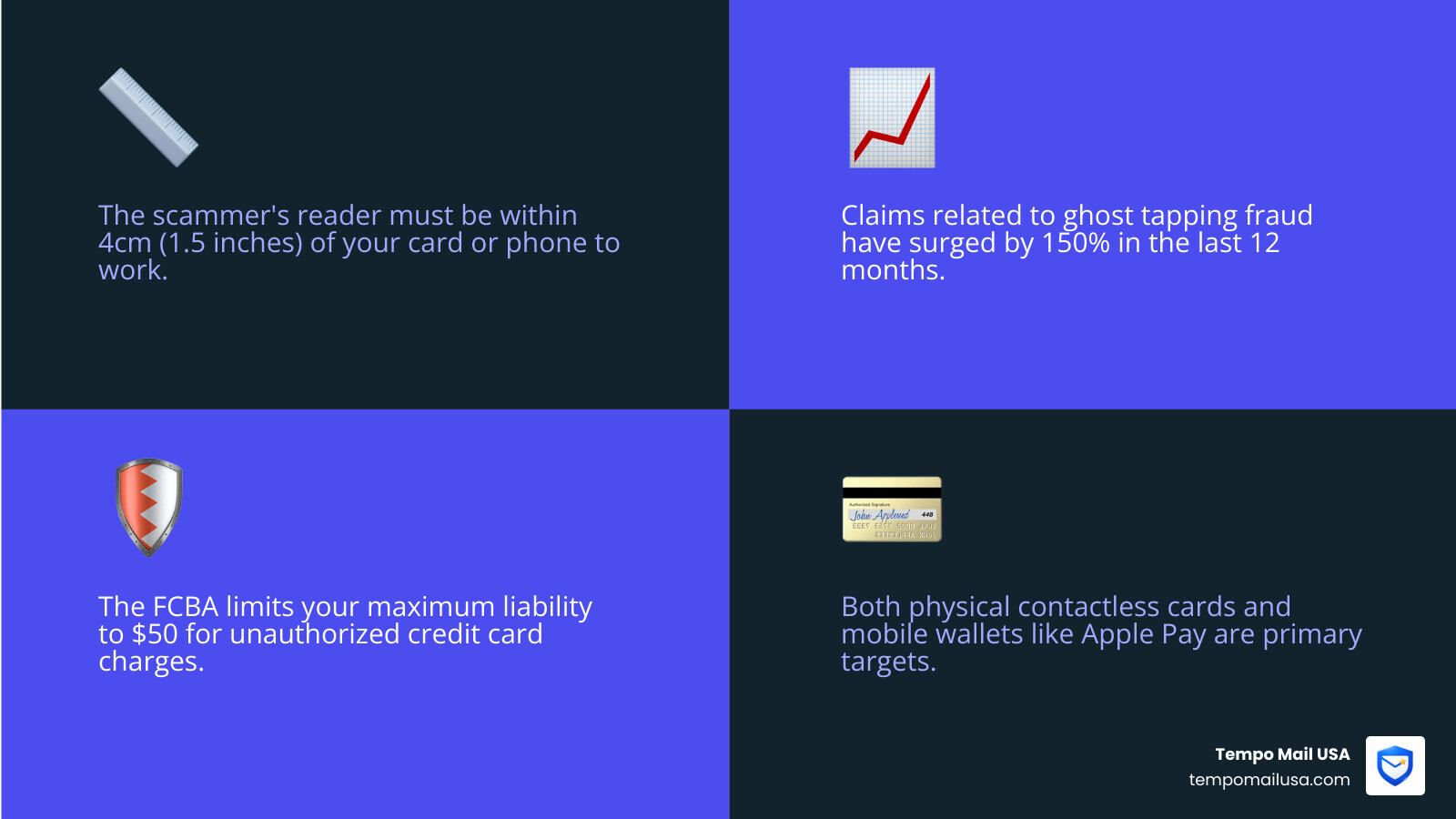
| Surge in reports | 150% increase in ghost tap-related claims over the past year |
| Common targets | Contactless cards, Apple Pay, Google Pay |
| Max credit card liability | $50 under the Fair Credit Billing Act (FCBA) |
Your card never leaves your pocket. That's the terrifying part.
Unlike a pickpocket or a card skimmer at an ATM, ghost tapping requires no physical theft. Scammers operate in plain sight — at crowded markets, transit stations, holiday fairs, or even at your front door — and victims often don't realize anything happened until they spot an unfamiliar charge days later.
In one reported case, a door-to-door scammer posing as a charity fundraiser charged victims $537 and $1,100 using a tap-to-pay device while keeping the screen hidden. In another, a victim had multiple charges of $2,496 processed to a PayPal account in a single encounter.
This isn't a niche threat. In May 2026, ghost tapping has become one of the fastest-growing proximity-based scams targeting everyday consumers.
Below, we break down exactly how it works, where it happens, and — most importantly — how to stop it.
What is the Ghost Tapping Scam and How Does it Work?
At its core, the ghost tapping scam exploits the very convenience we love: tap-to-pay. This technology relies on Near Field Communication (NFC), which allows two devices to exchange data wirelessly when they are extremely close to each other.
While you use this to buy your morning latte, a scammer uses it to "pull" money from your wallet. They don't need to see your card number, and they don't need your PIN. They simply need to bring a rogue reader within about 4 centimeters (roughly 1.5 inches) of your card or phone.
We have analyzed the Ghost Tapping Scam How It Works and found that scammers often use standard smartphones converted into mobile point-of-sale (POS) terminals. By registering as a "merchant" with various payment processors, they can initiate a charge, walk through a crowd, and collect payments from every pocket they pass.
| Vulnerability Factor | Physical Contactless Card | Mobile Wallet (Apple/Google Pay) |
|---|---|---|
| Encryption | High (EMV standard) | Very High (Tokenization) |
| Activation | "Always On" | Requires Biometrics/PIN |
| Visibility | Can be read through fabric | Usually requires screen wake |
| Risk Level | High in crowded pockets | Moderate (human error dependent) |
The Mechanics of a Ghost Tapping Scam
The technical backbone of this fraud is Radio Frequency Identification (RFID). Your contactless card contains a tiny chip and an antenna. When it enters the electromagnetic field of a reader, it transmits a one-time cryptographic code to authorize a payment.
The problem? In a ghost tapping scam, that "reader" is hidden in a scammer's bag or sleeve. Because the range is so short, they must be physically close to you. This is why news reports, such as Ghost tapping is on the rise — what Canadians need to know, emphasize that while the technology is secure, the proximity is the vulnerability.
Proximity and the "Bumping" Technique
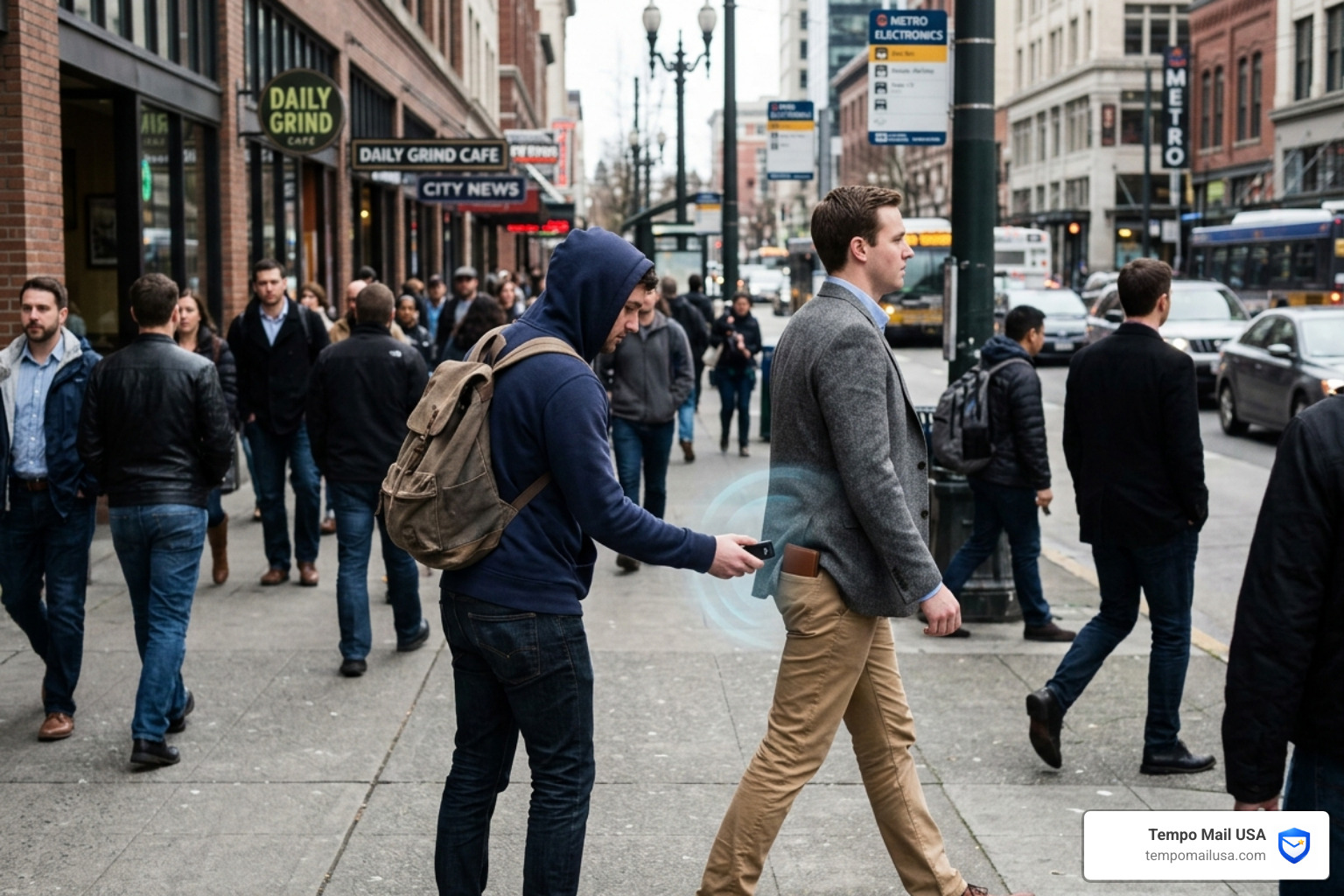
This is not a high-tech hack from across the street. It is a digital version of pickpocketing. Scammers target high-traffic areas where physical contact is normal. Think of a crowded subway car, a busy grocery store line, or a music festival.
The scammer may "accidentally" bump into you. During that split second of contact, their hidden reader is positioned right against your pocket or purse. The transaction happens instantly. There is no "ding" on your card, no receipt, and no physical sign that you just "paid" a stranger fifty dollars.
Real-World Patterns: Where and How Scammers Strike
We’ve seen a shift in how these criminals operate. While some prefer the anonymity of a crowd, others use social engineering to trick you into tapping voluntarily.

The Door-to-Door Deception
One of the most brazen versions of the ghost tapping scam involves door-to-door solicitors. Reports from the Better Business Bureau (BBB) highlight incidents where scammers pose as students selling chocolate or fundraisers for local charities.
They insist on tap-to-pay, claiming they don't carry cash. Here is the trick: they never show you the screen of their device. While you think you are tapping for a $5 donation, they have typed in $537. Because you are in a "rushed" social interaction, you tap your card and move on, only discovering the massive theft when your statement arrives.
High-Density Public Exploitation
At major events like holiday craft fairs or transit hubs, scammers act as "roaming vendors." They might offer a small item or a "free" sample, asking for a tiny "processing fee" or "donation" via tap. In the chaos of a festival, people are less likely to verify the merchant name on the terminal.
This is where it turns into a scam: the thief might process a small "test charge" first to see if the card is active, then immediately follow up with a much larger transaction, sometimes reaching as high as $2,496 in a single go.
Psychological Triggers: Why the Scam Succeeds
Why do smart people fall for this? Because scammers are experts at social engineering. They don't just use technology; they use you.
According to the guide on how to Beware of “Ghost Tapping” Scams, these criminals rely on transaction rushing. They create a sense of urgency—perhaps there’s a long line behind you, or they act like their device is "glitching" and needs a quick tap before it shuts off.
"This is where most users get tricked": You assume the technology is foolproof. You trust that the little black box in the vendor's hand is honest. Scammers exploit that trust by hiding the screen or claiming the "printer is broken," so you don't get a receipt that shows the actual amount charged.
Actionable Solutions: How to Protect Your Wallet
You don't have to stop using tap-to-pay, but you do need to upgrade your "digital hygiene."
Defending Against a Ghost Tapping Scam
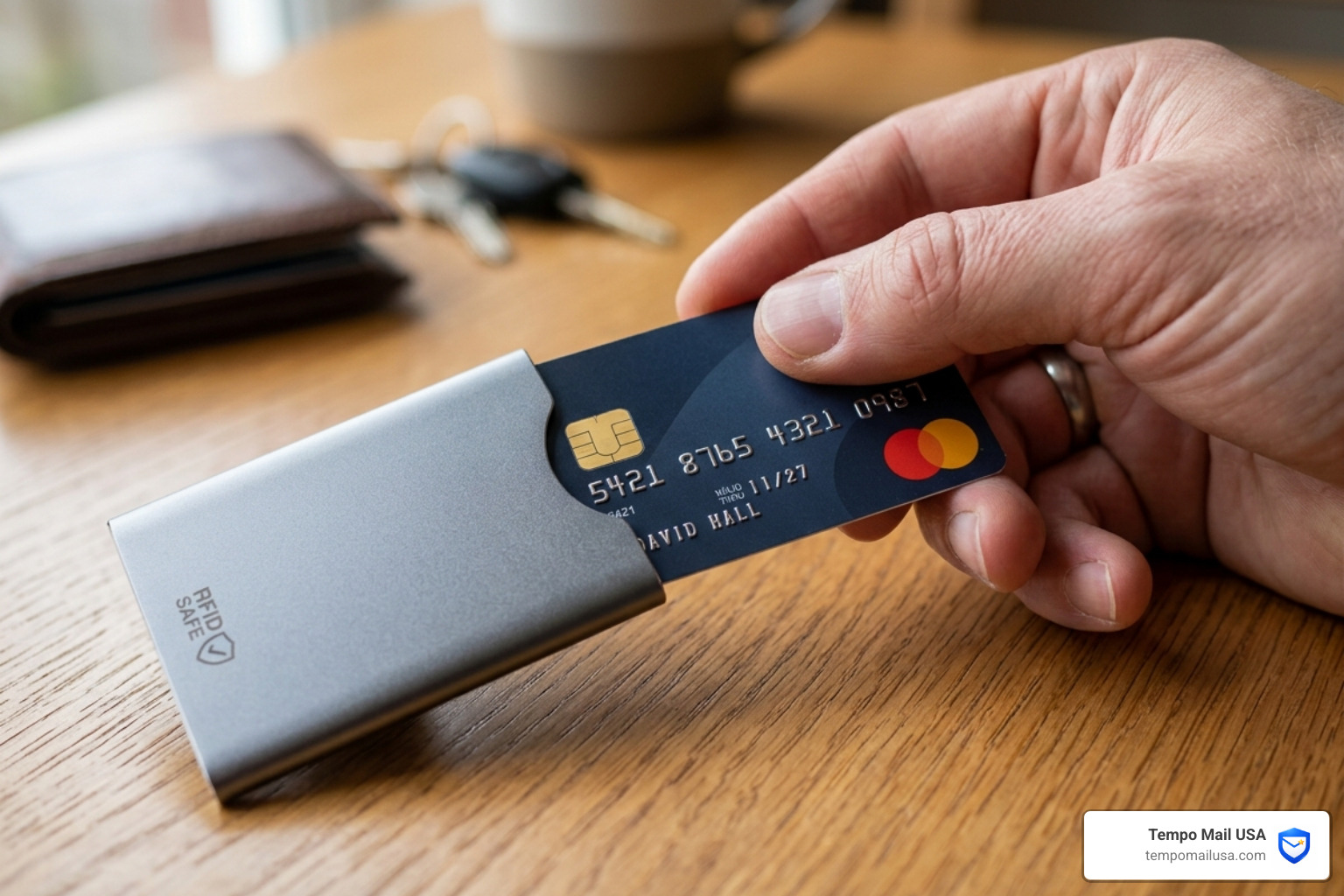
- Use RFID-Blocking Gear: This is the simplest defense. RFID-blocking wallets or individual sleeves act as a "Faraday cage," blocking the radio signals so a rogue reader can't communicate with your card while it's in your pocket.
- Audit Daily: Set up real-time transaction alerts on your phone. If a ghost tapping scam occurs, you’ll get a notification immediately, allowing you to freeze the card before the scammer makes a second attempt.
- Credit Over Debit: Always use a credit card for tap-to-pay. Under the Fair Credit Billing Act (FCBA), your liability for fraudulent charges is capped at $50, and the money isn't missing from your actual bank account while the dispute is pending.
Mobile Wallet Security Settings
Surprisingly, your phone is often safer than your physical card—if you set it up correctly.
- Require Biometrics: Ensure Apple Pay or Google Pay requires FaceID, a fingerprint, or a passcode for every transaction. This prevents a scammer from triggering a "passive" tap while your phone is in your pocket.
- Toggle NFC Off: On Android devices, you can actually turn off the NFC chip when you aren't using it.
- Keep Software Updated: Security patches often include fixes for vulnerabilities that scammers exploit.
Recovery Steps: What to Do if You’re Targeted
If you see a charge you don't recognize, time is of the essence. You usually have a 60-day window to report fraudulent charges to your bank to ensure full protection.
Checklist for Victims:
- [ ] Freeze the Card: Use your mobile banking app to lock the card instantly.
- [ ] Call Your Bank: Explicitly state that you suspect a "contactless fraud" or "ghost tap."
- [ ] Report to the BBB: Use the BBB Scam Tracker. While reports were low in early 2025, the surge in 2026 means your report helps authorities track these local "roaming" scammers.
- [ ] Contact the Attorney General: File a complaint with your state’s Consumer Protection Team to help build a legal case against rogue merchant accounts.
Frequently Asked Questions about Ghost Tapping
Can a scammer drain my account from across the street?
No. This is a common myth. NFC technology is physically limited. A scammer must be within 4 centimeters—about the length of a paper clip—to trigger a transaction. If someone is standing ten feet away, they cannot "ghost tap" your wallet.
Are mobile wallets like Apple Pay safer than physical cards?
Generally, yes. Physical cards are "always on." A reader can wake up the chip through your jeans. Mobile wallets, however, usually require you to double-click a button and provide biometric authentication before the NFC chip transmits any payment data.
How do I know if I've been ghost tapped?
Watch for "test charges." Scammers often run a tiny transaction ($0.01 or $1.00) to see if the card works. If you see a small alert from a merchant you’ve never visited, freeze your card immediately.
Conclusion
The convenience of 2026 comes with new risks. The ghost tapping scam is a reminder that as our payment methods become "invisible," so does the theft.
Protecting your financial life requires a multi-layered approach. Just as an RFID sleeve protects your physical card, tools like Tempo Mail USA protect your digital identity. By using a temp-mail service, you create a PII firewall, ensuring that when you sign up for rewards programs or vendor apps, your primary email and personal data stay shielded from the databases that scammers often hack to find their next targets.
Final Thought: As NFC standards evolve, scammers will find new ways to stretch the limits of proximity. Stay vigilant, check your screens before you tap, and don't let a "ghost" walk away with your hard-earned money.