



Why FIA Investment Returns and Fixed Indexed Annuity Cost Analysis Matter Before You Commit
FIA Investment Returns and Fixed Indexed Annuity Cost Analysis is one of the most important evaluations you can do before placing retirement savings into one of these contracts. Here is a fast-reference summary:
| Factor | What to Know |
|---|---|
| Typical blended returns | 2.5% - 6.5% annualized over multi-year horizons |
| Principal protection | 0% floor — you never lose money due to index declines |
| Upside limits | Caps, participation rates, or spreads reduce gains |
| Standalone fees | $0 annual fee on basic contracts; costs are built into the product |
| Optional rider fees | 0.80% - 1.40% annually, deducted from account value |
| Surrender period | Typically 5 - 10 years; early exit penalties apply |
| Tax treatment | Tax-deferred growth; gains taxed on withdrawal |
| Top cap rates (April 2026) | Up to 11.50% on 10-year terms |
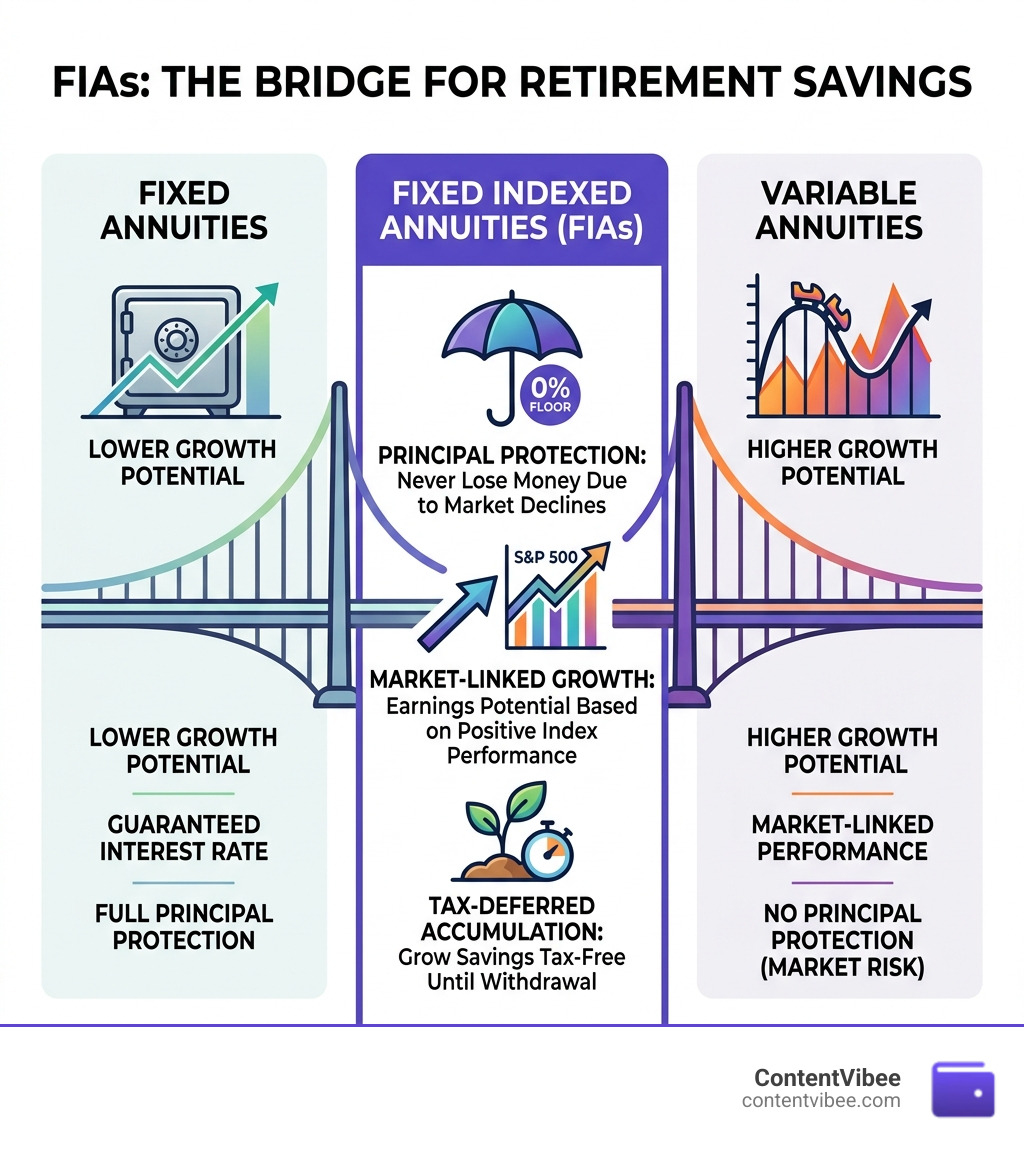
Fixed Indexed Annuities (FIAs) were created in 1995 to compete with CD returns. They sit in the middle ground between a conservative fixed annuity and a risky variable annuity.
The appeal is straightforward: your principal is protected from market losses, but your growth potential is linked to a market index like the S&P 500. If the index drops, you get 0% — not a negative return. If it rises, you earn a portion of that gain, up to a defined limit.
But the details matter a lot. Cap rates, participation rates, rider fees, and surrender schedules all affect what you actually earn versus what the marketing materials suggest. For self-directed investors, understanding these mechanics before committing is non-negotiable.
This guide breaks it all down — returns, costs, comparisons, and realistic expectations — so you can make a clear-eyed decision.
Understanding FIA Investment Returns and Fixed Indexed Annuity Cost Analysis
To understand how an FIA grows, we first need to pull back the curtain on how insurance companies actually fund these products. When you hand over your premium—often a minimum of $100,000 at major brokerages—the insurer doesn't just toss it into the stock market. Instead, they put the lion's share of your money into their "general account," which is mostly made up of high-quality corporate and government bonds.
The interest the insurer earns on those bonds is their "options budget." They use this budget to buy call options on a market index (like the S&P 500). If the index goes up, the options gain value, and that gain is passed to you as "credited interest." If the index goes down, the options expire worthless, but your principal remains safe in the bond-backed general account. This is the engine behind the 0% floor.
Evaluating this performance is critical, especially when comparing it to other retirement vehicles. You can learn more about this in our guide on How to Evaluate Retirement Investment Performance and Security. For a broader look at how these fit into your golden years, check out the Comprehensive Guide to Secure Retirement Planning 2026.

Crediting Methods and Upside Limits
The way interest is calculated is where things get technical. Insurers use several formulas to decide how much of the index's gain you actually get to keep. The most common methods include:
- Annual Point-to-Point: This compares the index value on day one of your contract year to the value on the last day. If it’s higher, you get a return (usually capped).
- Monthly Sum: This adds up the monthly changes in the index. Each month's gain is capped (e.g., 2%), while losses are usually unlimited on the downside for that month. At the end of the year, they are totaled.
- Participation Rates: Instead of a hard cap, you might get a percentage of the gain. For example, if the S&P 500 rises 10% and your participation rate is 90%, you are credited with 9%.
- Cap Rates: This is a hard ceiling. If your cap is 8.5% and the market gains 15%, you only get 8.5%.
Understanding these rates is the first step in building a robust financial defense. Dive deeper into these mechanics with our article on Understanding Crediting Rates and Financial Protection Strategies.
Realistic Expectations for FIA Investment Returns
We have all seen the marketing brochures showing double-digit returns during bull markets. However, in the real world of 2026, most diversified FIA strategies land in a 2.5% to 6.5% annualized range.
Why the gap? One word: Renewal Risk. The cap rates and participation rates you get on day one aren't usually guaranteed for the life of the contract. The insurer can reset them every year. If interest rates fall or market volatility rises, the insurer's "options budget" shrinks, and they may lower your caps.
Many modern FIAs now use "volatility-controlled indexes." These are custom-built indexes that automatically shift money between equities and cash to keep price swings steady. While this allows the insurer to offer higher participation rates, it often results in more modest returns during explosive bull markets. For more on managing these trade-offs, see Protecting Your Principal: How FIAs Work in Volatile Markets.
Current Market Rates and Performance Benchmarks
As of April 2026, the market has seen some significant movement. Cap rates have actually increased week-over-week by 0.25% to 0.75% across various terms. Here is what the top of the market looks like right now:
- 3-Year Terms: Top caps are hitting around 8.50%.
- 5-Year Terms: We are seeing caps as high as 10.50%.
- 10-Year Terms: The top rate recently rose to 11.50%.
While these numbers look enticing, we must evaluate carrier stability. A high cap from a carrier with a lower financial strength rating (like a B++) might carry more long-term risk than a slightly lower cap from an A+ rated insurer. Always check AM Best or S&P ratings before signing.
Breaking Down the Costs: Fees, Riders, and Penalties
One of the biggest selling points of a standalone FIA is that it usually has no explicit annual management fees. The insurer makes their money on the "spread"—the difference between what they earn on their investments and what they credit to you. However, just because there isn't a monthly bill doesn't mean there aren't costs.
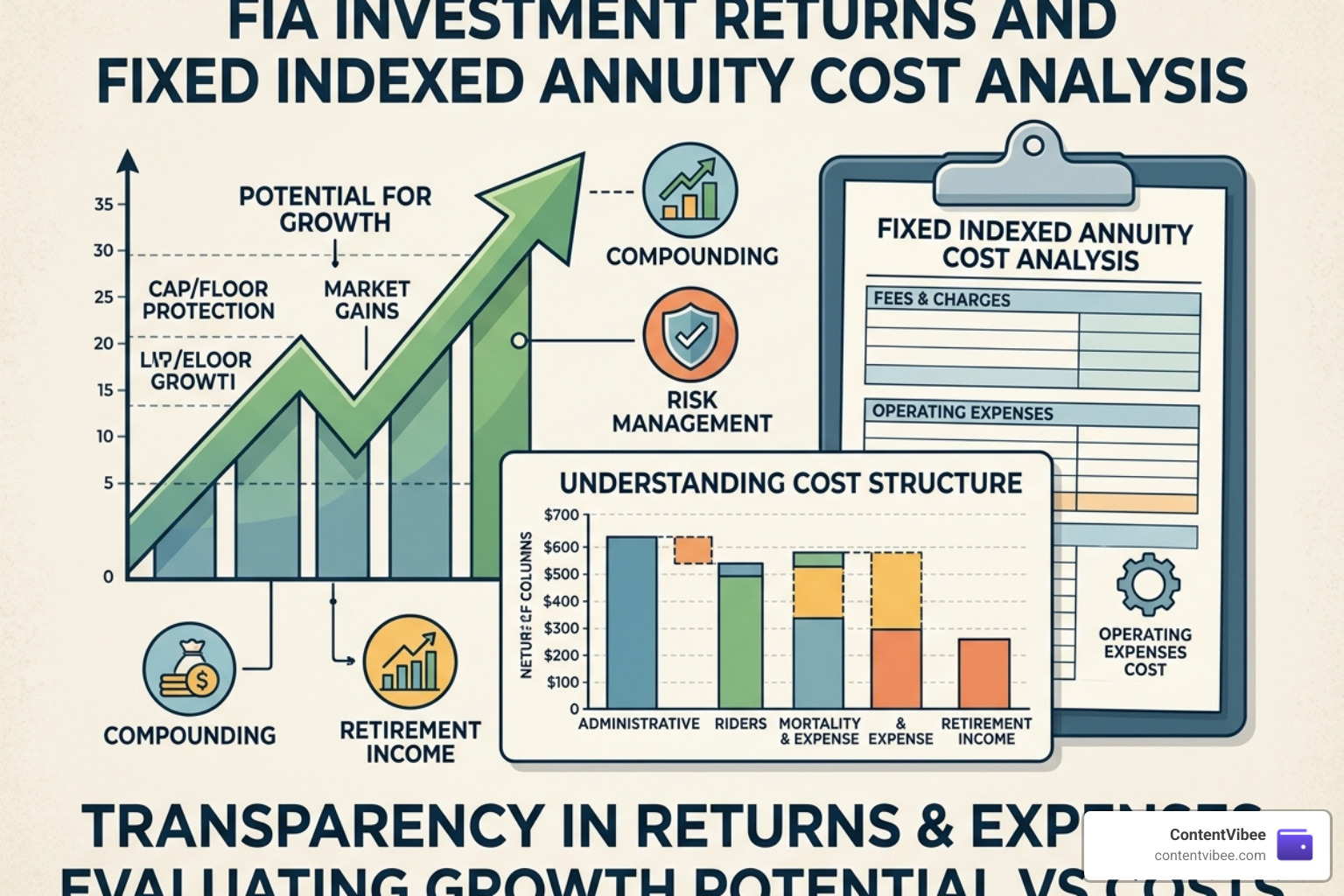
The most significant "cost" is the Surrender Charge. If you need to pull your money out early—typically within the first 5 to 10 years—you will pay a penalty. These often start high (7% to 15% in year one) and decline annually. Many contracts also include a Market Value Adjustment (MVA), which can further increase or decrease your payout depending on how interest rates have moved since you started the contract.
If you are used to the fee structures of other platforms, you might find this confusing. Compare these to more transparent models by reading What Are Wealth Management Fees and Why Robo Advisor Fees Comparison Matters.
Optional Riders and Their Impact on Net Returns
Many investors add a Guaranteed Lifetime Withdrawal Benefit (GLWB) to their FIA. This rider ensures you will receive a check for life, even if your account value hits zero.
But this "pension-like" security comes at a price. Typical rider fees range from 0.80% to 1.40% annually. These fees are deducted from your "account value" (your actual cash). If the market is flat and the index credits 0%, your account value will actually shrink because of the rider fee. It is vital to distinguish between your "Account Value" (what you can walk away with) and your "Benefit Base" (a hypothetical number used only to calculate your future income). For a deeper dive into these tradeoffs, see Evaluating Financial Product Pros and Cons for Asset Protection.
Fixed Indexed Annuity Cost Analysis vs. Opportunity Costs
The "hidden" cost of an FIA is the opportunity cost. When you buy an FIA, you are giving up dividends. Historically, dividends have accounted for a massive portion of the S&P 500's total return. Since FIAs only track the price index, you miss out on that yield.
Furthermore, the caps and spreads that protect you on the downside also "drag" on your performance during strong years. If the market goes up 25% and you are capped at 10%, you have "paid" a 15% opportunity cost for that protection. This is why we often categorize FIAs as alternative investments rather than pure equity plays. Learn more about these distinctions in Understanding Traditional Vs Alternative Investments.
Comparing FIAs to Other Low-Risk Financial Instruments
When we look at the low-risk landscape in 2026, FIAs compete directly with Certificates of Deposit (CDs) and Multi-Year Guaranteed Annuities (MYGAs).
| Feature | FIA | MYGA | CD |
|---|---|---|---|
| Return Potential | Variable (linked to index) | Fixed (guaranteed) | Fixed (guaranteed) |
| Principal Protection | Yes (0% floor) | Yes | Yes (FDIC insured) |
| Liquidity | 10% free withdrawal | Limited | Penalties apply |
| Typical Term | 5-10 years | 3-7 years | 6 months - 5 years |
| Taxes | Tax-deferred | Tax-deferred | Taxed annually |
FIAs generally offer higher potential returns than CDs or MYGAs but without the guaranteed "yield" of those products. If you prioritize a known return, a MYGA is likely better. If you want a chance to beat inflation while keeping your principal safe, the FIA is the contender.
Protecting these savings is paramount. If you ever face issues with your funds, knowing How to Dispute Unauthorized Transactions and Protect Retirement Savings is a vital skill. You can also explore Comparing Low-Risk Financial Protection Tools and Recovery Options for more ideas.
Fixed Indexed Annuity Cost Analysis for Income Planning
For those using an FIA as an income floor, we have to look at the Internal Rate of Return (IRR). This measures the efficiency of the income rider. Sometimes, a simpler approach—like a MYGA ladder combined with a future Single Premium Immediate Annuity (SPIA)—can actually produce more income for less total fee drag.
The goal here is to mitigate "sequence of returns risk"—the danger of a market crash right as you start withdrawing. FIAs excel here because the 0% floor prevents your balance from cratering during those critical early retirement years. To understand how these costs stack up against professional management, read Understanding Advisory Fees and Financial Recovery Costs.
Tax Implications and Withdrawal Strategies
One of the most powerful features of the FIA is tax deferral. You don't pay a dime in taxes on the growth until you take the money out.
However, withdrawals are generally taxed on a LIFO (Last-In, First-Out) basis. This means the IRS considers the first dollars you take out to be the "gains," which are taxed as ordinary income. If you have a "qualified" annuity (like an IRA rollover), the entire withdrawal is typically taxable. Most contracts allow you to take out 10% of the value each year without a surrender penalty, which is a great way to manage liquidity. For more on the insurance side of things, visit our category/insurance section.
Risk Mitigation and Suitability in 2026
Is an FIA right for you in 2026? It depends on your "job" for the money. If you need a safe "sleeve" for your portfolio that can still outpace a savings account, it's a strong candidate.
Safety, however, is only as good as the company backing the contract. Since FIAs are not FDIC insured, they rely on the "claims-paying ability" of the insurance company. We always recommend checking financial strength ratings from agencies like AM Best or Moody's. Additionally, most states have "guaranty associations" that provide a safety net (usually $100,000 to $500,000) if an insurer fails.
Beyond carrier failure, you must also guard against modern threats. Learn how to keep your nest egg safe in Identity Theft and Financial Fraud: How to Secure Your Retirement Accounts.
Evaluating Carrier Renewal Integrity
Not all insurance companies treat their existing customers the same. Some carriers offer high "teaser" caps to get you in the door, only to slash them significantly at the first renewal date.
Before you buy, ask for a carrier's renewal history. Do they have a track record of maintaining competitive caps for 10-year-old contracts, or do they only care about new business? This "renewal risk" is one of the biggest drivers of long-term return compression. Understanding how cash value grows—and what can hinder it—is discussed further in Why Life Insurance Investment Cash Value Growth.
Frequently Asked Questions about FIA Returns and Costs
Can I lose money in a Fixed Indexed Annuity?
Technically, your principal is protected from market losses by the 0% floor. However, you can see your account value decline in three specific scenarios:
- Surrender Penalties: If you withdraw more than the "free" amount before the term ends.
- Rider Fees: If you have an income rider and the index credits 0% for the year, the fee will still be deducted.
- Market Value Adjustments: If interest rates have risen significantly and you exit the contract early.
How do volatility-controlled indexes impact FIA Investment Returns?
These indexes use an "excess return" methodology. They aim for a specific volatility target (e.g., 5%). When the market gets "choppy," the index automatically moves into cash. This stability allows insurers to offer much higher participation rates (sometimes over 100%), but it often prevents the index from capturing the full "spike" of a rapid market recovery.
Are higher cap rates always better?
Not necessarily. A 12% cap on a 10-year contract might sound better than an 8% cap on a 5-year contract, but you are locking your money up for twice as long. You also have to consider the "reset" frequency. A higher cap with an annual reset is usually better than a slightly higher cap that only resets every two years.
Conclusion
Navigating FIA Investment Returns and Fixed Indexed Annuity Cost Analysis requires a balance of optimism for market growth and a healthy skepticism of marketing "fluff." These products are powerful tools for principal protection and tax-deferred growth, but they are not "get rich quick" schemes. They are defensive assets designed to provide a stable floor for your retirement.
At Autopilot, we believe in full fee transparency and risk-adjusted returns. Whether you are managing your own portfolio or looking for automated solutions, understanding the true cost of every investment is the key to long-term success. By evaluating the "cost-worthiness" of every rider and cap, you can ensure your retirement strategy is built on a solid foundation. For more insights into how to structure your assets, explore more info about investment categories.