



Why a Compound Interest Calculator for Retirement Planning Strategy Could Be the Most Important Tool You Use This Year
A Compound Interest Calculator for Retirement Planning Strategy helps you project how your savings grow exponentially over time — by calculating returns not just on your original investment, but on every dollar of interest you've already earned.
Here's the quick answer if you're short on time:
How to calculate compound interest for retirement in 5 steps:
- Set your starting principal — your current savings or initial deposit
- Input a realistic annual return rate — typically 7% after inflation for a diversified stock portfolio
- Define your monthly contributions — aim for 15-20% of gross income
- Choose your compounding frequency — monthly is standard for most retirement accounts
- Analyze the results and adjust — test scenarios, increase contributions, and account for inflation
Quick example: $500 per month at 7% annual return, starting at age 25, grows to approximately $1.2 million by age 65. Wait until age 35, and that same strategy yields only $566,000 — less than half. Time is the single most powerful variable in the equation.
The math behind this isn't magic — it's compounding. Albert Einstein is widely credited with calling compound interest "the eighth wonder of the world." Whether or not he actually said it, the sentiment holds: money earning returns on its own previous returns creates a snowball effect that accelerates dramatically over decades.
What most people don't realize is how much of their final retirement balance comes from compounding rather than their own contributions. Take a simple example: $10,000 invested at a 7% annual return grows to over $76,000 in 30 years — and roughly 87% of that final balance is pure compounding growth, not money you put in.
One more thing worth mentioning early: as you use online calculators and financial planning tools in April 2026, you're often prompted to sign up for accounts or enter personal information. This is a significant commercial risk to your privacy. Using a professional encryption tool like NordVPN alongside a PII firewall like Tempo Mail USA keeps your personal inbox and identity protected while you run your numbers.
Now, let's get into the mechanics.
The Mechanics of Wealth: Why Compounding is the "Eighth Wonder"
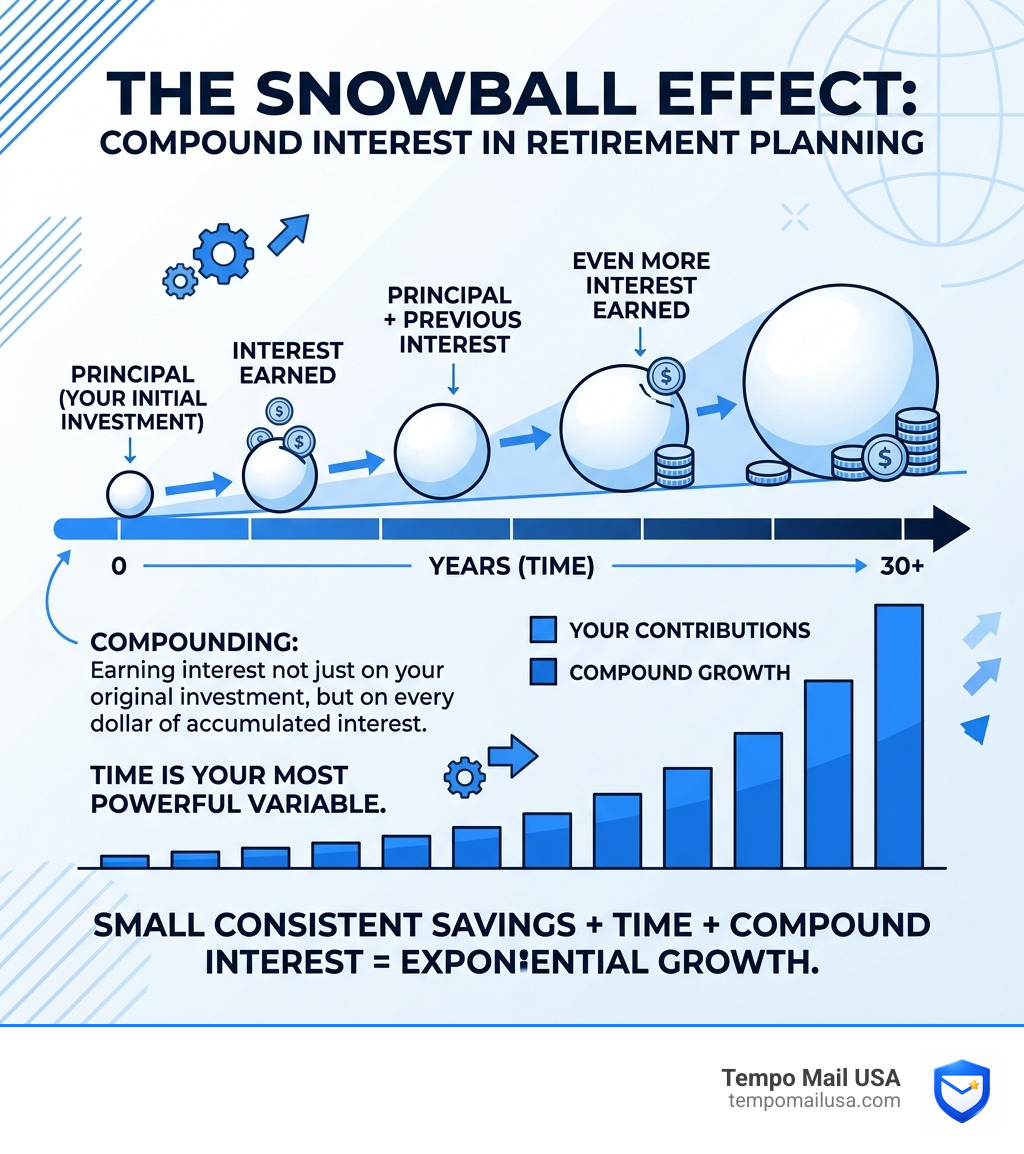
To understand why a Compound Interest Calculator for Retirement Planning Strategy is so vital, we first have to look at the "snowball effect." In finance, simple interest is like a flat road; you move forward at a steady pace based only on your original principal. Compound interest, however, is like rolling a small snowball down a massive mountain. As it rolls, it picks up more snow, which increases its surface area, allowing it to pick up even more snow.
By April 2026, the financial landscape has evolved, but the math remains the same. When you earn interest on your accumulated earnings, your wealth multiplier kicks into high gear. This is the cornerstone of financial independence. Instead of you working for money, your money begins to work harder than you do.
Through consistent asset accumulation and dividend reinvestment, your portfolio doesn't just grow; it accelerates. Many users now rely on secure platforms, insurance coverage, and advanced privacy tools to avoid financial or data-related risks while managing these large sums. Tools like the Money Guy Compound Interest Calculator can help you visualize this trajectory vividly.
The Difference Between Simple and Compound Interest
Simple interest is calculated only on the principal sum (the amount you originally deposited). If you put $10,000 in an account at 5% simple interest, you earn $500 every year. After 10 years, you have $15,000.
Compound interest, however, calculates interest on the principal plus the interest already earned. In that same scenario, by year two, you’re earning 5% on $10,500. By year ten, you have $16,289. Over a 30-year retirement horizon, that gap becomes a canyon. Compound interest provides a growth acceleration that simple interest simply cannot match.
Why Starting at Age 25 vs 35 Changes Everything
The most expensive thing you can own is a "late start." The opportunity cost of waiting just one decade is staggering.
- Investor A (The Early Bird): Starts at age 25, contributes $500/month at a 7% return. By age 65, they have $1.2 million.
- Investor B (The Procrastinator): Starts at age 35, contributes the same $500/month at 7%. By age 65, they have $566,000.
Investor B missed out on over $600,000 by waiting 10 years. Even if Investor B doubled their contributions to $1,000 a month starting at 35, they still wouldn't catch up to Investor A's final balance. Time-value of money is the ultimate leverage.

5 Steps to Use a Compound Interest Calculator for Retirement Planning Strategy
Using a digital interface to map your future requires precision. You aren't just "guessing" your way to retirement; you are engineering it. Here is how we recommend using a Compound Interest Calculator for Retirement Planning Strategy to get the most accurate results.
Step 1: Establish Your Starting Principal and Time Horizon
Your starting principal is whatever you have saved right now—your "Seed Money." If you're starting from zero, that's fine, but be honest about your current liquid assets. Next, define your time horizon. If it’s April 2026 and you plan to retire in 2056, your time horizon is 30 years. The Tempo Mail USA Compound Interest Calculator is a great place to start these initial projections.
Step 2: Input Realistic Returns for a Compound Interest Calculator for Retirement Planning Strategy
Don't fall into the trap of inputting a 15% return just because the market had a "green" year. Historically, the S&P 500 has averaged about 10% annually since 1926, which is roughly 7% after adjusting for inflation. For a balanced portfolio (stocks and bonds), a conservative 5-6% is often safer. You can use the Enhanced Compound Interest Calculator to factor in annual variance, which helps model "bad years" in the market.
Step 3: Define Your Monthly Contribution Strategy
Consistency beats intensity. This is where "dollar-cost averaging" comes in—investing the same amount every month regardless of whether the market is up or down. A common benchmark is to save 15-20% of your gross income. If you earn $60,000 a year, that’s $750 to $1,000 monthly. Automating these transfers ensures you never "forget" to pay your future self.
Step 4: Select Your Compounding Frequency
How often does the "interest on interest" get calculated?
- Daily: Most common for high-yield savings accounts.
- Monthly: Standard for most investment accounts and mutual funds.
- Annually: Common for certain bonds.
While daily compounding technically yields more than annual, the difference is relatively small compared to the impact of your total return rate and time. However, understanding your Effective Annual Rate (EAR) helps you compare different financial products accurately.
Step 5: Analyze and Adjust Your Compound Interest Calculator for Retirement Planning Strategy
Once you see the final number, ask yourself: Is this enough to live on? If the answer is no, you have three "levers" to pull:
- Increase contributions: Can you find an extra $100 a month?
- Extend the timeline: Can you work two years longer?
- Adjust risk: Do you need a slightly more aggressive portfolio to hit a higher return?
Advanced Variables: Inflation, Taxes, and the Rule of 72
A raw calculation can be misleading if you don't account for the "wealth eroders": inflation and taxes.
The Impact of Inflation on Future Value
Inflation reduces your purchasing power. If inflation averages 3%, $100,000 twenty years from now will only buy what roughly $55,000 buys today. When using a Compound Interest Calculator for Retirement Planning Strategy, it is often best to use a "real" return rate (e.g., using 7% instead of 10%) to see the results in today’s dollars. This gives you a more grounded sense of your future cost of living.
Tax-Advantaged Growth vs Taxable Accounts
Where you put your money matters as much as how much you put in.
| Account Type | Tax Treatment | Best For |
|---|---|---|
| 401(k) / Traditional IRA | Tax-deferred (Pay taxes later) | High earners seeking immediate tax breaks |
| Roth IRA | Tax-free growth (Pay taxes now) | Those expecting higher tax brackets in retirement |
| Taxable Brokerage | Capital gains tax (Pay every year) | Flexibility and early retirement access |
Tax drag can reduce your final balance by over 20% if you aren't careful. Utilizing tax-advantaged accounts allows your compound interest to snowball without being "chipped away" by the IRS every April. For those looking at the debt side of the equation, you might also find value in our loan calculator tools to see how interest works against you.
The Rule of 72
The Rule of 72 is a mental shortcut to see how fast your money doubles. Divide 72 by your expected return rate.
- At 6% return, your money doubles every 12 years.
- At 8% return, your money doubles every 9 years. This highlights why even a 2% difference in returns can lead to hundreds of thousands of dollars in difference over a 30-year career.
Risk Mitigation: Sequence of Returns and Digital Privacy
As you get closer to retirement, "Sequence of Returns Risk" becomes your biggest threat. This is the danger that the market crashes right as you start taking withdrawals. If you lose 20% of your portfolio in Year 1 of retirement while also pulling out 4% for living expenses, your portfolio may never recover. This is why most advisors suggest a conservative shift toward bonds as you age.
Protecting Your Financial Data During Planning
In April 2026, financial data is more valuable than gold. When you use various "free" calculators online, many sites harvest your data to sell to insurance or loan companies. This leads to "PII exposure" (Personally Identifiable Information).
To maintain your digital security, we recommend:
- Using a PII Firewall: Use Tempo Mail USA to create a temporary email address when signing up for financial newsletters or tools. This keeps your real identity shielded from data brokers.
- Secure Your Connection: Before accessing any financial dashboard or calculator, activate a trusted VPN like NordVPN to encrypt your data and mask your IP address from potential bad actors.
- Identity Protection: Regularly check for leaks of your financial data.
Managing Volatility Near Retirement
To mitigate risk, consider "Bond Ladders" or "Cash Buckets." By keeping 2-3 years of living expenses in a high-yield savings account, you can avoid selling your stocks during a market downturn, giving your compound growth time to recover.
Decision Matrix: Comparing Savings Vehicles and Growth Scenarios
Not all compounding is created equal. Your Compound Interest Calculator for Retirement Planning Strategy will show very different results depending on where you "park" your cash.
High-Yield Savings vs Stock Market Compounding
- High-Yield Savings/CDs: Currently offering around 4-5% in 2026. These are safe but rarely beat inflation significantly. They are perfect for your 3-6 months emergency fund.
- Stock Market/Mutual Funds: Historically offer 10% (nominal). This is where true wealth is built, but it comes with the "stomach-churning" volatility of market cycles.
The $500 Monthly Contribution Benchmark
If you are wondering where to start, $500 a month is a powerful milestone.
- Over 30 years at 7%, you contribute $180,000.
- Your total balance grows to $607,438.
- Interest earned is $427,438. In this scenario, your interest earned is nearly 2.4 times the amount of money you actually worked for. If you increase that contribution by just $100 a month, your final balance jumps by over $120,000. For more detailed breakdowns, check out our compound interest tool.
Best Options Compared: Where to Compound?
- Employer Match (401k): This is a 100% "instant" return. Always start here.
- Roth IRA: Best for tax-free compounding.
- High-Yield Savings: Best for liquidity and emergency funds.
- Index Funds: Best for long-term, low-fee growth.
Frequently Asked Questions about Retirement Compounding
How much does $500 a month grow to in 30 years?
At a 7% annual return, $500 invested monthly grows to approximately $607,438 over 30 years, with over $427,000 of that total coming from compound interest growth rather than your own contributions.
What is the best compounding frequency for retirement?
Monthly compounding is the standard for most retirement accounts and provides a significant advantage over annual compounding, though the difference compared to daily compounding is marginal for long-term investors.
Can I retire on compound interest alone?
No, compound interest requires a starting principal and consistent contributions; it acts as a mathematical multiplier for the money you save, not a replacement for the act of saving itself.
Conclusion: Take Control of Your Exponential Future
Strategic planning is the difference between a retirement of "just getting by" and a retirement of true freedom. By understanding the mechanics of compound interest, you can make informed decisions today that will pay dividends for decades.
As you move forward with your planning in 2026, your financial security is tied to your digital security. Protect your identity with a PII firewall like Tempo Mail USA to ensure your path to wealth isn't marred by identity theft or data leaks.
Your Next Steps:
- Automate: Set up that monthly contribution today.
- Diversify: Don't put all your eggs in one basket.
- Protect: Use secure tools and temporary aliases to shield your financial journey.
- Consult: When in doubt, speak with a fee-only financial advisor to refine your strategy.
The best time to start was ten years ago. The second best time is right now.