
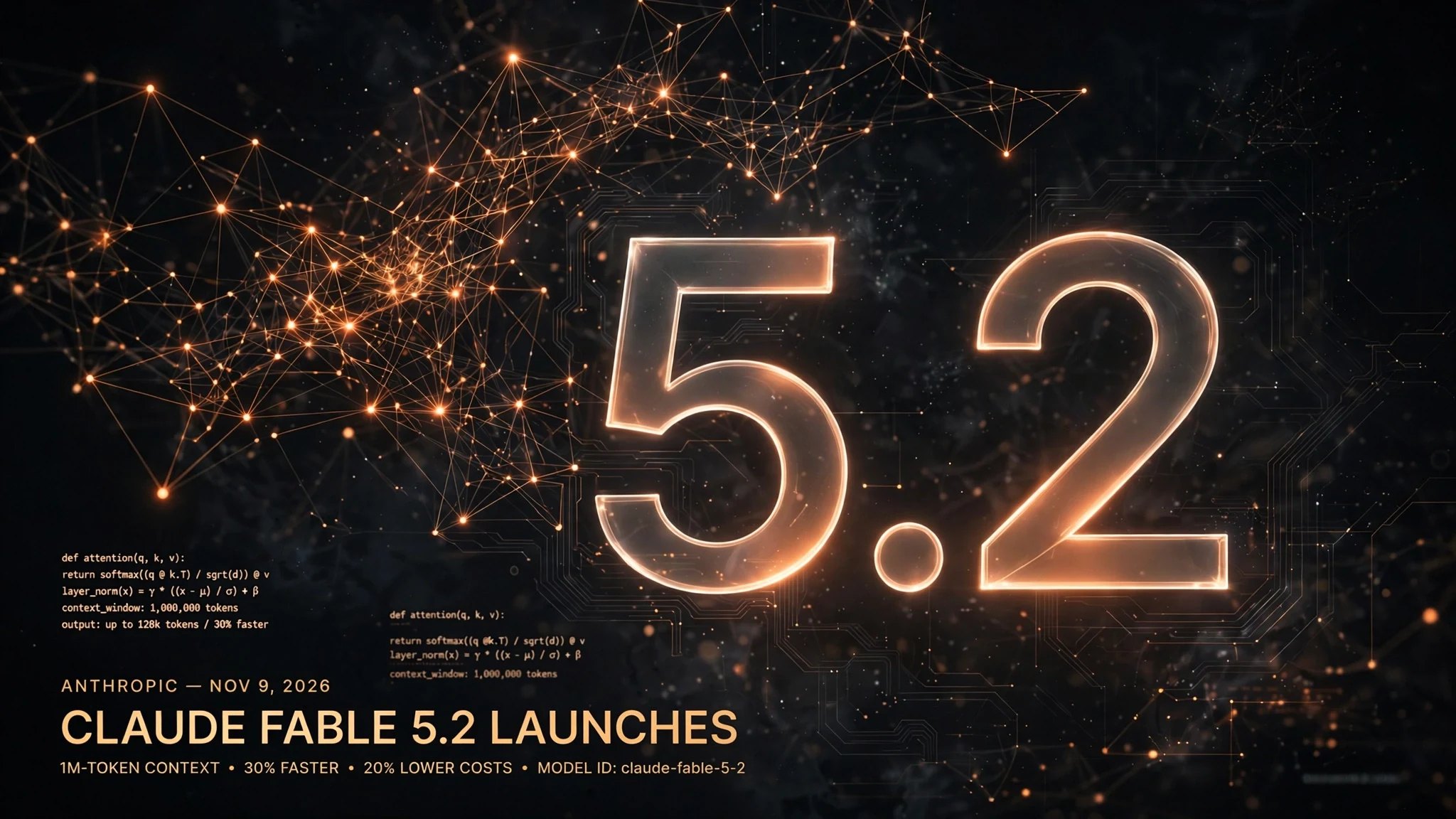
Claude Fable 5.2 Is Here — What It Costs, Who Should Upgrade, and the 'Free Access' Emails to Ignore

Anthropic shipped Claude Fable 5.2 on Monday, November 9, 2026, and the launch did what every big AI launch does now: it climbed Google Trends within hours. By late afternoon Eastern, "fable 5.2" sat at number 13 on Google's US trending list, up more than 1,000 percent, with "claude fable 5.2" as the top related query. The model arrived alongside a sibling, Claude Mythos 5.2, and a price cut that is more interesting than any benchmark on the announcement page.
I have read the launch materials, the system card summaries, and the first wave of coverage, and my honest read is this: Fable 5.2 is a real step forward for a narrow group of users, a shrug for everyone else, and — like every launch with this much search heat — already bait for the fake-access emails that follow AI releases around. This post sorts out which group you are in, what the numbers actually say, and how to try the new model without handing your real inbox to a stranger.
Fable 5.2, Mythos 5.2, and Opus 5.5: three names, one model, different doors
The naming is the first thing to get straight, because Anthropic launched two models that are, by its own account, the same model.
Fable 5.2 is the general-release version. It carries safeguards that block most cybersecurity and biology requests, and that is what lets Anthropic sell it to everyone. Mythos 5.2 is the same underlying model with some of those safeguards relaxed, and it goes only to vetted organizations — cybersecurity and life-sciences teams accepted into Anthropic's verification programs, including its Project Glasswing effort. If you are not one of those organizations, Mythos is not a product you can buy, and any email offering you "Mythos early access" is lying twice over: about the access and about who it is from.
Opus 5.5 is the model most Claude users actually live with day to day, and Anthropic's own guidance still points ordinary coding and knowledge work at Opus first. Fable is positioned above it, for what Anthropic calls "the most ambitious, open-ended technical work." That sentence does a lot of quiet work. It means: if your work is not long, hard, and open-ended, Fable 5.2 is not your upgrade.
| Model | Who can use it | What it is for |
|---|---|---|
| Claude Fable 5.2 | Paid Claude plans, Claude Code, Claude Platform, AWS, Google Cloud, Microsoft Azure | The hardest, longest-running technical work |
| Claude Mythos 5.2 | Vetted cybersecurity and life-sciences organizations only | Same model, relaxed safeguards for approved teams |
| Claude Opus 5.5 | Everyone on Claude | Everyday coding and knowledge work — still Anthropic's default recommendation |
Fable 5.2 is available now on paid Claude plans, in Claude Code, and through the Claude Platform under the model ID claude-fable-5-2. Cognition put it in Devin Desktop and Devin CLI on launch day. There is no free tier, no waitlist to join for the model itself, and no "early access" form floating around — a detail that matters once the scam emails start, because every one of them will pretend otherwise.
The benchmark table, read the way Anthropic wrote it
Anthropic's launch comparison puts Fable 5.2 ahead on 13 of 15 reported score lines, counting two ways of scoring one knowledge-work test separately. The headline number is from Cognition's FrontierCode 2.0 test: Fable 5.2 scored 49.1 percent, against 45.5 percent for Opus 5.5 and 32.4 percent for Fable 5.1. Anthropic also cites an average cost of $6.72 per task on that test at High effort, from its own system card.
Those numbers are vendor-reported. The methodology lives in the system card, and at the time of writing none of it has been independently replicated. Two outside testers had published results by launch evening, and at least one disagreed with Anthropic about the effort levels involved. That does not make the numbers false. It makes them provisional, and the honest way to read them is as Anthropic's best case, not as settled fact.
The same caution applies to the science claims, which are the most eye-catching part of the announcement and the easiest to overstate. Anthropic says Fable 5.2 completed calculations addressing two open questions in theoretical black-hole physics during prerelease testing, and points to preprints. A preprint is a finding made available for scrutiny; it is not broad acceptance by the research community. The Fermat's Last Theorem result is simpler to misread: roughly 1,000 model agents translated an existing proof into Lean, the formal language in which a computer can check each step. Fable 5.2 did not discover a new proof of a centuries-old theorem. It did an enormous, careful transcription job, which is impressive in a different way than the headlines suggest.
There are two internal-use claims worth knowing about, because they tell you what Anthropic itself uses the model for. The company says over 90 percent of changes merged into its core codebase are now written by Claude with human guidance, and that a team of agents running an earlier version of Fable 5.2 migrated a critical production service from Python to Rust — a service that is now more efficient, more reliable, and starts about 26 times faster. Neither claim can be checked from outside the company. Both are consistent with what the benchmark numbers suggest: this model earns its keep on long, multi-step engineering work, not on short answers.
My opinion, stated plainly: the 49.1 percent FrontierCode number is the one to watch, and not because it is big. FrontierCode measures the kind of work where a model has to hold a large task together for hours — the exact work where earlier models fell apart. A jump from 32.4 to 49.1 on that test, if it holds up in independent testing, matters more than any single benchmark record. If it does not hold up, Fable 5.2 is a faster, cheaper 5.1 with better marketing. The next few weeks of independent testing will decide which one it is, and there is no reason to pay for the answer before it arrives.
The price cut is the actual news
Here is the part of the launch that affects the most people, and it has nothing to do with benchmarks. Fable 5.2 costs $8 per million input tokens and $40 per million output tokens on the standard API price — down from $10 and $50 for the 5.1 generation. That is a 20 percent cut. Outputs run up to 30 percent faster than Fable 5.1, and a fast mode offers up to 2.5 times faster token generation.
Put the price next to Opus 5.5 and the picture sharpens: Opus costs $4 per million input tokens and $20 per million output tokens. Fable 5.2 is still exactly twice the price of Opus on both sides. So the honest math is that Fable got cheaper, and Opus is still the cheap seat. Anyone telling you Fable 5.2 is "affordable now" is skipping the second half of that sentence.
Who saves real money? Teams already running Fable 5.1 at volume, where a 20 percent cut on a large token bill is a line item, not a rounding error. Everyone else saves almost nothing, because the model they should be using — Opus 5.5 — did not change price. The speed gain is the better deal for most people: up to 30 percent faster output on the same work is time back, and time is what the long tasks Fable is built for actually consume. Fast mode has its own price, and it is not small: $16 per million input tokens and $80 per million output tokens — double the standard rate for up to 2.5 times faster generation. That trade is fair only when the wait is the bottleneck, not the tokens. If your job is already cheap, paying double to finish it sooner is a luxury, not a saving.
There is one cost that is not on the pricing page and deserves a line of its own. Reporting on the launch notes that most buyers moving up to Fable 5.2 accept 30-day retention of prompts and completions, and that the model is unavailable under zero data retention unless Anthropic authorizes an exception. If your work involves client data, health information, or anything under a contract that promises no retention, that condition matters more than the $2 per million tokens you save. Check it before you migrate a workflow, not after.
Who should switch on day one, and who should wait
The launch is less than a day old, and the correct move for most people is to do nothing yet. But "most people" is not "everyone," so here is how I would sort it.
Switch now if you run long, multi-step coding or research jobs where Fable 5.1 was already your tool and its failures cost you real time — the FrontierCode jump and the 30 percent speed gain are aimed directly at you, and the price cut pays for the experiment. Switch now if you are a Devin user: Fable 5.2 is already in Devin Desktop and Devin CLI, so there is nothing to set up.
Wait if your daily work is ordinary coding, writing, analysis, or chat. Anthropic itself says start with Opus 5.5, and Opus costs half as much. Nothing in the launch changes that advice. Wait if you are on a free Claude plan: Fable 5.2 is on paid plans, and no free-tier announcement came with it. Anyone offering you free Fable 5.2 access is not Anthropic. Wait if your work has data-retention requirements — confirm the 30-day retention terms against your contracts first.
Do not switch at all if the reason is a benchmark headline. Benchmarks are the vendor's best case until independent testing says otherwise, and the model's real advantage — holding huge tasks together — only shows up in work that most people never ask a model to do.
One more piece of context: Google unveiled Gemini 4 Carbon on October 28, and it remains in limited release as of November 9, with access going first to selected cybersecurity defenders. Anthropic's launch lands less than two weeks later, and the timing is not a coincidence. The frontier-model race now runs on two-week cycles. That is a reason to be skeptical of any single launch's claims, and a reason to let the independent numbers arrive before you rebuild a workflow around them.
The launch-week inbox problem
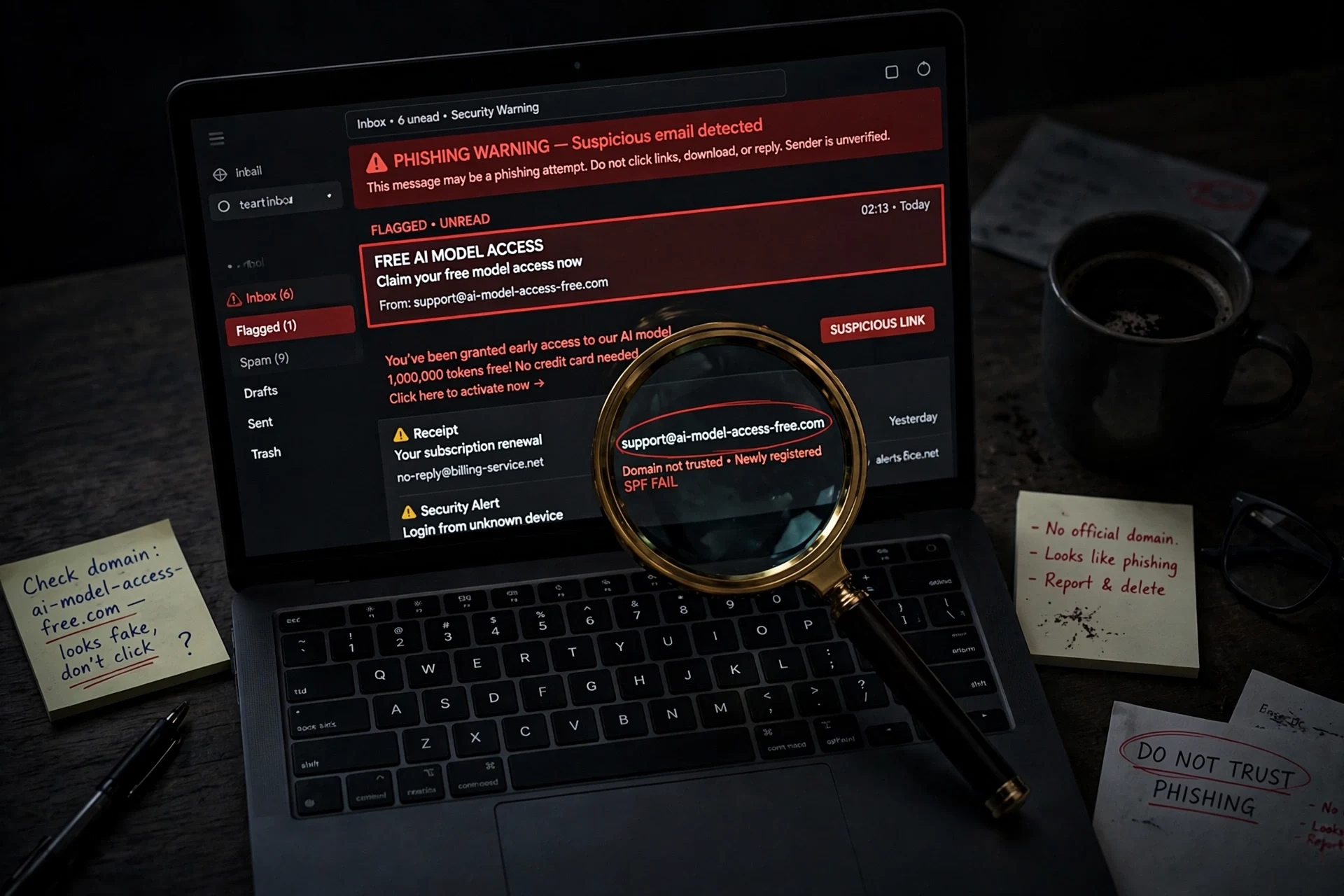
Every AI launch with this much search heat gets a second, unofficial launch: the fake-access emails. The pattern is well documented by now, and it played out twice in the last two days alone — around the Nvidia CEO investigation story on Sunday and the James Gunn exit from DC Studios on Monday, where fake free-stream pages and phishing emails were live within hours of the news. Fable 5.2 is a better lure than either of those, because it combines three things scammers love: a product people want, a price tag that makes "free" sound valuable, and a signup flow that normally asks for an email address.
Here is what to expect in your inbox this week. The emails will promise free Fable 5.2 access, an early-access invite, or a "limited" free tier that Anthropic never announced. They will borrow Anthropic's branding, quote the real $8/$40 pricing to sound informed, and link to a page that asks for an email address first and a password or payment details second. Some will claim your "invite expires in 24 hours." None of it is real. Anthropic announced no free tier, no waitlist, and no early-access program for Fable 5.2. The model is on paid plans, and that is the whole list.
The tells are the same ones that gave away the fake streams this week. The sender domain is close to anthropic.com but not anthropic.com. The link goes somewhere the announcement never mentions. The page asks for a card "to verify you are human" — no legitimate free trial needs your card to prove you are human. And the urgency is manufactured: a real product launch does not expire your access in a day.
If one of these emails lands in your inbox, do not click through to "check." The click is the product. Report it as phishing in your mail client and delete it. If you already entered an email address on one of these pages, that address is now on a list that will be sold and retried; the damage is limited if it was an address you can abandon, and that is the entire point of the next section.
Trying Fable 5.2 without handing out your real email
Not every signup around this launch is a scam. Some of it is legitimate and still not worth your real address: the third-party waitlists, the "notify me when Fable 5.2 comes to our tool" forms, the Devin-adjacent betas, the newsletter that promises launch-day benchmarks. Each one wants an email address, each one will send you mail for months, and none of them needs the address that receives your password resets.
This is the exact job a disposable inbox exists for. Generate an address on tempomailusa.com, use it for the waitlist or the trial signup, get the verification code, and walk away. If the list turns out to be a spam farm, the spam goes to an inbox that expires instead of yours. If the trial turns out to be worth keeping, you can always re-register with your real address once you know what the service actually is. The rule I use: the less I know about a signup page, the less permanent the address I give it.
The same logic applies to Claude itself, with one honest limit. A temporary address works for trying things out and for signing up to services where the email is not the account. It does not work as the recovery address for an account you care about, and Anthropic's own signup reality is stricter than most — our earlier walkthrough of temp mail for Claude AI signup explains where the line sits. Use the disposable address for the disposable relationship, and keep your real inbox for the relationships that last.
That distinction is the whole skill. The launch-week mess is not a reason to stop trying new AI tools. Our morning test of Jarvis for small business showed how much you can learn from a single morning with a new tool — five real jobs, real friction, a real verdict. The point is to try things with your eyes open and your real address closed, so the experiment costs you an hour and not an inbox.
Three checks before you pay for Fable 5.2

If you do decide to pay, run these three checks first. They take ten minutes and they catch the mistakes that cost real money.
One: confirm the retention terms against your actual work. Fable 5.2's 30-day prompt and completion retention is the default for most buyers, and zero-retention setups need an explicit exception. If you handle client code, patient data, or anything under a confidentiality clause, get the retention answer in writing from your Anthropic contact before the first API call. A $2-per-million-token saving is not worth a contract breach.
Two: check which plan actually includes it. Fable 5.2 is on paid Claude plans, in Claude Code, and on the Claude Platform — but "paid plans" covers more than one tier, and tiers change. Open your own plan page and confirm the model appears there before you assume your subscription includes it. Anthropic's launch-week terms give Pro and standard Team seats Fable access until November 16, up to 50 percent of their weekly limits, with one Fable limit reset — a window that closes, so confirm your own plan's dates rather than assuming the access is permanent. The launch announcement lists the surfaces; your billing page lists the truth.
Three: price the job, not the token. The $8/$40 headline is per million tokens, and a long Fable task burns tokens the way a long drive burns fuel. Run one representative job, look at the actual token count and the actual bill, and compare it against the same job on Opus 5.5 at $4/$20. Anthropic's own system-card figure — $6.72 average per FrontierCode task at High effort — is a useful anchor, but your tasks are not FrontierCode tasks. One real job tells you more than the whole pricing page.
And the check that sits underneath all three: if the "Fable 5.2 access" you are about to pay for came to you by email, stop. Anthropic sells Fable 5.2 through its own plans and platform, not through an email link. The phishing wave around the Nvidia CEO investigation and the James Gunn exit used exactly this shape — real news, fake access, a link that harvests the click. The model is real. The email offering it to you is not.
Frequently asked questions
Is Claude Fable 5.2 free? No. Fable 5.2 is available on paid Claude plans, in Claude Code, and through the Claude Platform at $8 per million input tokens and $40 per million output tokens. Anthropic announced no free tier and no early-access program. Any email or page offering free Fable 5.2 access is not from Anthropic.
What is the difference between Fable 5.2 and Mythos 5.2? They are the same underlying model. Fable 5.2 carries safeguards that block most cybersecurity and biology requests, which is what allows general access. Mythos 5.2 has some of those safeguards relaxed and is available only to vetted cybersecurity and life-sciences organizations.
Is Fable 5.2 better than Opus 5.5? On Anthropic's own launch benchmarks, yes for the hardest work — Fable 5.2 scored 49.1 percent on Cognition's FrontierCode 2.0 test against 45.5 percent for Opus 5.5. But those numbers are vendor-reported and not yet independently replicated, and Fable costs twice as much per token. Anthropic still recommends Opus 5.5 for everyday coding and knowledge work.
How much does Fable 5.2 cost? $8 per million input tokens and $40 per million output tokens on the standard API price, down from $10 and $50 for Fable 5.1. That is a 20 percent cut. A fast mode offers up to 2.5 times faster token generation.
Can I use a temporary email to try Fable 5.2? A disposable address is the right tool for waitlists, third-party trials, and launch-week signup forms around Fable 5.2 — anywhere the email is not the account. It is not the right address for a paid Claude account you care about, where the email is your recovery path. Use the throwaway inbox for the throwaway relationship.
Why am I getting emails about free Fable 5.2 access? Because the launch is trending — "fable 5.2" jumped over 1,000 percent on Google Trends in the US on launch day — and scammers follow search heat. Fake early-access and free-tier emails are the standard second act of every big AI launch. Delete them, report them as phishing, and never enter payment details on a page an email linked you to.
The bottom line
Fable 5.2 is a genuine improvement aimed at a narrow job: long, hard, open-ended technical work where a model has to hold a huge task together for hours. The price cut to $8/$40 is real and helps the teams already running Fable at volume. The benchmarks are promising and unproven in equal measure, and the right move for most people is to let independent testing arrive before rebuilding anything around them. Opus 5.5 remains the sensible default, at half the price, and Anthropic says so itself.
The launch-week emails are the part of this story you can act on today, and the action is simple: the model is on paid plans, there is no free tier, and no email will ever be the way in. Try the new tools with a disposable address, keep your real inbox for the accounts that matter, and check the calendar before you click — a film that opens in 2027 cannot be streamed today, and a model that ships on paid plans cannot be free in your inbox.
Need a disposable temporary email?
Protect your real inbox from spam and promotional clutter instantly and free.
Received a suspicious email, text, or charge alert?
Verify whether the sender domain is disposable, spoofed, or unverified before clicking links.