


Why Detecting AI-Generated Emails Matters for Your Privacy and Security
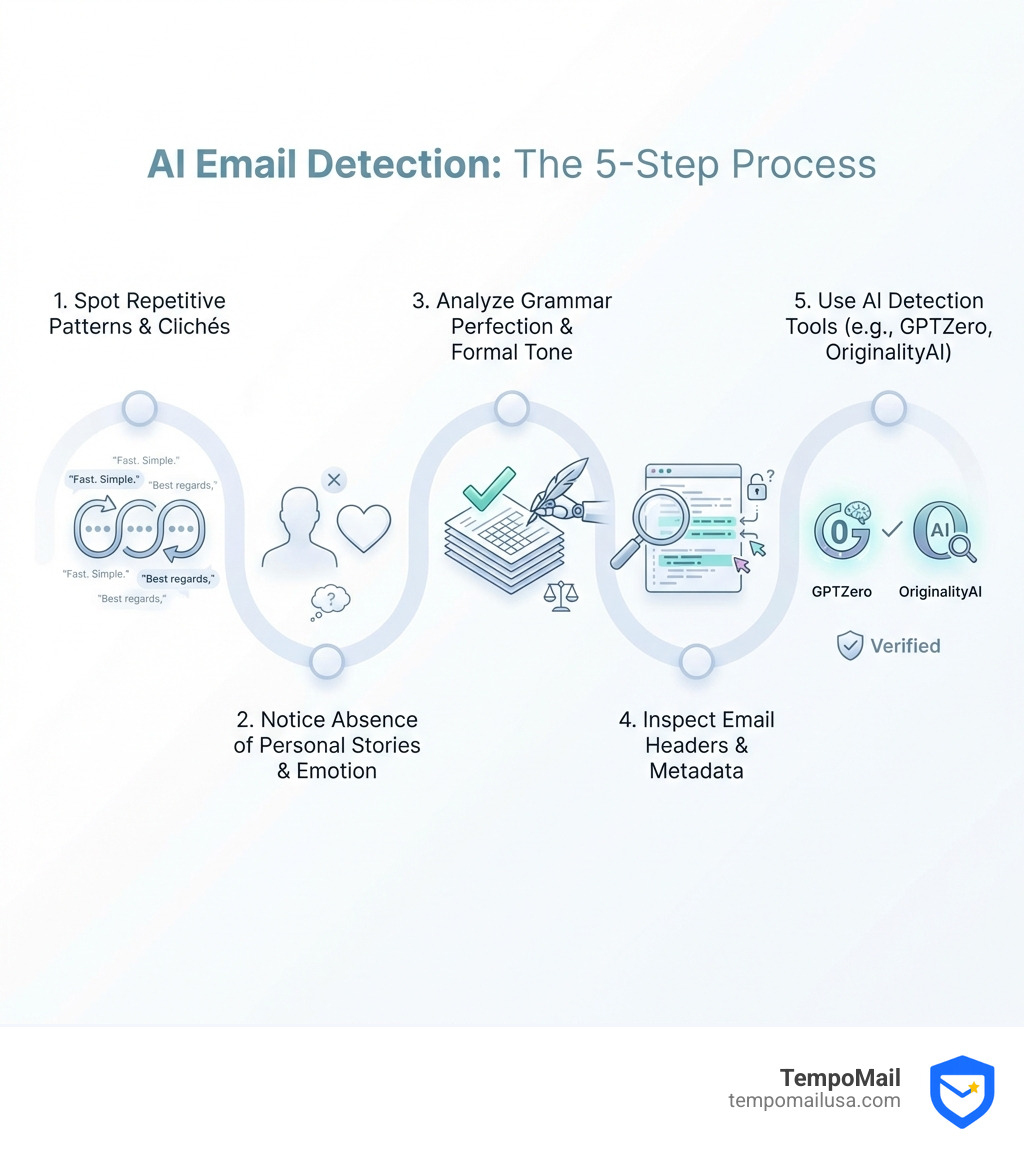
How to tell if an email is ai generated involves recognizing specific patterns left by language models. Here are the quickest ways to spot them:
Quick Detection Checklist:
- Overly formal language - AI often sounds like a business textbook.
- Repetitive triplets - Phrases like "Fast. Simple. Effective."
- Zero personal stories - AI rarely includes lived experiences.
- Too-perfect grammar - Humans make small mistakes; AI doesn't.
- Generic greetings - Formulaic openings or placeholders.
- Excessive bullet points - AI favors structure over natural flow.
- Lack of semicolons - AI rarely uses this punctuation correctly.
The stakes are high. Research shows 64% of customers prefer companies didn't use AI for customer service, yet adoption is skyrocketing. Cybercriminals also use AI to craft phishing emails that bypass traditional filters.
I'm Mohammad Waseem, and I've spent years building privacy tools and testing email systems. This guide breaks down how to detect AI authorship in your inbox.
Linguistic Red Flags: How to Tell if an Email is AI Generated
One of the most immediate ways to detect if an email is AI-generated is by scrutinizing its language. AI models often leave behind telltale linguistic patterns that human writers typically avoid. A 2024 study found that 55% of US consumers could accurately identify AI-generated content.
Repetitive Sentence Patterns and Phrasing
AI models often fall into predictable rhythms, especially when seeking clarity. This manifests as:
- Repetitive Triplets: Phrases like "No fluff. No filler. No stress." are classic AI giveaways. While humans use triplets, AI tends to overdo them, making the email feel formulaic.
- Formulaic Descriptive Phrases: You might see stock phrases like "Your thoughtful strategy" or "Intentional design" that lack genuine flair.
- Predictable Sentence Structures: AI often generates sentences of similar length, creating a monotonous reading experience unlike human writing, which naturally varies for rhythm.
Overly Formal or Cliché Language
- Awkward Transitions: AI struggles with conversational transitions. You might encounter stiff connectors like "furthermore" or "consequently" where a human would use "also" or "so."
- Overly Dramatic Phrases: AI often deploys marketing jargon like "game-changer" or "cutting-edge" generically, making them sound like bad ad copy.
"Too Perfect" Grammar
An email with grammar that is too perfect can be a red flag. Humans make typos and use clunky sentences that feel authentic. AI strives for absolute correctness. If an email is flawlessly structured and devoid of human quirks, it might be the work of a machine. Modern users often prefer something real and relatable over technically perfect writing.
The Human Element: Why AI Struggles with Storytelling and Nuance
While AI can master grammar, it often stumbles with storytelling, emotional nuance, and contextual understanding. This absence of personalization impacts marketing quality and customer trust.
Lack of Storytelling or Personal Anecdotes
One of the most telling indicators is the lack of personal narratives. Humans naturally share experiences and relate personal struggles to connect emotionally.
- Zero Storytelling: AI doesn't have lived experiences. AI-generated emails often jump straight to facts and benefits without the engaging wrapper of a personal story, making the message feel cold and transactional.
- Absence of Personal Connection: When an email lacks these touches, the reader feels like a number. Customers usually sense whether an email lacks authenticity, which can negatively affect brand perception.
Emotional Depth and Nuance
AI struggles with the subtle dance of human emotion. It can use emotional words but often fails to convey genuine empathy or humor.
- Generic Emotional Language: Phrases like "we understand your frustration" often feel hollow because they aren't backed by genuine understanding.
- Inability to Convey Nuance: Nuance requires an understanding of subtext and social cues. AI emails might miss the mark in sensitive situations, sounding tone-deaf.
Context and Industry Nuances
- Contextual Irrelevance: While AI is good at mimicking human speech, it sometimes misses the big picture, offering solutions to problems you don't have.
- Lack of Industry Understanding: AI may not grasp the subtle jargon or specific concerns prevalent within a niche industry, leading to generic-sounding messages.
At TempoMail, we believe authentic communication is paramount. When an email feels inauthentic, it raises a red flag about the sender's intentions.
Technical Indicators and Security Risks of AI Emails
Beyond the linguistic tells, there are technical clues that can suggest an email is AI-generated, often with significant security implications. Cybercriminals are increasingly leveraging AI to craft sophisticated attacks, making these technical indicators vital for our collective cybersecurity.
The Rise of AI-Powered Phishing
The security risks associated with AI-generated emails are growing. Cybercriminals increasingly use AI generators to craft realistic phishing emails. Using AI, these emails appear genuine and are highly personalized, making them more challenging than ever to detect. This presents serious security concerns for everyone.
Imagine a phishing email that perfectly mimics your bank's tone, references recent transactions, and uses impeccable grammar. This level of sophistication, previously requiring skilled human attackers, is now within reach of AI. These AI-crafted emails can bypass traditional spam filters that rely on detecting common grammatical errors or generic phrases. They can trick even vigilant users into divulging sensitive information or clicking malicious links.
Technical Indicators: Beyond the Text
While the content itself is a primary indicator, sometimes the metadata surrounding an email can offer clues. These are often hidden from plain sight but can be revealed with a little digging.
- Source Metadata and Email Headers: The email header is like a digital passport, containing routing information, sender details, and various timestamps. While not a direct "AI-generated" flag, inconsistencies here can be suspicious.
- Mismatched Sender Addresses: An email claiming to be from a well-known company might have a sender address that's slightly off (e.g.,
support@companyy.cominstead ofsupport@company.com). AI can help generate the plausible display name, but the underlying email address often reveals the deception. - Unusual IP Addresses: The IP address in the header indicates where the email originated. If an email claiming to be from your local bank originates from a server in a different country known for spam, it's a major red flag. AI doesn't directly generate IP addresses, but it enables attackers to send emails from compromised or geographically diverse servers more easily.
- Timestamp Analysis: Look at the
Received:headers. Do the timestamps make sense? A sudden burst of emails from a new sender, or emails arriving at odd hours from a supposed business contact, could indicate automated (AI-driven) sending. If an AI is generating and sending thousands of emails, the sending pattern might look robotic or lack human-like pauses. - Email Client/Mailer Information: Sometimes, the
X-MailerorUser-Agentheaders might reveal an unusual or generic email client not typically used by a legitimate sender. While not definitive, it adds to the suspicion.
- Mismatched Sender Addresses: An email claiming to be from a well-known company might have a sender address that's slightly off (e.g.,
The TempoMail Perspective: Protecting Your PII
At TempoMail USA, we're deeply concerned about the escalating threat of AI-generated phishing attempts. Our core mission is to protect your Personally Identifiable Information (PII) by acting as a firewall, generating secure aliases that shield your real identity from online services. When AI makes phishing emails more convincing, the need for such protective layers becomes even more critical.
Understanding these technical indicators, alongside linguistic red flags, forms a robust defense against malicious actors. It empowers you to not only identify suspicious emails but also understand the mechanisms behind them, reinforcing your personal cybersecurity posture.
Using Tools to Detect if an Email is AI Generated
While manual inspection is crucial, tools are becoming vital. These leverage algorithms to analyze text for patterns characteristic of AI authorship. 95% of marketers using generative AI for emails find it helpful, meaning we'll encounter more AI content daily.
| Feature | Manual Review (Human) | Automated Detection Tools (AI Detector) |
|---|---|---|
| Method | Linguistic analysis, intuition | Machine learning, statistical analysis |
| Strengths | High accuracy for nuance and context | Speed, scalability, identifies subtle patterns |
| Weaknesses | Time-consuming, prone to error | Can have false positives/negatives |
| Indicators | Storytelling, emotional depth, natural flow | Perplexity, burstiness, grammar patterns |
Automated tools look for Perplexity (how predictable the word choice is) and Burstiness (variation in sentence length). Human writing is typically more "bursty" and less predictable than AI.
Specialized Detection Software
- GPTZero: Designed to detect content from various AI models. It analyzes word choice and sentence combination to determine AI probability. Check it at gptzero.me.
- OriginalityAI: Uses machine learning to provide an ‘AI likelihood’ score. It is powerful but may struggle with hybrid content. Visit originality.ai.
- CopyLeaks: Provides a percentage score indicating the likelihood of AI authorship. Visit copyleaks.com.
Limitations of Software
- False Positives and Negatives: No tool is 100% accurate. Premium tools might achieve 84% accuracy, while free versions hover around 68%.
- AI Humanizers: Tools now exist to modify AI text to bypass detectors by artificially increasing perplexity.
- Hybrid Content: Many creators use AI for outlines and then add human "heart" through editing, which is very difficult for tools to detect.
- Evolving Models: How AI writes is constantly changing. New models are released frequently, making detection a moving target.
We recommend using these tools alongside critical thinking and manual review.
Frequently Asked Questions about AI Emails
Can customers reliably tell if an email was written by AI?
Often, yes. A 2024 study found 55% of US consumers could accurately identify AI-generated content. Customers are attuned to cues in tone and personalization. If an email sounds robotic, their "AI radar" goes off, which can erode trust.
What are the most common "AI-isms" in professional emails?
Beyond repetitive triplets, common tells include:
- Stiff Transitions: Using "furthermore" or "moreover" instead of natural flow.
- Lack of Personality: A complete absence of humor or unique quirks.
- Excessive Bolding: Overusing bold text for emphasis, making it look like a report.
- Business Jargon: Overuse of terms like "synergy," "leverage," or "optimize."
- Hyperbolic Tone: Overly enthusiastic language that feels pushy.
- Dense Paragraphs: Long, unbroken blocks of text without natural white space.
- Empty Placeholders: Errors like "Hi {First Name}," indicating a failed personalization system.
Is it ethical for businesses to use AI for customer communication?
This is complex. AI offers efficiency and scale, and 95% of marketers find it helpful. However, ethical concerns arise regarding transparency. If AI is used to mimic human interaction perfectly without disclosure, it can feel deceptive.
We believe ethical use hinges on transparency. AI should be a tool to improve communication, not replace the human touch entirely. Best practices involve using AI for drafts while having humans provide oversight to ensure authenticity and emotional nuance.
Conclusion
As we steer an increasingly AI-driven digital world, understanding how to tell if an email is ai generated is no longer just a curiosity—it's a critical skill for privacy, security, and maintaining authentic communication. We've explored the linguistic red flags, the human elements that AI struggles to replicate, and the technical indicators that can betray an AI's handiwork.
From repetitive patterns and overly formal language to the profound absence of personal storytelling and emotional nuance, AI leaves distinct footprints. We've also seen how these AI-generated emails pose significant security risks, with cybercriminals leveraging them for sophisticated phishing attempts, making our vigilance more important than ever. While AI detection tools offer valuable assistance, they are best used in conjunction with our own critical human judgment.
At TempoMail USA, our mission is deeply intertwined with these challenges. By providing identity proxying services and generating secure aliases, we act as a firewall, protecting your Personally Identifiable Information (PII) from the prying eyes of online services, including those powered by AI. Understanding the nature of the emails you receive is a crucial step in maintaining your cybersecurity and privacy.
The future of email communication will undoubtedly feature more AI, but by staying informed and applying the detection techniques we've outlined, you can confidently distinguish between genuine human connection and the clever mimicry of machines. This empowers you to protect your digital identity and engage with your inbox on your own terms.
Want to experience the power of AI for email writing, while understanding its nuances? Try our free AI email generator to see how it works and develop your own keen eye for AI-generated content.